MCQ
$10\,N$ and $\frac{1}{{10}}\,N$ solution is called
  • A
    Decinormal and decanormal solution
  • B
    Normal and decinormal solution
  • C
    Normal and decanormal solution
  • Decanormal and decinormal solution

Answer

Correct option: D.
Decanormal and decinormal solution
d
(d) $10\,N = {\rm{Deca - normal}}$, $\frac{1}{{10}}$ $N =$ Deci-normal.

Need a full question paper?

Generate a complete, print-ready paper with questions like this in minutes — across 16+ boards, with answer keys.
Start Generating Free

Similar questions

Which one among the following chemical tests is used to distinguish monosaccharide from disaccharide?
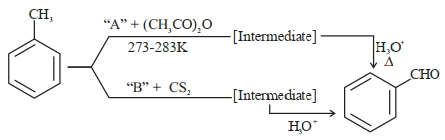
In the given reactions identify the reagent $A$ and reagent $B$
The trivalent ion having largest size in following is
The oxidation state of chromium in the final product formed by the reaction between $KI$  and acidified potassium dichromate solution is
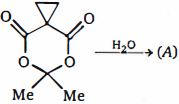
Predict the product of hydrolysis of the above molecule.
If the CFSE of $\left[ Ti \left( H _2 O \right)_6\right]^{3+}$ is $-96.0\,kJ / mol$, this complex will absorb maximum at wavelength $........nm$. (nearest integer)

Assume Planck's constant $( h )=6.4 \times 10^{-34}\,Js$ Speed of light $( c )=3.0 \times 10^8\,m / s$ and Avogadro's constant $\left( N _{ A }\right)=6 \times 10^{23} / mol$
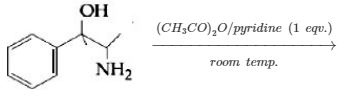
The major product obtained in the following reaction is
Evaluate the following statements for their correctness.

$(A)$ The elevation in boiling point temperature of water will be same for $0.1 M NaCl$ and $0.1 M$ urea.

$(B)$ Azeotropic mixtures boil without change in their composition

$(C)$ Osmosis always takes place from hypertonic to hypotonic solution

$(D)$ The density of $32 \% H _2 SO _4$ solution having molarity $4.09\,M$ is approximately $1.26\,g\,mL ^{-1}$

$(E)$ A negatively charged sol is obtained when $KI$ solution is added to silver nitrate solution.

Choose the correct answer from the options given below :
With oxalic acid, glycerol at ${260\,^o}C$ gives
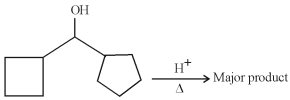
In the above reaction. Left hand side and right hand side rings are named as ' $A$ ' and ' $B$ ' respectively. They undergo ring expansion. The correct statement for this process is: