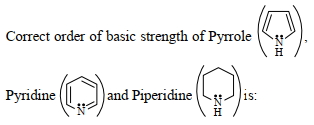
MCQ
  • Piperidine $>$ Pyridine $>$ Pyrrole
  • B
    Pyrrole $>$ Pyridine $>$ Piperidine
  • C
    Pyridine $>$ Piperidine $>$ Pyrrole
  • D
    Pyrrole $>$ Piperidine $>$ Pyridine

Answer

Correct option: A.
Piperidine $>$ Pyridine $>$ Pyrrole
a
Order of basic strength is

$\mathrm{N}\left(\mathrm{sp}^3\right.$, localized lone pair $)>\mathrm{N}\left(\mathrm{sp}^2\right.$, localized lone

pair $)>\mathrm{N}\left(\mathrm{sp}^2\right.$, delocalized lone pair, aromatic)

$\therefore$ Piperidine $>$ Pyridine $>$ Pyrrole

Need a full question paper?

Generate a complete, print-ready paper with questions like this in minutes — across 16+ boards, with answer keys.

Start Generating Free

Similar questions

The number of bridging $CO$ ligand$(s)$ and $Co-Co$ bond$(s)$ in $Co_2 (CO)_8$ respectively are
The correct order of $\left[ FeF _6\right]^{3-},\left[ CoF _6\right]^{3-},\left[ Ni ( CO )_4\right]$ and $\left[ Ni ( CN )_4\right]^{2-}$ complex species based on the number of unpaired electrons present is :
For the reaction $SO_2(g) + \frac{1}{2} O_2(g) \rightleftharpoons SO_3(g),$ if $K_P = K_C ( RT)^x$ where the symbols have usual meaning then the value of $x$ is (assuming ideality) :
Among the following options, select the option in which each complex in Set-$l$ shows geometrical isomerism and the two complexes in Set-$II$ are ionization isomers of each other.

$\text { [en }= H _2 NCH _2 CH _2 NH _2 \text { ] }$

When an electric current is passed through acidulated water $112 ml $ of hydrogen gas at $N.T.P. $ collect at the cathode in $965$  seconds. The current passed, in amperes is
Approximate $pH$ of $0.01\,\,M\,NaHA$  is calculated by $: ({K_{{a_1}}}\, = \,{10^{ - 6}}$ and ${K_{{a_2}}}\, = \,{10^{ - 8}}$ are ionization constant of $H_2A$ )
$1\,g$ of a carbonate $\left( M _2 CO _3\right)$ on treatment with excess $HCl$ produces $0.01 mol$ of $CO _2$ The molar mass of $M _2 CO _3$ is $..........\,g\,mol ^{-1}$. (Nearest integer)
The pair of electrons in the given carbanion, $CH_3C \equiv C^-,$ is present in which of the following orbitals ? 
At constant $T$ and $P$, which one of the following statements is correct for the reaction, $CO(g) + \frac{1}{2}{O_2}(g) \to C{O_2}(g)$
The set of compounds in which the reactivity of halogen atom in the ascending order is