MCQ
$2 - Hexyne$ can be converted into trans- $2 - hexene$ by the action of
  • A
    $H_2-Pd/BaSO_4$
  • $Na+Liq.NH_3$
  • C
    $NaBH_4$
  • D
    All above

Answer

Correct option: B.
$Na+Liq.NH_3$
b
Birch reduction

Need a full question paper?

Generate a complete, print-ready paper with questions like this in minutes — across 16+ boards, with answer keys.

Start Generating Free

Similar questions

Among the following compounds which is planar in shape
The correct order of the  $O-O$  bond length in  $O_2, H_2O_2$  and  $O_3$  is
Under normal condition which of the following electronic configuration is able to form dipositive ion
Complete combustion of $750\, g$ of an organic compound provides $420\, g$ of $CO _{2}$ and $210\, g$ of $H _{2} O$. The percentage composition of carbon and hydrogen in organic compound is $15.3$ and ............. respectively. (Round off to the Nearest Integer)
$\begin{array}{*{20}{c}}
  {C{H_3} - C{H_2} - CH - C{H_3}\xrightarrow[{KOH}]{{Alc.}}\mathop X\limits_{\left( {{\text{major}}} \right)} \,;} \\ 
  {\,\,\,\,\,\,\,\,\,\,\,\,|\,\,\,\,\,\,\,\,\,\,\,\,\,\,\,\,\,\,\,\,\,\,\,\,\,\,\,\,\,\,\,} \\ 
  {\,\,\,\,\,\,\,\,\,\,\,\,\,Br\,\,\,\,\,\,\,\,\,\,\,\,\,\,\,\,\,\,\,\,\,\,\,\,\,\,\,\,\,} 
\end{array}\,$

$\begin{array}{*{20}{c}}
  {C{H_3} - C{H_2} - CH - C{H_3}\xrightarrow[\Delta ]{{EtoNa}}\mathop {{\text{ }}Y}\limits_{\left( {{\text{major}}} \right)} } \\ 
  {{\mkern 1mu} {\mkern 1mu} {\mkern 1mu} {\mkern 1mu} {\mkern 1mu} {\mkern 1mu} {\mkern 1mu} {\mkern 1mu} {\mkern 1mu} {\mkern 1mu} {\mkern 1mu} {\mkern 1mu} |{\mkern 1mu} {\mkern 1mu} {\mkern 1mu} {\mkern 1mu} {\mkern 1mu} {\mkern 1mu} \,\,\,\,\,{\mkern 1mu} \,\,\,\,{\mkern 1mu} {\mkern 1mu} {\mkern 1mu} {\mkern 1mu} {\mkern 1mu} {\mkern 1mu} {\mkern 1mu} {\mkern 1mu} {\mkern 1mu} {\mkern 1mu} {\mkern 1mu} {\mkern 1mu} {\mkern 1mu} {\mkern 1mu} {\mkern 1mu} {\mkern 1mu} {\mkern 1mu} {\mkern 1mu} {\mkern 1mu} {\mkern 1mu} {\mkern 1mu} {\mkern 1mu} {\mkern 1mu} {\mkern 1mu} } \\ 
  {{\mkern 1mu} {\mkern 1mu} {\mkern 1mu} \mathop {{\mkern 1mu} {\mkern 1mu} {\mkern 1mu} {\mkern 1mu} \,\,\,\,\,\,\,NM{e_3}\,\,\,\,\,\,\,{\mkern 1mu} }\limits_{\,\,\,\,\,\,\,\,\,\, \oplus \,\,\,\,\,\,\,\,\,\,\,\,\,\,\,\,\,\,\,\,} {\mkern 1mu} {\mkern 1mu} {\mkern 1mu} {\mkern 1mu} {\mkern 1mu} {\mkern 1mu} {\mkern 1mu} {\mkern 1mu} {\mkern 1mu} {\mkern 1mu} {\mkern 1mu} {\mkern 1mu} {\mkern 1mu} {\mkern 1mu} } 
\end{array}{\mkern 1mu} $

Product $(X)$ and $(Y)$ respectively is
The electronic configuration of an element is $1{s^2}2{s^2}2{p^6}3{s^2}3{p^6}3{d^5}4{s^1}$. This represents its
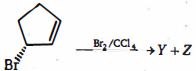
$(R)-3$ -bromocyclopentene (shown below) reacts with $Br_2/CCl_4$ to form two  products, $Y$ and $Z, Y$ is not optically active (does not rotate plane- polarized light). What is the structure of $Y$ ? 
The number of protons, neutrons and electrons in ${ }_{71}^{175} Lu ,$ respectively, are :
The number of possible isomers of dichloronitrobenzene is
The correct order of increasing ionic radii is .... .