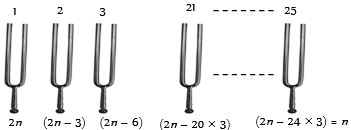
$25$ tunning forks are arranged in series in the order of decreasing frequency. Any two successive forks produce $3\, beats/sec.$ If the frequency of the first turning fork is the octave of the last fork, then the frequency of the $21^{st}$ fork is .... $Hz$
Medium


Download our appand get started for free
Experience the future of education. Simply download our apps or reach out to us for more information. Let's shape the future of learning together!No signup needed.*
Similar Questions
- 1View SolutionIn stationary wave
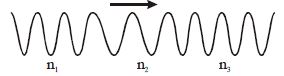
- 2A light wave travels through three transparent materials of equal thickness. Rank in order, from the highest to lowest, the indices of refraction $n_1, n_2$ and $n_3$.View Solution
- 3Two sound waves of slightly different frequencies have amplitude ratio $\frac{11}{9} .$ What is the difference of sound levels in decibels of maximum and minimum intensities heard at a point :- ............. $\mathrm{dB}$View Solution
- 4A vehicle with a horn of frequency $n$ is moving with a velocity of $30\, m/s$ in a direction perpendicular to the straight line joining the observer and the vehicle. The observer perceives the sound to have a frequency $n + {n_1}$. Then (if the sound velocity in air is $300\, m/s$)View Solution
- 5The tension in a wire is decreased by $19 \%$. The percentage decrease in frequency will be ......... $\%$View Solution
- 6View SolutionQuality of a musical note depends on
- 7Two cars are moving on two perpendicular roads towards a crossing with uniform speeds of $72\; km/hr$ and $36\; km/hr$. If first car blows horn of frequency $280\; Hz,$ then the frequency of horn heard by the driver of second car when line joining the cars make $45^o$ angle with the roads; will be .... $Hz$View Solution
- 8A stretched string resonates with tuning fork frequency $512\; Hz$ when length of the string is $0.5\; m$. The length of the string required to vibrate resonantly with a tuning fork of frequency $256 \;Hz$ would be .......... $m$View Solution
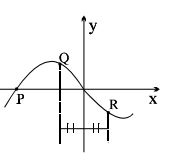
- 9At a certain moment, the photograph of a string on which a harmonic wave is travelling to the right is shown. Then, which of the following is true regarding the velocities of the points $P, Q$ and $R$ on the string.View Solution
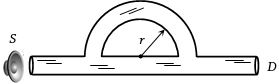
- 10A sound wave of wavelength $32 cm$ enters the tube at $S$ as shown in the figure. Then the smallest radius $r$ so that a minimum of sound is heard at detector $D$ is ... $cm$View Solution