A vehicle with a horn of frequency $n$ is moving with a velocity of $30\, m/s$ in a direction perpendicular to the straight line joining the observer and the vehicle. The observer perceives the sound to have a frequency $n + {n_1}$. Then (if the sound velocity in air is $300\, m/s$)
AIIMS 2000,AIPMT 1998, Easy


Download our appand get started for free
Experience the future of education. Simply download our apps or reach out to us for more information. Let's shape the future of learning together!No signup needed.*
Similar Questions
- 1A bus is moving with a velocity of $5 m/s$ towards a huge wall. the driver sounds a horn of frequency $165 Hz.$ If the speed of sound in air is $355 m/s,$ the number of beats heard per second by a passenger on the bus will beView Solution
- 2$‘SONAR’$ emits which of the following wavesView Solution
- 3A wire of density $9 \times 10^3 kg /m^3$ is stretched between two clamps $1 m$ apart and is subjected to an extension of $4.9 \times 10^{-4} m$. The lowest frequency of transverse vibration in the wire is ..... $Hz$ ($Y = 9 \times 10^{10} N / m^2$)View Solution
- 4View SolutionDoppler's effect will not be applicable when the velocity of sound source is
- 5A wave is propagating along $x$-axis. The displacement of particles of the medium in $z$-direction at $t = 0$ is given by: $z =$ exp$[ -(x + 2)^2]$ , where $‘x’$ is in meters. At $t = 1s$, the same wave disturbance is given by: $z =$ exp $ [ - (2 - x)^2 ]$. Then, the wave propagation velocity isView Solution
- 6View SolutionWhich one of the following statements is true
- 7View SolutionOf the following the one which emits sound of higher pitch is
- 8A tuning fork with frequency $800 \;\mathrm{Hz}$ produces resonance in a resonance column tube with upper end open and lower end closed by water surface. Surface. Successive resonance are observed at length $9.75 \;\mathrm{cm}, 31.25\; \mathrm{cm}$ and $52.75\; \mathrm{cm} .$ The speed of sound in air is ......$m/s$View Solution
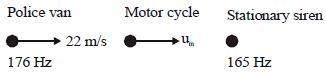
- 9A police van, moving at $22\, m/s$ , chases a motor-cyclist. The police man sounds horn at $176\, Hz$ , while both of them move towards a stationary siren of frequency $165\, Hz$ as shown in the figure. If the motor-cyclist does not observe any beats, his speed must be .... $m/s$ (take the speed of sound $= 330\, m/s$ )View Solution
- 10The first overtone frequency of an open organ pipe is equal to the fundamental frequency of a closed organ pipe. If the length of the closed organ pipe is $20 \,cm$. The length of the open organ pipe is........$cm$.View Solution