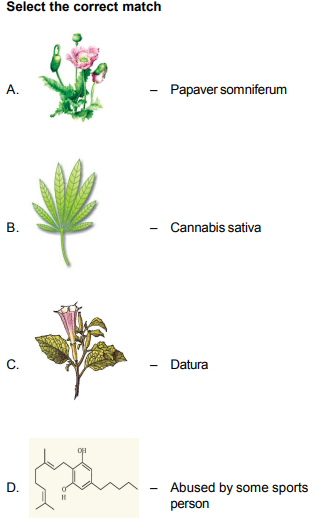
MCQ
Image
  • A
    A, B, C only
  • B
    A, B, D only
  • C
    B, C, D, only
  • D
    All

Answer

Need a full question paper?

Generate a complete, print-ready paper with questions like this in minutes — across 16+ boards, with answer keys.

Start Generating Free

Similar questions

Given below are four statements pertaining to separation of $DNA$ fragments using gel electrophoresis. Identify the incorrect statements

$(a)\; DNA$ is negatively charged molecule and so it is loaded on gel towards the Anode terminal

$(b) \;DNA$ fragments travel along the surface of the gel whose concentration does not affect movement of $DNA.$

$(c)$ Smaller the size of $DNA$ fragment larger is the distance it travels through it.

$(d)$ Pure $DNA$ can be visualized directly by exposing UV radiation.

Choose correct answer from the options given below

Mark the correct match.
When yeast ferments glucose, the products obtained are
The anatomy of springwood shows some peculiar features. Identify the correct set of statements about springwood.

$(a)$ It is also called as the earlywood

$(b)$ In spring season cambium produces xylem elements with narrow vessels

$(c)$ It is lighter in colour

$(d)$ The springwood along with autumnwood shows alternate concentric rings forming annual rings

$(e)$ It has lower density

Choose the correct answer from the options given below:

When growth is exemplified by a root elongation at a constant rate. Mathematically, it is expressed as
Which of the following pair are correctly matched?

$A$. Microtubules - Structural components of cilia

$B$. Centrioles - Store hydrolytic enzymes

$C$. Amyloplasts - Store oil protein and starch in plants
How many species have been identified till $2004$ in the world?
Funaria gametophyte is
Which one of the following statements is not true?
Select the wrong statement for placentation.
(i) Mustard and Argemone ovary is one-chambered but it becomes two chambered due to the formation of the false septum.
(ii) Dianthus and Primrose the placentation is called free central.
(iii) In basal placentation, the placenta develops at the base of ovary and many ovule are attached.
(iv) In sunflower and marigold, basal placentation present.
(v) In mustard and Argemone, free central placentation present.