Question types

Model Paper 3 question types

180 questions across 4 question groups — pick any mix to generate a NEET paper with step-by-step answer keys.

180
Questions
4
Question groups
5
Question types
Sample Questions

Model Paper 3 questions

One sample from each question group in this chapter. Select any group above to see the full set with answer keys.

The electromagnetic wave travelling in a medium has relative permeability 1.3 and relative permittivity 2.14. The speed of EM wave in that medium will be
  • A
    $13.6 \times 10^6 m / s$
  • B
    $1.8 \times 10^6 m / s$
  • C
    $3.6 \times 10^8 m / s$
  • $1.8 \times 10^8 m / s$

Answer: D.

View full solution
A magnet of magnetic moment $50 \hat{ I } A - m ^2$ placed along $X$-axis, where magnetic field is $B=(0.5 \hat{i}+3.0 \hat{j}) T$. The torque acting on magnet is
  • A
    $175 \hat{k} N- m$
  • $150 \hat{k} N-m$
  • C
    $75 \hat{ k N}- m$
  • D
    $25 \sqrt{37} \hat{ k N}- m$

Answer: B.

View full solution
A projectile is thrown with an initial velocity of $v =( p \hat{i}+q \hat{j}) m / s$. If the range of the projectile is double the maximum height reached by it, then
  • A
    q = p
  • q = 2p
  • C
    p = 2q
  • D
    q = 4p

Answer: B.

View full solution
200 g of a solid ball at $20^{\circ}$ C is dropped in an equal amount of water at $80^{\circ}$ C. The resulting temperature is $60^{\circ}$ C. This means that specific heat of solid is
  • A
    four times of water
  • B
    twice of water
  • one-half of water
  • D
    one-fourth of water

Answer: C.

View full solution
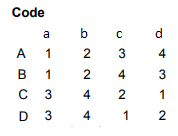
Macth the Column I with Column II and select the correct answer using given codes.
Column IColumn II
A. 3d-transition series1. Cerium (Z = 58)
B. 4d-transition series2. Actinium (Z = 89)
C. 4f-inner transition series3. Zinc (Z = 30)
D. 5f-inner transition4.Yttrium (Z = 39)
Image
View full solution
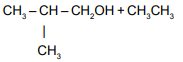
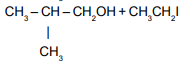
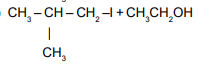
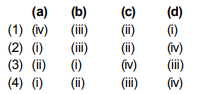
Match the compounds given in column I with the name reactions given by them in column II and select the correct option given below:
Column IColumn II
a. Phenol(i) Etard
b. Acetic acid(ii) Canniozzaro
c. Formaldehyde(iii) Reimer-Tiemann
d. Toluene(iv) Hell-Volhard Zelinsky
  • A
    a(iii), b(i), c(ii), d(iv)
  • B
    a(iii), b(iv), c(i), d(ii)
  • C
    a(ii), b(i), c(iv), d(iii)
  • a(iii), b(iv), c(ii), d(i)

Answer: D.

View full solution
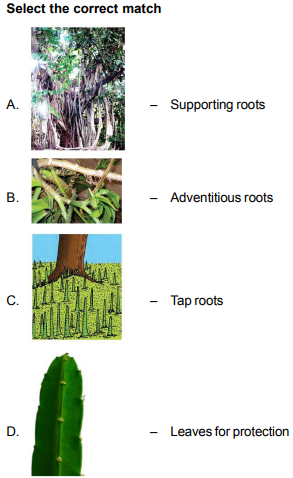
Choose the mismatched pair of leaf character with its example :
  • Palmately compound – Alstonia
  • B
    Alternate Phyllotaxy – Chinarose
  • C
    Leaf tendril – Pea
  • D
    Opposite phyllotaxy – Calotropis

Answer: A.

View full solution
Which of the following is not a character of collenchyma tissue? :
  • A
    They provide mechanical support to the growing part of the plant
  • B
    They occur in layers below epidermis in dicotyledonous plants
  • C
    They consist of cells with thick corners due to cellulose deposition
  • They are usually dead and without protoplasts

Answer: D.

View full solution
Which one of the following is not a criterion of genetic material :
  • Should not provide the scope for changes for evolution
  • B
    Should be able to express itself in the form of Mendelian character
  • C
    Should be able to generate its replica
  • D
    Should be stable chemically and structurally

Answer: A.

View full solution
Which one of the following experiments of Frederick Griffith resulted in the discovery of bacterial transformation :
  • A
    S-strain(heat-killed) $\rightarrow$ injected into Mice $\rightarrow$ Mice lived
  • S-strain (heat killed) + R-strain(live) $\rightarrow$ injected into Mice $\rightarrow$ Mice died
  • C
    S-stain $\rightarrow$ injected into Mice $\rightarrow$ Mice died
  • D
    R-strain $\rightarrow$ injected into Mice $\rightarrow$ Mice lived

Answer: B.

View full solution
Select the plant cells/tissue
Guard cell, Subsidiary cells, Leydig cells, Parenchyma, Leukocytes, Bulliform cells, Phloem, Podocytes, Mesophyll, Thrombocytes, Sertoli cells
  • A
    Seven
  • Six
  • C
    Five
  • D
    Eight

Answer: B.

View full solution
On the basis of the mode of pouring of their secretions, glands are divided into two categories these categories are
  • A
    Simple and compound
  • B
    Dense and special
  • Exocrine and endocrine
  • D
    Loose and dense

Answer: C.

View full solution
View full solution

Generate a Model Paper 3 paper free

Pick question groups from the list above, set marks and difficulty, and export a branded PDF with step-by-step answer keys. First 3 chapters free — no signup.

Download App