MCQ
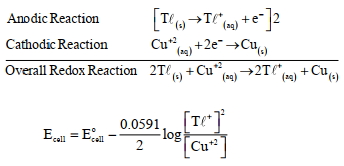
$298 \mathrm{~K}$. It could be increased by :
  • A
    increasing concentration of $\mathrm{T1}^{+}$ions
  • B
    increasing concentration of both $\mathrm{T1}^{+}$and $\mathrm{Cu}^{2+}$ ions
  • C
    decreasing concentration of both $\mathrm{T1}^{+}$and $\mathrm{Cu}^{2+}$ ions
  • increasing concentration of $\mathrm{Cu}^{2+}$ ions

Answer

Correct option: D.
increasing concentration of $\mathrm{Cu}^{2+}$ ions
d
$\mathrm{E}_{\text {cell }}$ increases by increasing concentration of $\left[\mathrm{Cu}^{+2}\right]$ ions.

Need a full question paper?

Generate a complete, print-ready paper with questions like this in minutes — across 16+ boards, with answer keys.

Start Generating Free

Similar questions

Which of the following pairs are isostructural ?
In electrolysis of dilute ${H_2}S{O_4}$using platinum electrodes
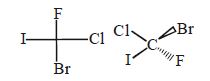
What is relation between following molecules
The name of $Cl{H_2}C - \mathop {\mathop C\limits_{|\,\,} }\limits_{Br} = \mathop {\mathop C\limits_{|\,\,} }\limits_{Br} - C{H_2}Cl$ according to $IUPAC$ nomenclature system is :
Dipole moment is shown by
The reaction of $K _3\left[ Fe ( CN )_6\right]$ with freshly prepared $FeSO _4$ solution produces a dark blue precipitate called Turnbull's blue. Reaction of $K _4\left[ Fe ( CN )_6\right]$ with the $FeSO _4$ solution in complete absence of air produces a white precipitate $X$, which turns blue in air. Mixing the $FeSO _4$ solution with $NaNO _3$, followed by a slow addition of concentrated $H _2 SO _4$ through the side of the test tube produces a brown ring.

Precipitate $X$ is

$(A)$ $Fe _4\left[ Fe ( CN )_6\right]_3$

$(B)$ $Fe \left[ Fe ( CN )_6\right]$

$(C)$ $K _2 Fe \left[ Fe ( CN )_6\right]$

$(D)$ $KFe \left[ Fe ( CN )_6\right]$

Among the following, the brown ring is due to the formation of

$(A)$ $\left[ Fe ( NO )_2\left( SO _4\right)_2\right]^{2-}$

$(B)$ $\left[ Fe ( NO )_2\left( H _2 O \right)_4\right]^{3+}$

$(C)$ $\left[ Fe ( NO )_4\left( SO _4\right)_2\right]$

$(D)$ $\left[ Fe ( NO )\left( H _2 O \right)_5\right]^{2+}$

Which of the following is a redox reaction
Consider the reaction :

$Cl_2(aq) + H_2S(aq) \to  S(s) + 2H^+(aq) + 2Cl^-(aq)$

The rate equation for this reaction is rate $= k[Cl_2][H_2S]$ Which of these mechanisms is/are consistent with this rate equation ?

$A.\,C{l_2} + {H_2}S \to {H^ + } + C{l^ - } + C{l^ + } + H{S^- }$  (slow)

$C{l^ + } + H{S^ - } \to {H^ + } + C{l^ - } + {S}$   (fast)

$B.\, H_2S  \Leftrightarrow  H^+ + HS^-$   (fast equilibrium)

$Cl_2 + HS^-\to  2Cl^-+ H^+ + S$ (slow)

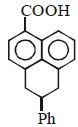
Calculate double bond equivalent in following compound.
Inorganic graphite is