MCQ
$300\, gm$ of water at $25°C$ is added to $100\, gm$ of ice at $0°C$. The final temperature of the mixture is........ $^oC$
  • A
    $ - \frac{5}{3}$
  • B
    $ - \frac{5}{2}$
  • C
    $-5$
  • $0$

Answer

Correct option: D.
$0$
d
(d) ${\theta _{{\rm{mix}}}} = \frac{{{m_W}{\theta _W} - \frac{{{m_{\,i}}{L_{\,i}}}}{{{S_W}}}}}{{{m_{\,i}} + {m_W}}}$$ = \frac{{300 \times 25 - \frac{{100 \times 80}}{1}}}{{100 + 300}} = - {1.25^o}C$

Which is not possible. Hence ${\theta _{mix}} = {0^o}C$

Need a full question paper?

Generate a complete, print-ready paper with questions like this in minutes — across 16+ boards, with answer keys.

Start Generating Free

Similar questions

Neglecting the air resistance, the time of flight of a projectile is determined by
An incandescent bulb has a thin filament of tungsten that is heated to high temperature by passing an electric current. The hot filament emits black-body radiation. The filament is observed to break up at random locations after a sufficiently long time of operation due to non-uniform evaporation of tungsten from the filament. If the bulb is powered at constant voltage, which of the following statement($s$) is(are) true?

($A$) The temperature distribution over the filament is uniform

($B$) The resistance over small sections of the filament decreases with time

($C$) The filament emits more light at higher band of frequencies before it breaks up

($D$) The filament consumes less electrical power towards the end of the life of the bulb

The force of gravitation is
Water rises to a height of $10\,cm$ in a certain capillary tube. An another identical tube when dipped in mercury the level of mercury is depressed by $3.42\,cm$. Density of mercury is $13.6\, g/cc$. The angle of contact for water in contact with glass is $0^o$ and mercury in contact with glass is $135^o$. The ratio of surface tension of water to that of $Hg$ is :-
The amplitude and the time period in a $S.H.M.$ is $0.5 \,cm$ and $0.4 \,sec$ respectively. If the initial phase is $\pi /2$ radian, then the equation of $S.H.M.$ will be
The molar specific heat at constant pressure of an ideal gas is $\Big(\frac{7}{2}\text{R}\Big).$ The ratio of specific heat at constant pressure to that at constant volume is:
The raindrops are in spherical shape due to
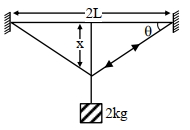
A wire of cross sectional area $A$, modulus of elasticity $2 \times 10^{11} \mathrm{Nm}^{-2}$ and length $2 \mathrm{~m}$ is stretched between two vertical rigid supports. When a mass of $2 \mathrm{~kg}$ is suspended at the middle it sags lower from its original position making angle $\theta=\frac{1}{100}$ radian on the points of support. The value of $A$ is. . . . . .  $\times 10^{-4} \mathrm{~m}^2$ (consider $\mathrm{x}<\mathrm{L}$ ).

(given: $\mathrm{g}=10 \mathrm{~m} / \mathrm{s}^2$ )
Two solid rubber balls $A$ and $B$ having masses $200$ and $400\, gm$ respectively are moving in opposite directions with velocity of $A$ equal to $0.3 \,m/s$. After collision the two balls come to rest, then the velocity of $B$ is .............. $\mathrm{m} / \mathrm{s} $
Which of the following statements is correct about satellites?