Answer

Correct option: A.
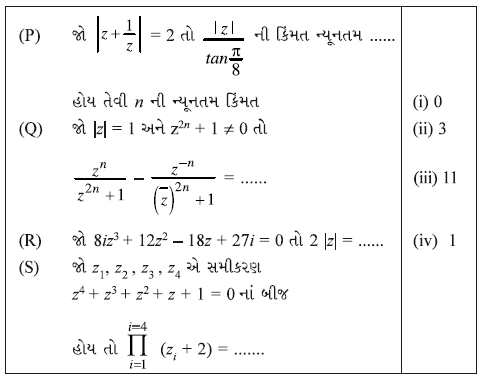
(P-i),(Q-ii),(R-iii),(S-iv)
A
$(P)$ $||z| - \frac{1}{|z|}| \leq |z + \frac{1}{z} | = 2$
$ \therefore -2 \leq |z| - \frac{1}{|z|} \leq 2$
$ \therefore |z|^2 + 2|z| - 1 \geq 0$ અને $\therefore |z|^2 - 2|z| - 1 \leq 0$
$\therefore (|z| + 1)^2 \geq 2, (|z| - 1)^2 \leq 2$ $(-\sqrt{2} \leq |z| -1 \leq\sqrt{2} ) $
$ |z| \geq \sqrt{2} - 1, |z| \leq \sqrt{2} + 1$
$ |z|$ ની ન્યુનતમ કીમત $ \sqrt{2} - 1$ થાય.
$ \therefore \frac{|z|}{tan\frac{\pi}{8}}$ ની ન્યુનતમ કીમત $ \frac{\sqrt{2} - 1}{\sqrt{2} - 1} = 1 $ $ (P) \rightarrow (iv)$
$(Q)$ ધારો કે $ z = cos\theta + isin\theta$
$ \frac{z^n}{z^{2n} + 1} - \frac{z^{-n}}{(\overline{z})^{2n} + 1} = \frac{cosn\theta +isin n\theta}{1+cos2n\theta+i \sin 2n \theta} - \frac{cosn\theta -isin n\theta}{1+cos2n\theta-isin 2n\theta)} $
$ \frac{z^n}{z^{2n} + 1} - \frac{z^{-n}}{(\overline{z})^{2n} + 1} = \frac{cosn\theta +isin n\theta}{2cosn\theta(cosn\theta +isin n\theta)} - \frac{cosn\theta -isin n\theta}{2cosn\theta(cosn\theta -isin n\theta)} $
$ = \frac{1}{2cos n\theta} - \frac{1}{2cos n\theta} = 0$ $ (Q) \rightarrow (i)$

Need a full question paper?

Generate a complete, print-ready paper with questions like this in minutes — across 16+ boards, with answer keys.

Start Generating Free

Similar questions

ત્રિકોણના શિરોબિંદુ $\left( 3,4 \right),\left( 5\cos \theta ,5\sin \theta \right)$ અને $\left( 5\sin \theta ,-5\cos \theta \right)$ હોય,તો ત્રિકોણના મધ્યકેન્દ્રના બિંદુગણનું સમીકરણ ............ .
જો $a$ અને $c$ ધન વાસ્તવિક સંખ્યાઓ હોય અને ઉ૫વલય $\frac{{{x}^{2}}}{4{{c}^{2}}}+\frac{{{y}^{2}}}{{{c}^{2}}}=1$ નાં ચા૨ ભિન્ન બિંદુઓ વર્તુળ ${{x}^{2}}+{{y}^{2}}=9{{a}^{2}}$ ૫૨ ૫ણ હોય , તો .......... .
$\mathop {\lim }\limits_{x \to \pi /2} \tan x\log \sin x = $
સમીકરણ $2 x^2-8 x+k=0$નું એક બીજ અંતરાલ $(1,2)$માં આવે તેનું બીજું બીજ અંતરાલ $(2,3)$માં આવે,તે માટેની $k$ની પૂર્ણાંક કિંમતોની સંખ્યા $...........$ છે.
દ્વિઘાત સમીકરણ ${x^2} - 6x + a = 0$ અને ${x^2} - cx + 6 = 0$ નું એક બીજ સામાન્ય છે. અને પ્રથમ અને દ્વિતીય સમીકરણના બીજા બીજનો ગુણોતર $4:3$ છે. તો સામાન્ય બીજ મેળવો.
જો $\alpha ,\beta \in C$ એ સમીકરણ ${x^2} - x + 1 = 0$ ના ભિન્ન બીજ હોય તો ${\alpha ^{101}} + {\beta ^{107}}$ મેળવો.
$2{C_0} + \frac{{{2^2}}}{2}{C_1} + \frac{{{2^3}}}{3}{C_2} + .... + \frac{{{2^{11}}}}{{11}}{C_{10}}$= . . 
સમીકરણ $x^{2}+y^{2}+p x+(1-p) y+5=0$  એ વર્તુળ દર્શાવે છે કે જેની ચલિત ત્રીજ્યા $\mathrm{r} \in(0,5]$ છે તો ગણ $S=\left\{q: q=p^{2}\right.$ અને $\mathrm{q}$ એ પૂર્ણાંક છે. $\}$ ની સભ્ય સંખ્યા મેળવો.
ધારો કે $C$ એ ત્રિજ્યા $1$ વાળો ઉગમબિંદૂ ની નજીકનો એવો વર્તુળ છે કે જેથી બિંદૂ $(3,2)$ માંથી પસાર થતી અને યામાક્ષોને સમાંતર એવી રેખાઓ તેને સ્પર્શે છે. તો, બિંદૂ $(5,5)$ નું વર્તુળ $C$ થી ન્યૂનતમ અંતર ........... છે.
જો $\cos \alpha + \cos \beta + \cos \gamma = \sin \alpha + \sin \beta + \sin \gamma = 0$ તો $\cos 3\alpha + \cos 3\beta + \cos 3\gamma $ મેળવો.