MCQ
$37$ Rutherford equals
  • $1$ milli curie
  • B
    $1$ milli bacquerel
  • C
    $1$ micro bacquerel
  • D
    $1$ micro curie

Answer

Correct option: A.
$1$ milli curie
a
(a)

The Rutherford (symbol Rd) is a non-SI unit of radioactive decay. It is defined as the activity of a quantity of radioactive material in which one million nuclei decay per second.

$37$ Rutherford will be $1$ milli curie.

Need a full question paper?

Generate a complete, print-ready paper with questions like this in minutes — across 16+ boards, with answer keys.
Start Generating Free

Similar questions

Beta particle An unknown particle is being studied in a magnetic field of variable intensity and direction. When the magnetic field is turned off, the particle is observed to move toward the earth. When the magnetic field is turned on, the particle is observed to continue to move toward the earth, no matter the strength or the direction of the magnetic field. Which of the particles listed below is most likely the unknown particle?
Which statement is correct
If the capacitors in the previous question are joined in parallel, the capacitance and the breakdown voltage of the combination will be :
A charged particle with specific charge $S$ moves undeflected through a region of space containing mutually perpendicular uniform electric and magnetic fields $E$ and $B$ . When electric field is switched off, the particle will move in a circular path of radius
In Young’s double slit experiment, the two slits act as coherent sources of equal amplitude $A$ and wavelength $\lambda$. In another experiment with the same set up the two slits are of equal amplitude $A$ and wavelength $\lambda$ but are incoherent. The ratio of the intensity of light at the mid-point of the screen in the first case to that in the second case is
Potentiometer wire of length $1 \,m$ is connected in series with $490\,\Omega $ resistance and $2\,V$ battery. If $0.2\, mV/cm $ is the potential gradient, then resistance of the potentiometer wire is ................ $\Omega$
While using an electric bulb, the reflection for street lighting should be from
A cell of internal resistance 3 ohm and emf 10 volt is connected to a uniform wire of length 500 cm and resistance 3 ohm. The potential gradient in the wire is
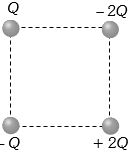
Four charges are placed on corners of a square as shown in figure having side of $5\,cm$. If $Q$ is one microcoulomb, then electric field intensity at centre will be
A charge $Q$ is distributed over three concentric spherical shell of radii $a, b, c (a < b < c)$ such that their surface charge densities are equal to one another. The total potential at a point at distance $r$ from their common centre, where $r < a$, would be