Question
Generate a complete, print-ready paper with questions like this in minutes — across 16+ boards, with answer keys.
| Column I | Column II |
| (i) Nephrons | (a) The organ that collects filtrate and urine from renal pelvis and takes it to the bladder for urination. |
| (ii) Ureter | (b) The artery that brings waste-filled blood from the aorta to the kidney. |
| (iii) Renal artery | (c) |
| (iv) Glomerulus | (d) Filtration units in the kidneys. |
| (e) A cluster of blood capillaries surrounded by a bowman's capsule. |
| Column I | Column II |
| (i) Implantation | (a) Testosterone |
| (ii) Fertilisation | (b) Vasectomy |
| (iii) Contraception in males | (c) Spermatozoa |
| (iv) Leydig cells | (d) Uterus |
| (e) Fallopian tube |
| Column I | Column II |
| (i) Auxin | (a) Promotes fruit ripening |
| (ii) Gibberellin | (b) Involvement in seed germination |
| (iii) Cytokinin phototropism | (c) Regulates apical dominance and |
| (iv) Abscisic acid | (d) Induces stomatal closure during drought |
| (e) Stimulates cell division and shoot development |
| Column I | Column II |
| A. Turgid | (i) intake of mineral salts |
| B. Diffusion | (ii) a cell charged with water |
| C. Active transport | (iii) limiting membrane of a vacuole |
| D. Osmosis | (iv) movement of particles from higher to lower concentration |
| (v) movement of solvent across semi-permeable membrane |
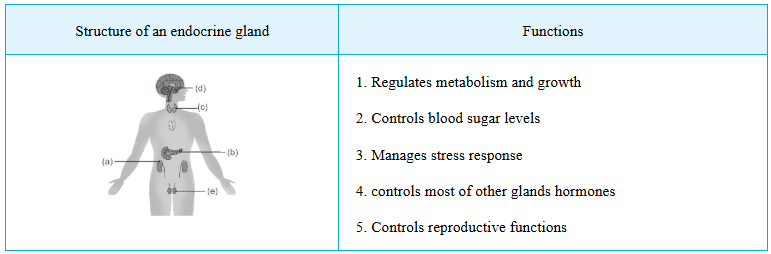
| Column I | Column II |
| (i) Acrosome | (a) Oestrogen |
| (ii) Ovulation | (b) Male gamete |
| (iii) Sperm | (c) Stoppage of menstrual cycle |
| (iv) Menopause | (d) Spermatozoa |
| (e) Testosterone |
| Column I | Column II |
| (i) Addison's disease | (a) Emergency hormone. |
| (ii) Dwarfism | (b) Regulates the amount of water excreted in urine. |
| (iii) Adrenaline | (c) Under-secretion of adrenal cortex |
| (iv) Vasopressin | (d) Under-secretion of growth hormone. |
| (e) Master of master gland. |
| Column I | Column II |
| (i) Adrenal | (a) Master of master gland. |
| (ii) Hypothalamus | (b) Heterocrine gland. |
| (iii) Pancreas | (c) Increases heart and breathing rate, raises blood pressure. |
| (iv) Testes | (d) Emergency hormone. |
| (e) Produces male sex characteristics. |
| Column I | Column II |
| (i) Pituitary | (a) Increases rate of metabolism. |
| (ii) Ovaries | (b) Development of a normal, healthy immune system. |
| (iii) Thyroid | (c) Heterocrine gland |
| (iv) Thymus | (d) Produces female sex characteristics. |
| (e) Simulates skeletal growth. |