Question
Generate a complete, print-ready paper with questions like this in minutes — across 16+ boards, with answer keys.
| Column I | Column II |
| (i) Auxin | (a) Promotes fruit ripening |
| (ii) Gibberellin | (b) Involvement in seed germination |
| (iii) Cytokinin phototropism | (c) Regulates apical dominance and |
| (iv) Abscisic acid | (d) Induces stomatal closure during drought |
| (e) Stimulates cell division and shoot development |
| Component | Approximate number | Life Span |
| I. RBCs | (A) 7,000 | (i) 3-5 days |
| II. WBCs | (B) 2,50,000 | (ii) 100-120 days |
| III. Blood platelets | (C) 4.8-5-5 million | (iii) 2 weeks |
| Column I | Column II |
| (i) Coronary artery | (a) Largest artery |
| (ii) Aorta | (b) Blocking of coronary arteries. |
| (iii) Heart attack | (c) Sphygmomanometer |
| (iv) Blood pressure | (d) Largest vein |
| (e) Carry oxygenated blood to heart muscles. |
| Column I | Column II |
| (i) Transpiration | (a) Cacti plants |
| (ii) Movement of water | (b) Stomata |
| (iii) Guttation | (c) Maize plant |
| (iv) Low rate of transpiration | (d) Xylem |
| (e) Hydathodes |
| Column I | Column II |
| (i) Chloroplasts | (a) Raw materials |
| (ii) Oxygen and Hydrogen | (b) Raw materials |
| (iii) Carbon dioxide and water | (c) Photolysis |
| (iv) Cells in the leaf | (d) Light reaction |
| (e) Glucose + oxygen |
| Column I | Column II |
| (i) Superior vena cava | (a) Collect deoxygenated blood from the wall of the heart. |
| (ii) Inferior vena cava | (b) Carry oxygenated blood to heart muscles. |
| (iii) Pulmonary vein | (c) Collects deoxygenated blood from upper parts of the body. |
| (iv) Coronary veins | (d) Collects deoxygenated blood from lower parts of the body. |
| (e) Brings oxygenated blood from lungs. |
| Column I | Column II |
| (i) Anaphase | (a) Chromosomes become arranged in a horizontal plane at the equator. |
| (ii) Prophase | (b) Daughter chromosomes move to opposite poles of the spindle. |
| (iii) Telophase | (c) Chromosomes become visible as fine, long threads. |
| (iv) Metaphase | (d) Chromosomes lose their distinctiveness and gradually become transformed into chromatin network. |
| Column I | Column II |
| (i) Geotropism | (a) Response to touch or physical contact |
| (ii) Phototropism | (b) Growth towards or away from water |
| (iii) Hydrotropism stimulus | (c) Growth towards or away from a chemical |
| (iv) Thigmotropism | (d) Growth in response to gravity |
| (e) Growth towards the light |
| Column I | Column II |
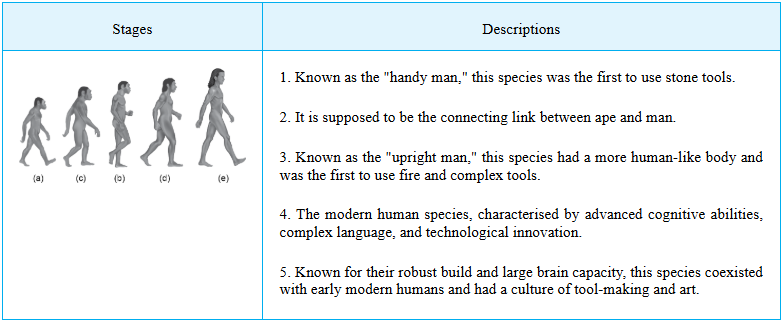
| 1. Homo habilis | a. 1450 cc |
| 2. Neanderthal | b. 680 cc |
| 3. Cro-Magnon | с. 1000 cc |
| 4. Homo erectus | d. 1600 cc |