Question types

Human Evolution question types

123 questions across 9 question groups — pick any mix to generate a Biology paper with step-by-step answer keys.

123
Questions
9
Question groups
5
Question types
Sample Questions

Human Evolution questions

One sample from each question group in this chapter. Select any group above to see the full set with answer keys.

Q 1MCQ1 Mark
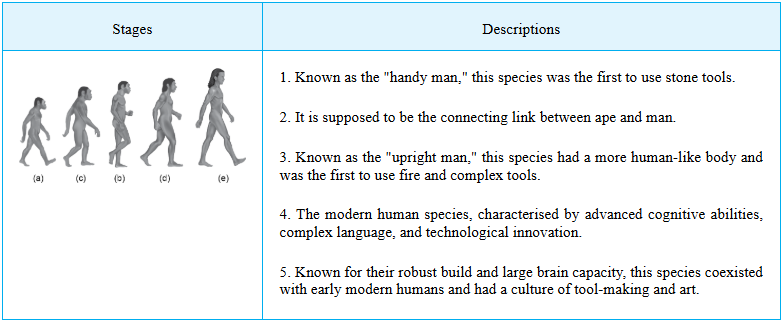
Identify the pre$-$human ancestor.
  • Ramapithecus
  • B
    Australopithecus
  • C
    Neanderthal man
  • D
    Cro$-$Magnon

Answer: A.

View full solution
Q 2MCQ1 Mark
The organism studied for industrial melanism was a $.......$
  • A
    Butterfly
  • Moth
  • C
    Honeybee
  • D
    Cockroach

Answer: B.

View full solution
Q 3MCQ1 Mark
The theory of Natural Selection was proposed by $.......$
  • A
    Mendel
  • B
    Lamarck
  • C
    Wallace
  • Darwin

Answer: D.

View full solution
Q 4MCQ1 Mark
The first scientist who proposed his theory for evolution was$.......$
  • A
    Darwin
  • B
    Mendel
  • Lamarck
  • D
    Wallace

Answer: C.

View full solution
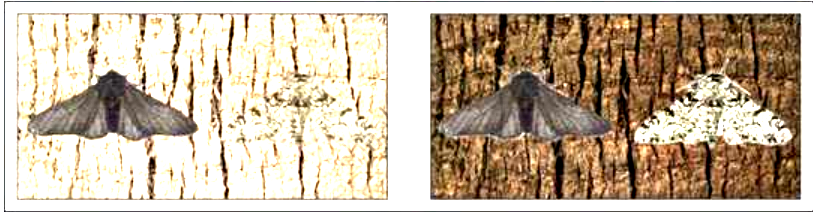
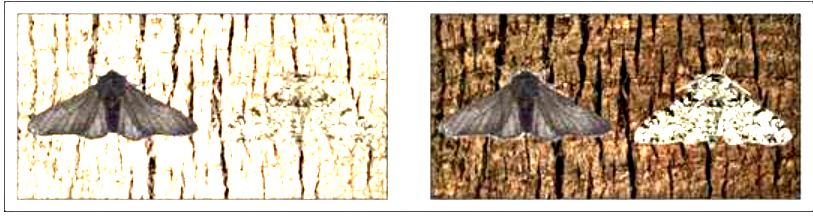
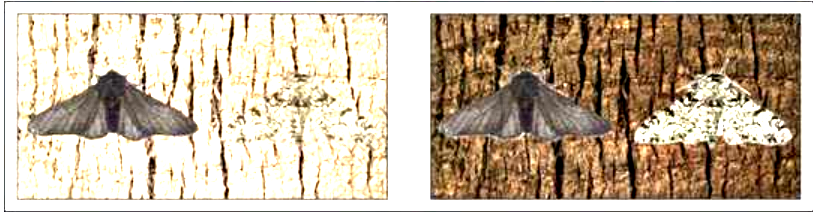
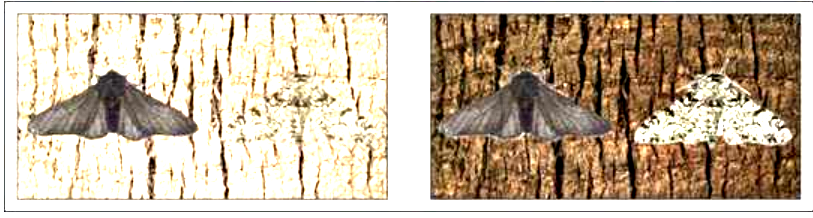
Given alongside are two figures (A and B) showing a phenomenon that was first observed in Manchester before and after the year 1850.

Answer the following.
What name has been given to this phenomenon?
View full solution
Given alongside are two figures (A and B) showing a phenomenon that was first observed in Manchester before and after the year 1850.

The following phenomenon provides a classical explanation of a scientific theory given by a certain scientist.
(i) Name and explain the said theory.
(ii) Give the name of the scientist who gave this theory.
View full solution
Given alongside are two figures (A and B) showing a phenomenon that was first observed in Manchester before and after the year 1850.

Give the common name and the scientific name of the insect involved in this phenomenon.
View full solution
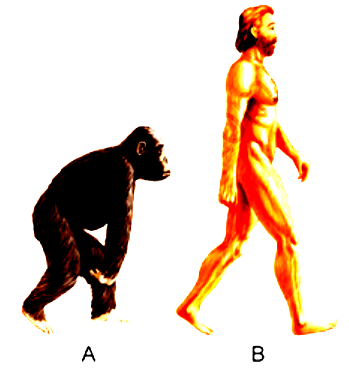
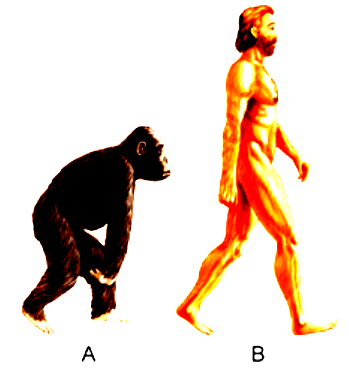
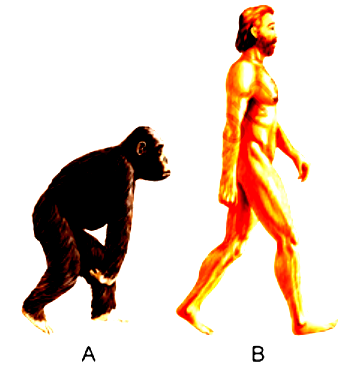
Given alongside are two figures (A and B) representing the two stages of evolution of human beings. Answer the following

Write all the stages of human evolution in their correct sequence.
View full solution
Column IColumn II
(i) Neanderthal man(a) Vestigial organ
(ii) Adaptive characters(b) Darwin's theory
(iii) Natural selection(c) 600 cc
(iv) Pinna(d) 1400 cc
 (e) Characters acquired during lifetime
View full solution
Column IColumn II
(i) Australopithecus(a) 735 cc
(ii) Homo habilis(b) 900 cc
(iii) Homo erectus(c) 850-1300 cc
(iv) Peking man(d) 600 cc
 (e) Vestigial organ
View full solution
Given alongside are two figures (A and B) showing a phenomenon that was first observed in Manchester before and after the year 1850.

Briefly mention why the changes shown in the two figures appeared.
View full solution
Given alongside are two figures (A and B) representing the two stages of evolution of human beings. Answer the following:

Mention any two contrasting characters between the two stages.
View full solution
Q 35TRUE / FALSE1 Mark
The traits acquired by the organism during his lifetime due to changes in environmental conditions are called acquired traits.
View full solution

Generate a Human Evolution paper free

Pick question groups from the list above, set marks and difficulty, and export a branded PDF with step-by-step answer keys. First 3 chapters free — no signup.

Download App