Question
3x – 4y – 15 = 0 and y + x + 2 = 0. Can these equations be solved by eliminating x ? Is the solution same?
Answer

3x – 4y – 15 = 0
∴ 3x – 4y = 15 …(i)
y + x + 2 = 0
∴ x + y = -2 ……(ii)
Multiplying equation (ii) by 3,
3x + 3y = -6 …(iii)
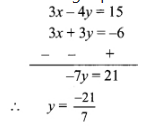
Subtracting equation (iii) from (i),

Image
∴ y = -3
Substituting y = -3 in equation (ii),
∴ x – 3 = -2
∴ x = – 2 + 3
∴ x = 1
∴ (x, y) = ( 1, -3)
Yes, the given equations can be solved by eliminating x. Also, the solution will remain the same.

Need a full question paper?

Generate a complete, print-ready paper with questions like this in minutes — across 16+ boards, with answer keys.
Start Generating Free

Similar questions

Curved surface area of a cone is $251.2 cm^2$ and radius of its base is $8\ cm $. Find its slant height and perpendicular height, ( $\pi=3.14$ )
Given: Radius $( r )=8 cm$, curved surface area
of cone $=251.2 cm^2$
To find: Slant height $( l )$ and the perpendicular height $( h )$ of the cone
If $\overline{\text{X}}$ is the mean of the ten natural numbers $x_1, x_2, x_3, ..., x_{10}$ show that:
$\Big(\text{x}_1-\overline{\text{X}}\Big)+\Big(\text{x}_2-\overline{\text{X}}\Big)+\dots+\Big(\text{x}_{10}-\overline{\text{X}}\Big)=0$
A capsule of medicine is in the shape of a sphere of diameter $3.5mm$. How much medicine $(mm^3)$ is needed to fill this capsule?
Express the following decimals in the form $\frac{\text{p}}{\text{q}},$ where p, q are integers and $\text{q}\neq0.$$0.3\overline{178}$
If a and b are different positive primes such that$\Big(\frac{\text{a}^{-1}\text{b}^2}{\text{a}^2\text{b}^2}\Big)^7\div\Big(\frac{\text{a}^3\text{b}^{-5}}{\text{a}^{-1}\text{b}^3}\Big)=\text{a}^\text{x}\text{b}^\text{y},$ find x and y.
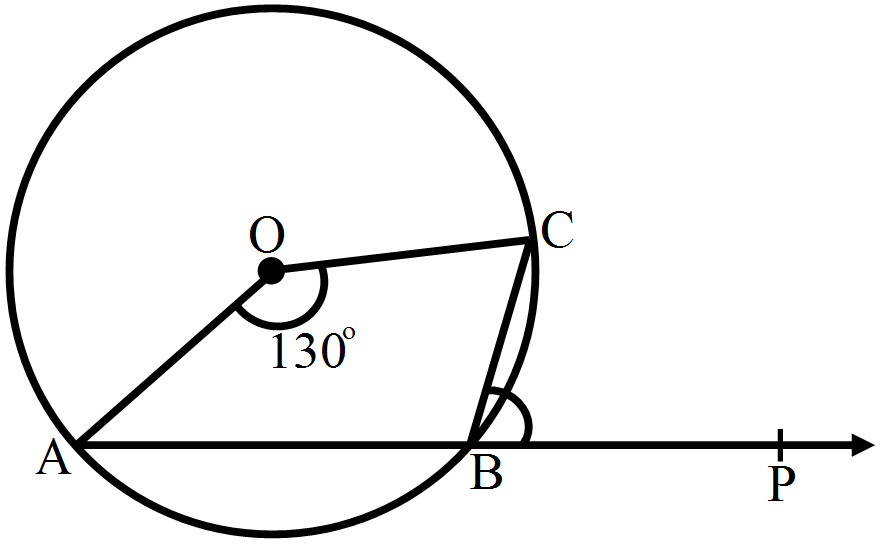
In the given figure, O is the centre of the circle and arc ABC subtends an angle of 130° at the centre. If AB is extended to P, find $\angle\text{PBC}.$
In figure, ABC is a right angled triangle at A, BCED, ACFG and ABMN are squares on the sides BC, CA and AB respectively. Line segment $\text{AX}\perp\text{DE}$ meets BC at Y. Show that: $\text{ar}(\text{BYXD})=2\text{ar}(\triangle\text{MBC})$
Factorise:$\text{x}^2-2\text{x}+\frac{7}{16}$
Assuming that x, y, z are positive real numbers, simplify the following:$(\sqrt{\text{x}})^{-\frac{2}{3}}\sqrt{\text{y}^4}\div\sqrt{\text{xy}^{-\frac{1}{2}}}$
Factorize:
$9(2a - b)^2 - 4(2a - b) - 13$