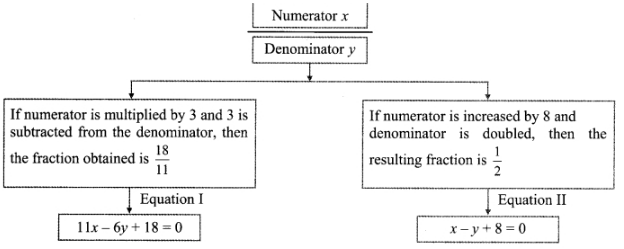
$\therefore$ Given function $=\frac{6}{14}$
Verify the answer obtained.
Similarly, for the fraction $\frac{6}{14}$, if the numerator is increased by 8 and the denominator is doubled, we get fraction $\frac{1}{2}$.
18 questions · self-marked practice — reveal the answer and mark yourself.

$\therefore$ Given function $=\frac{6}{14}$
Verify the answer obtained.

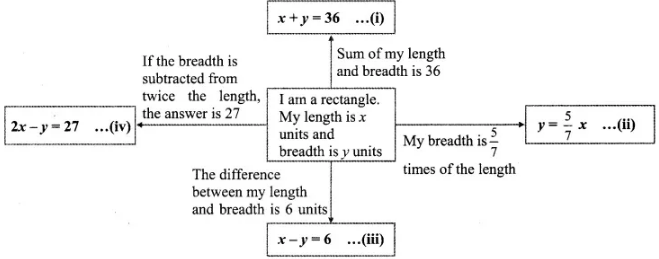
Solution of each pair given above is (21, 15).
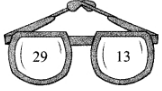
Here, all four equations are of same rectangle. By solving any two equations simultaneously, we get length and breadth of the rectangle.

ii. Their sum is 37 and difference is 11.

iii. Their sum is 54 and difference is 20.

iv. Their sum is … and difference is … .

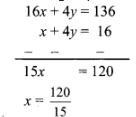
x = 8
Substituting x = 8 in equation (i),
4x + y = 34
∴ 4(8) + y = 34
∴ 32 + y = 34
∴ y = 34 – 32 = 2
∴ (8, 2) is the solution of the given equations.

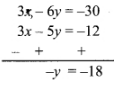
∴ y = 18
Substituting y = 18 in equation (i),
x – 2y = -10
∴ x – 2(18) = -10
∴ x – 36 = -10
∴ x = -10 + 36 = 26
∴ (26, 18) is the solution of the given equations.

∴ (2,1) is the solution of the given equations.


∴ y = -3
Substituting y = -3 in equation (ii),
∴ x – 3 = -2
∴ x = – 2 + 3
∴ x = 1
∴ (x, y) = ( 1, -3)
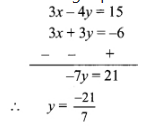
Yes, the given equations can be solved by eliminating x. Also, the solution will remain the same.
∴ y = -2
Substituting y = -2 in equation (ii),
x = 11 + 5y
∴ x = 11 + 5(-2)
∴ x = 11 – 10 = 1
∴ (1, -2) is the solution of the given equations.
∴ y = 3
Substituting y = 3 in equation (i),
x = 2y
∴ x = 2(3) = 6
∴ (6, 3) is the solution of the given equations.
y = -2
Substituting y = -2 in equation (ii),
x = 8 + 3 (-2)
∴ x = 8 – 6 = 2
∴ (2, -2) is the solution of the given equations.
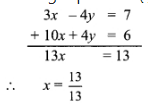
∴ x = 2
Substituting x = 2 in equation (i),
2(2) + y = 5
4 + y = 5
∴ y = 5 – 4 = 1
∴ (2, 1) is the solution of the given equations.
Substituting y = 1 in equation (i),
x = 4 – 1 = 3
∴ (3,1) is the solution of the given equations.
Alternate method:
Elimination Method:
x + y = 4 …(i)
2x – 5y = 1 ……(ii)
Multiplying equation (i) by 5,
5x + 5y = 20 … (iii)
Adding equations (ii) and (iii),
2x – 5y = 1
+ 5x + 5y = 20
7 = 21
$\therefore x=\frac{21}{7}$
∴ x = 3
Substituting x = 3 in equation (i),
3 + y = 4
∴ y = 4 – 3 = 1
(3,1) is the solution of the given equations.