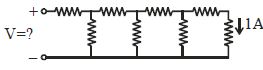
$4$ bulbs marked $40\, W$, $250\, V$ are connected in series with $250\, V$ mains. The total power is ............. $W$
Easy


Download our appand get started for free
Experience the future of education. Simply download our apps or reach out to us for more information. Let's shape the future of learning together!No signup needed.*
Similar Questions
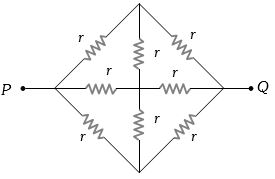
- 1The equivalent resistance between the points $P$ and $Q$ in the network given here is equal to ................ $\Omega$ (given $r = \frac{3}{2}\Omega $)View Solution
- 2Two electric bulbs, rated at $(25\, W, 220\, V)$ and $(100\, W, 220\, V)$, are connected in series acroos a $220\, V$ voltage source. If the $25\, W$ and $100\, W$ bulbs draw powers $P_1$ and $P_2$ respectively, thenView Solution
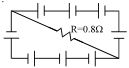
- 3$\mathrm{A}$ circuit is comprised of eight identical batteries and a resistor $R = 0.8\,\Omega$ . Each battery has an $\mathrm{emf}$ of $1.0\, V$ and internal resistance of $0.2\,\Omega$ . The voltage difference across any of the battery is ............. $V$View Solution
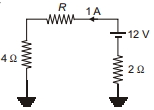
- 4Value of the resistance $R$ in the figure is .......... $\Omega$View Solution
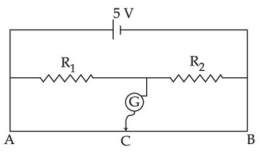
- 5In the given figure of meter bridge experiment, the balancing length $AC$ corresponding to null deflection of the galvanometer is $40\,cm$. The balancing length, if the radius of the wire $AB$ is doubled, will be $....cm$View Solution
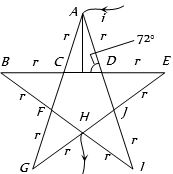
- 6In the following star circuit diagram (figure), the equivalent resistance between the points $A$ and $H$ will be ..............$r$View Solution
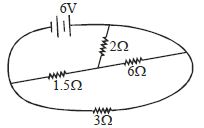
- 7Find the value of current from battery in the circuit ............... $A$View Solution
- 8View SolutionThe colour sequence in a carbon resistor is red, brown, orange and silver. The resistance of the resistor is
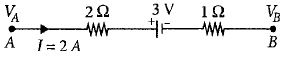
- 9The potential difference $(V_A - V_B)$ between the points $A$ and $B$ in the given figure is ............ $V$View Solution
- 10Each element in the finite chain of resistors shown in the figure is $1\,\Omega $. A current of $1\, A$ flows through the final element. Then what is the potential difference $V$ across input terminals of the chain ............... $\mathrm{volt}$View Solution