In the following star circuit diagram (figure), the equivalent resistance between the points $A$ and $H$ will be ..............$r$
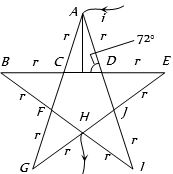
Diffcult


Download our appand get started for free
Experience the future of education. Simply download our apps or reach out to us for more information. Let's shape the future of learning together!No signup needed.*
Similar Questions
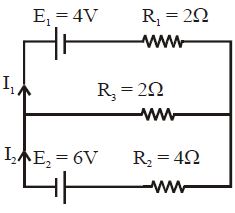
- 1In the circuit shown : $E_1 = 4.0\ V, R_1 = 2 \ \Omega,$$ E_2 = 6.0\ V, R_2 = 4\ \Omega$ and $R_3 = 2\ \Omega.$ The current $I_1$ is : ................ $A$View Solution
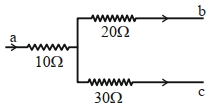
- 2Figure shows a part of an electric circuit. The potentials at points $a , b$ and $c$ are $30\,V , 12\,V$ and $2\,V$ respectively. The current through the $20 \Omega$ resistor will be $........\,A$View Solution
- 3A galvanometer of resistance, $G,$ is connected in a circuit. Now a resistance $R$ is connected in series of galvanometer. To keep the main current in the circuit unchanged, the resistance to be put in parallel with the series combination of $G$ and $R$ isView Solution
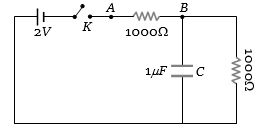
- 4When the key $K$ is pressed at time $t = 0$, which of the following statements about the current $I$ in the resistor $AB$ of the given circuit is trueView Solution
- 5A current of $2\,A$ flows through a $2\,\Omega$ resistor when connected across a battery. The same battery supplies a current of $0.5\,\, A$ when connected across a $9 \,\,\Omega$ resistor. The internal resistance of the battery isView Solution
- 6An electric bulb is designed to draw power $P_0$ at voltage $V_0$. If the voltage is $V$ it draws a power $P$. ThenView Solution
- 7When current supplied by a cell to a circuit is $0.3 \,A$, its terminal potential difference is $0.9 \,V$. When the current supplied becomes $0.25 \,A$, its terminal potential difference becomes $1.0 \,V$. The internal resistance of the cell is ............ $\Omega$View Solution
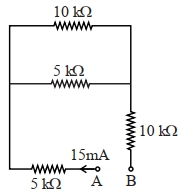
- 8A current of $15\,mA$ flows in the circuit as shown in figure. The value of potential difference between the points $A$ and $B$ will be $...\,V$View Solution
- 9View SolutionConstantan wire is used in making standard resistances because its
- 10View SolutionSee the electrical circuit shown in this figure. Which of the following equations is a correct equation for it ?