Question

Image

Answer

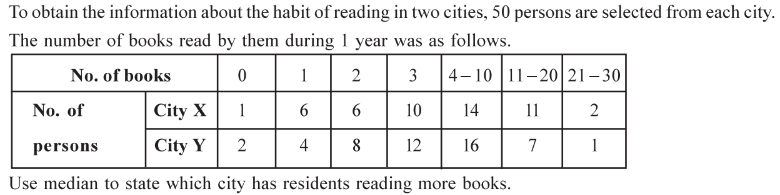
For city $X M=4.5$ booksFor city $Y M=3$ books$\therefore$ More books are read in city $X$.

Need a full question paper?

Generate a complete, print-ready paper with questions like this in minutes — across 16+ boards, with answer keys.

Start Generating Free

Similar questions

Define symmetric frequency distribution and state its characteristics.
The marks in a test for a group of students are as follows. Find the mean marks of these students.
Marks
$0-10$ $10-20$ $20-30$ $30-40$ $40-50$ $50-60$ $60-70$
No. of students
$3$ $5$ $12$ $16$ $11$ $5$ $4$
Discuss the method of collecting primary data by direct inquiry.
In usual notations find combined standard deviation from the following informations:
$n_{1}=10, \bar{x}_{1}=16, S_{1}=2 ; n_{2}=60, \bar{x}_{2}=$
$22, s_{2}=2.5$
The workers in a factory are working in two shifts. Total number of workers is $5000$ . There are $2000$ workers in the first shift. In this shift, among the local workers, the number of male workers is $1200$ and the number of female workers is $300$ . In the second shift, among the local workers, the number of male workers is $2000$ and the number of female workers is $600$ . There are total $1200$ female workers in the factory, of them $500$ female workers are working in the first shift. Present the data in a tabular form.
The information of profits (in lakh $₹$ ) of $50$ firms is given below. Find mean profit.
Profit (Lakh ₹)
$0-7$ $7-14$ $14-21$ $21-28$ $28-35$
No. of firms
$4$ $9$ $18$ $12$ $7$
The data about population (in thousand) of $70$ villages in a district is given in the following table :
Population (in thousand) $0 -10$ $10 – 20$ $20 – 30$ $30 -40$ $40 -50$
No. of villages $6$ $18$ $22$ $15$ $9$
Find the mode for the population using graphical method.
A bus operator gets the following number of passengers in $10$ trips on a day. Find the quartile deviation and the coefficient of quartile deviation of number of passengers from the following data :
$19, 25, 35, 10, 24, 8, 12, 5, 20, 30$
By considering the inclusive frequency distribution obtained in illustration $3$, find
$(i)$ Exclusive frequency distribution and
$(ii)$ Frequency distribution showing mid value of each class.
If $S_{n}=8\left[\left(\frac{3}{2}\right)^{n}-1\right]$, find $T_{n+1}$ and hence the value of $T_{2}+T_{3}$.