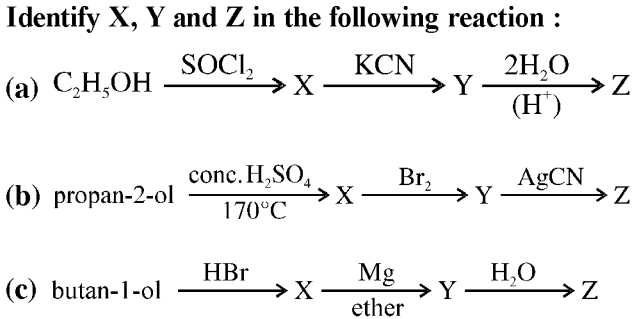
Question
Image

Answer

Get the step-by-step solution for this question inside the Vidyadip app.

Get the answer in the app

Need a full question paper?

Generate a complete, print-ready paper with questions like this in minutes — across 16+ boards, with answer keys.

Start Generating Free

Similar questions

The following results have been obtained during the kinetic studies of the reaction:

2A + B → C + D

Experiment [A]/mol L-1 [B]/mol L-1

Initial rate of formation of

D/mol L-1 min-1

I 0.1 0.1 6.0 × 10-3
II 0.3 0.2 7.2 × 10-2
III 0.3 0.4 2.88 × 10-1
IV 0.4 0.1 2.40 × 10-2
Determine the rate law and the rate constant for the reaction.

State Raoult’s law for a solution containing volatile components. How does Raoult’s law become a special case of Henry’s law?
Write the equations of the reactions of forming primary amines by the following methods:
(a) Hydrolysis of alkyl isocyanide
(b) Reductive amination of carbonyl compounds
(c) Alkaline hydrolysis of alkyl isocyanate
a. Write down the reaction occurring on two inert electrodes when electrolysis of copper chloride is done. What will happen if a concentrated solution of copper sulphate is replaced with copper chloride?
b. Write an expression for the molar conductivity of aluminium sulphate at infinite dilution according to Kohlrausch law.
Write electrode reactions taking place in:
  1. Ni–Cd cell.
  2. Lead Acid Accumulator.
$E_{\text {cell }}^0$ for the given redox reaction is 2.71 V
$Mg _{( s )}+ Cu _{(0.01 M )}^{2+} \longrightarrow \stackrel{2++ Cu _{( s )}}{ Mg _{(0.001 M )}^{2+}}$
Calculate $E_{\text {cell }}$ for the reaction. Write the direction of flow of current when an external opposite potential applied is
(i) less than 2.71 V and (ii) greater than 2.71 V .
Give reasons:
  1. n-Butyl bromide has higher boiling point than t-butyl bromide.
  2. Racemic mixture is optically inactive.
  3. The presence of nitro group (–NO2) at o/p positions increases the reactivity of haloarenes towards nucleophilic substitution reactions.
Calculate the potential for half-cell containing
0.10M K2Cr2O7 (aq), 0.20M Cr3+(aq) and 1.0 × 10⁻⁴M H+(aq). The half cell reaction is
$\text{Cr}_2\text{O}_7^{2-}(\text{aq})14\text{H}^+(\text{aq})+6\text{e}^-\xrightarrow{ \ \ \ \ \ \ \ \ \ \ }2\text{Cr}^{3+}(\text{aq})+7\text{H}_2\text{O}(\text{l})$
and the standard electrode potential is given as E° = 1.33V.
Identify the product of the following reaction:

$ \ \ \ \ \ \ \ \ \ \text{CH}_3\\ \ \ \ \ \ \ \ \ \ \ \ \ \ \text{|}\\\text{CH}_3-\text{C}-\text{CH}_2-\text{Br}\xrightarrow{\stackrel{{}}{\hbox{Na}}\stackrel{{}}{\hbox{OH}}}\\ \ \ \ \ \ \ \ \ \ \ \ \ \ \text{|} \ \ \ \ \ \ \ \ \ \ \ \ \ \ \ \ \ \ \ \ \ \ \ \ \ \ \ \ \ \Delta\\ \ \ \ \ \ \ \ \ \ \text{CH}_3$

An octahedral complex is prepared by mixing CoCl3 and NH3 in the molar ratio 1 : 4, 0.1m solution of this complex was found to freeze at 0.372°C. What is the formula of the complex? Given that molal depression constant (Kf) for water = 1.86°C/m.