MCQ
$4a^2 + b^2 + 4ab + 8a + 4b + 4 = ?$
  • A
    $(2a - b + 2)^2$
  • $(2a + b + a)^2$
  • C
    $(a + 2b + 2)^2$
  • D
    None of these.

Answer

Correct option: B.
$(2a + b + a)^2$

We know that,
$(x+y+z)^2=x^2+y^2+z^2+2 x y+2 y z+2 z x$
$2 a^2+b^2+4+4 a b+8 a+4 b+4$
$=4 a^2+b^2+4+4 a b+8 a+4 b$
$=\left(2 a^2\right)+b^2+2^2+2(2 a) b+2(2 a)(2)+2(2 b)$
$=(2 a+b+2)^2$

Need a full question paper?

Generate a complete, print-ready paper with questions like this in minutes — across 16+ boards, with answer keys.
Start Generating Free

Similar questions

If $\bar{\text{x}}$ is the mean of $x_1, x_2, x_3, \ldots, x_n$ then $\sum\limits_{\text{i}=1}^\text{n}(\text{x}_\text{i}-\bar{\text{x}})=?$
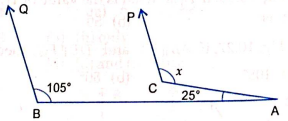
In Fig. if CP ||BQ, then the measure of x is
Image
The length of two sides of a triangle are $7$ units and $10$ units. Which of the following length can be the length of the third side?
Choose the rational number which does not lie between $-\frac{2}{3}$ and $-\frac{1}{5}.$
Directions: In the following questions, the Assertions $(A)$ and Reason(s) $(R) $have been put forward. Read both the statements carefully and choose the correct alternative from the following:
Assertion: A cylinder and right circular cone are having the same base and same height the volume of cylinder is three times the volume of cone.
Reason: If the radius of cylinder is doubled and height is halved the volume will be doubled.
A cube whose volume is $\frac{1}{8}$ cubic centimeter is placed on a cube whose volume is $1 \mathrm{~cm}^3$. The two cubes are then placed on top a third cube whose volume is $8 \mathrm{~cm}^3$. The heigght of the stacked cubes is:
If $\left(x^{100}+2 x^{99}+k\right)$ is divisible by $(x+1)$ then the value of $k$ is:
 
If $10^\text{x}=64,$ what is the value of $10^{\frac{\text{x}}{2}+1}?$
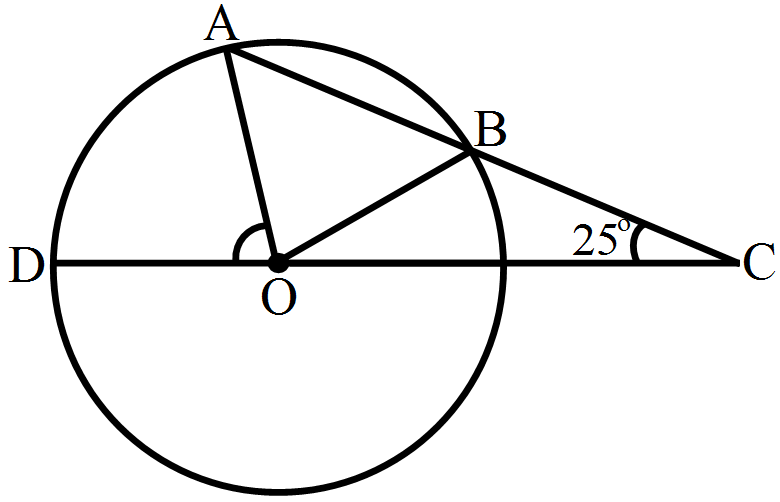
In the given figure, $AB$ is a chord of a circle with centre $O$ and $AB$ is produced to $C$ such that $BC = OB.$ Also, $CO$ is joined and produced to meet the circle in $D.$ If $\angle\text{ACD}=25^\circ,$ then $\angle\text{AOD}=?$
It is known that if $x + y = 10$ then $x + y + z = 10 + z$. Euclid’s axiom that illustrates this statement is: