MCQ
$4\,g$ of copper was dissolved in concentrated nitric acid. The copper nitrate solution on strong heating gave $5\,g$ of its oxide. The equivalent weight of copper is
- A$23$
- ✓$32$
- C$12$
- D$20$
|
Element |
Wt. |
At Wt. |
$Wt./At.Wt. \ne x$ |
Ratio |
|
$Cu$ |
$4\,gm$ |
$63.5$ |
$4/63.5=0.0625$ |
$\frac{{.0625}}{{0.0625}} = 1$ |
|
$O$ |
$1\,gm$ |
$16$ |
$1/16 =0.0625$ |
$\frac{{.0625}}{{0.0625}} = 1$ |
Emperical formula $= CuO$ of oxide
In this oxide, oxidation no. of $Cu = + 2$
Equivalent weight $ = \frac{{{\rm{Molecular\, weight }}}}{{{\rm{Oxidation\, no}}{\rm{.}}}} = \frac{{63.5}}{2} \approx 31.75$ but Equivalent weight should be an
integeral no.$ = 32$
Generate a complete, print-ready paper with questions like this in minutes — across 16+ boards, with answer keys.

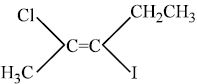
The correct structure of
$\begin{array}{*{20}{c}}
{C{H_3} - CH - CH - C{H_3}\xleftarrow[{ether}]{{Na}}R\,' - Br\,\xrightarrow{{Mg}}'D'\,\xrightarrow{{{H_2}O}}E} \\
{\,\,\,\,|\,\,\,\,\,\,\,\,\,\,\,\,\,|\,\,\,\,\,\,\,\,\,\,\,\,\,\,\,\,\,\,\,\,\,\,\,\,\,\,\,\,\,\,\,\,\,\,\,\,\,\,\,\,\,\,\,\,\,\,\,\,\,\,\,\,\,\,\,\,\,\,\,\,\,\,\,\,\,\,\,\,\,\,\,\,\,\,\,\,\,\,\,\,\,\,\,\,\,\,\,} \\
{\,\,\,\,\,C{H_3}\,\,\,\,\,C{H_3}\,\,\,\,\,\,\,\,\,\,\,\,\,\,\,\,\,\,\,\,\,\,\,\,\,\,\,\,\,\,\,\,\,\,\,\,\,\,\,\,\,\,\,\,\,\,\,\,\,\,\,\,\,\,\,\,\,\,\,\,\,\,\,\,\,\,\,\,\,\,\,\,\,\,\,\,\,\,\,\,\,\,\,}
\end{array}$
| Rate Constant | Activation energy | |
| Step $1$ | $k_1$ | $E_{a_1} = 180\ kJ/mol$ |
| Step $2$ | $k_2$ | $E_{a_2} = 80\ kJ/mol$ |
| Step $3$ | $k_3$ |
$E_{a_3} = 50\ kJ/mol$ |