Question
$5 \frac{1}{2}-3 \frac{1}{3}$

Answer

$\begin{aligned} & 5 \frac{1}{2}-3 \frac{1}{3} \\ & 5 \frac{1}{2}-3 \frac{1}{3}=\frac{5 \times 2+1}{2}-\frac{3 \times 3+1}{3} \\ & =\frac{10+1}{2}-\frac{9+1}{3} \\ & =\frac{11}{2}-\frac{10}{3} \\ & =\frac{11 \times 3}{2 \times 3}-\frac{10 \times 2}{3 \times 2} \\ & =\frac{33}{6}-\frac{20}{6} \\ & =\frac{33-20}{6}=\frac{13}{6} \\ & 5 \frac{1}{2}-3 \frac{1}{3}=2 \frac{1}{6} \\ & \end{aligned}$

Need a full question paper?

Generate a complete, print-ready paper with questions like this in minutes — across 16+ boards, with answer keys.

Start Generating Free

Similar questions

Match the following:
(a)
Area of a rectangle
(i)
$\pi\text{r}^2$
(b)
Area of a square
(ii)
$4 \times $ $\text {side}$
(c)
Perimeter of a rectangle
(iii)
$\text {l} \times \text {b}$
(d)
Perimeter of a square
(iv)
$\text ({side}){}^2$
(e)
Area of a circle
(v)
$2(l + b)$
Two ropes, one 8 metres long and the other 12 metres long are to be cut into pieces of the same length. What will the maximum possible length of each piece be?
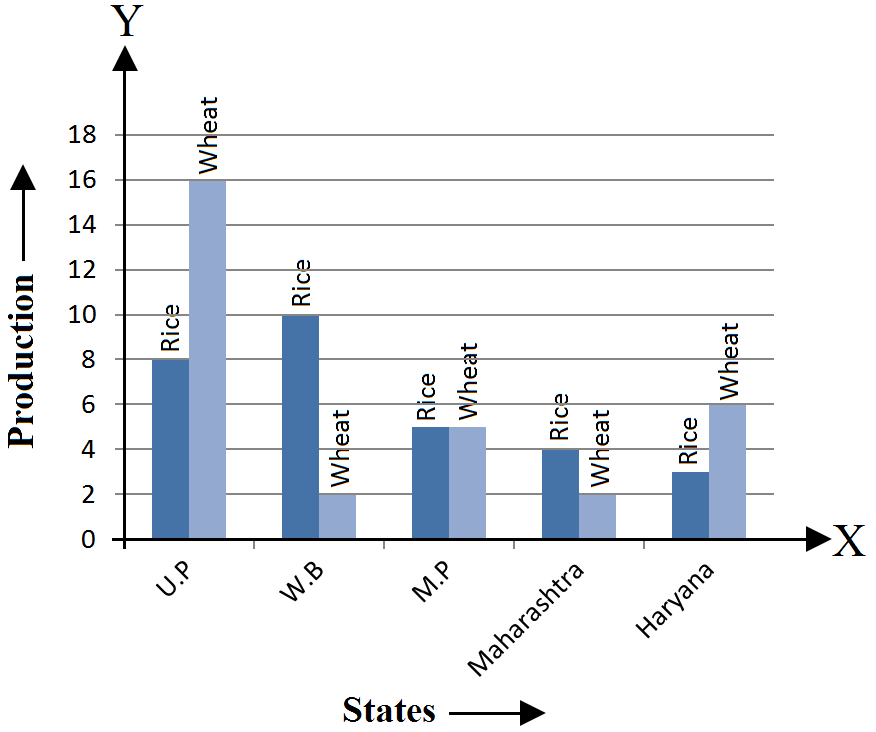
Read the following bar group and answer the following questions:
  1. What information is given by the bar group?
  2. Which state is the largest producer of rice?
  3. What state is the largest producer of wheat?
  4. Which state has total production of rice and wheat as its maximum?
  5. Which state has the total production of wheat and eice minimum?
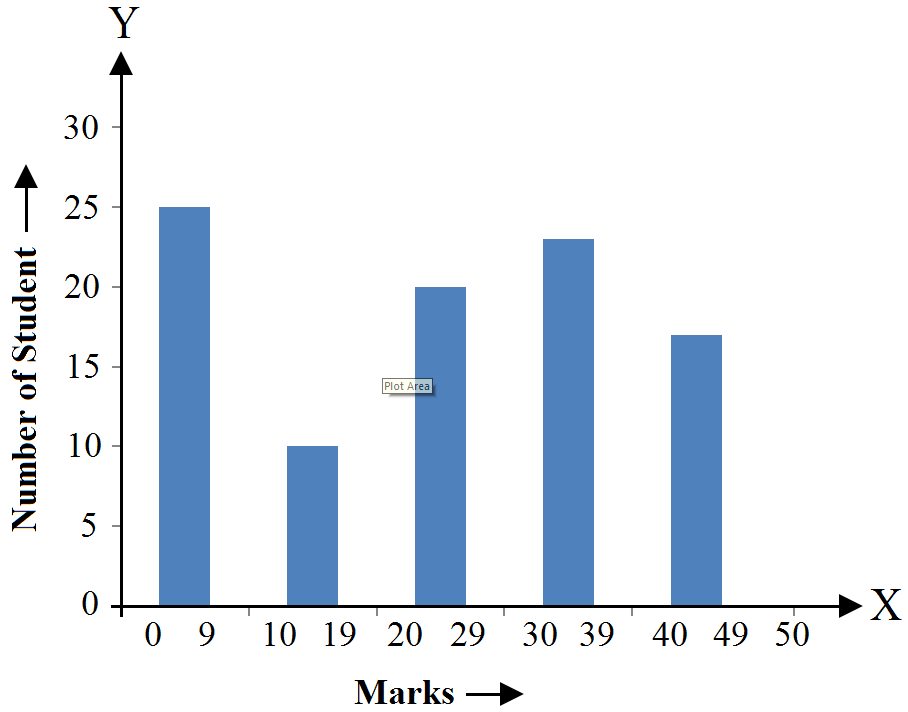
Given below is the bar graph indicating the marks obtained out of 50 in mathematics paper by 100 students. Read the bar graph and answer the following questions:
  1. It is decidec to distribute work books on mathematics to the students obtaining less than 20 marks, giving one workbook to each of such students. If a work book costs ₹ 5, what sum is required to buy the work books?
  2. Every student belonging to the highest mark group is entitled to get a prize of ₹ 10. How much amount of money is required for distributing the prize money?
  3. Every student belonging to the lowest mark-group has to solve 5 problems per day. How many problems, in all, will be solved by the students of this group per day?
  4. State whether true or false.
  1. 17% students have obtained marks ranging from 40 to 49.
  2. 59 students have obtained marks ranging from 10 to 29.
  1. What is the number of students getting less than 20 marks?
  2. What is the number of students getting more than 29 marks?
  3. What is the number of students getting marks between 9 and 40?
  4. What is the number, of students belonging to the highest mark group?
  5. What is the number of students obtaining more than 19 marks?
In a mathematics test following marks were obtained by 40 students of class VI. Arrange these marks in a table using, tally marks.
8
1
3
7
6
5
5
4
4
2
4
9
5
3
7
1
6
5
2
7
7
3
8
4
2
8
9
5
8
6
7
4
5
6
9
6
4
4
6
6
  1. Find how many students obtained marks equal to or more than 7?
  2. How many students obtained marks below 4?
Use a pair of compasses and construct the following angles:
$22\frac{1}{2}^\circ$
Use a pair of compasses and construct the following angles:
105°
Arrange the following numbers in descending order:
190909, 1808088, 16060666, 16007777, 181888, 1808090
Find the HCF of the numbers in the following using the division method:391, 425, 527
$3 \frac{1}{3}-1 \frac{1}{4}$