MCQ
$5$ litre of benzene weighs
  • A
    More in summer than in winter
  • More in winter than in summer
  • C
    Equal in winter and summer
  • D
    None of the above

Answer

Correct option: B.
More in winter than in summer
b
(b)Similar to previous question, benzene contracts in winter. So $5$ litre of benzene will weigh more in winter than in summer.

Need a full question paper?

Generate a complete, print-ready paper with questions like this in minutes — across 16+ boards, with answer keys.
Start Generating Free

Similar questions

In a series $L-C-R$ circuit, current in the circuit is $11\, A$ when the applied voltage is  $220\, V$. Voltage across the capacitor is $200\, V$. If value of resistor is $20\, \Omega$,  then the voltage across the unknown inductor is.......$V$
In a plane electromagnetic wave, the directions of electric field and magnetic field are represented by $\hat{ k }$ and $2 \hat{ i }-2 \hat{ j },$ respectively What is the unit vector along direction of propagation of the wave.
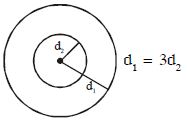
A circular disc is shown. On heating, $d_1$ increases by $0.3\%$ , then $d_2$ will
In Young’s double slit experiment the amplitudes of two sources are $3a$ and $a $ respectively. The ratio of intensities of bright and dark fringes will be
A man is running with constant speed along a circular path of radius $2 \sqrt 2\, m$. He completes $1$ round in $10\, second$. Find instantaneous speed at $2.5 \,sec.$
 The resistance of a galvanometer is $50\,\Omega $ and it requires $2\,\mu A$ per two division deflection. The value of the shunt required in order to convert this galvanometer into ammeter of range $5\,A$ is (The number of divisions on the galvanometer scale on one side is $30$)
A ship is travelling due east at $10\, km/hr$. $A$ ship heading $30^o$ east of north is  always due north from the first ship. The speed of the second ship in $km/hr$ is
Two solid cylinders $P$ and $Q$ of same mass and same radius start rolling down a fixed inclined plane form the same height at the same time. Cylinder $P$ has most of its mass concentrated near its surface, while $Q$ has most of its mass concentrated near the axis. Which statement $(s)$ is (are) correct?
Assertion : The ionising power of $\beta  - $ particle is less compared to $\alpha  - $ particles but their penetrating power is more.

Reason : The mass of $\beta  - $ particle is less than the mass of $\alpha  - $ particles

The Cauchy’s dispersion formula is