MCQ
A circular disc is shown. On heating, $d_1$ increases by $0.3\%$ , then $d_2$ will
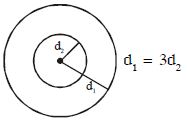
- ADecrease by $0.1\%$
- BDecrease by $0.3\%$
- CIncrease by $0.1\%$
- ✓Increase by $0.3\%$
$\Rightarrow d_{1}, 0.3 \%$
Generate a complete, print-ready paper with questions like this in minutes — across 16+ boards, with answer keys.
(If initial charge is $q_{0}$ )
|
Column $-I$ Angle of projection |
Column $-II$ |
| $A.$ $\theta \, = \,{45^o}$ | $1.$ $\frac{{{K_h}}}{{{K_i}}} = \frac{1}{4}$ |
| $B.$ $\theta \, = \,{60^o}$ | $2.$ $\frac{{g{T^2}}}{R} = 8$ |
| $C.$ $\theta \, = \,{30^o}$ | $3.$ $\frac{R}{H} = 4\sqrt 3 $ |
| $D.$ $\theta \, = \,{\tan ^{ - 1}}\,4$ | $4.$ $\frac{R}{H} = 4$ |
$K_i :$ initial kinetic energy
$K_h :$ kinetic energy at the highest point
$y = a\sin (kx + \omega t)$ ......$(1)$
$y = a\sin (\omega t - kx)$ ......$(2)$
$y = a\cos (kx + \omega t)$ ......$(3)$
$y = a\cos (\omega t - kx)$ ......$(4)$
emitted by four different sources ${S_1},\,{S_2},\,{S_3}$ and ${S_4}$ respectively, interference phenomena would be observed in space under appropriate conditions when