Question
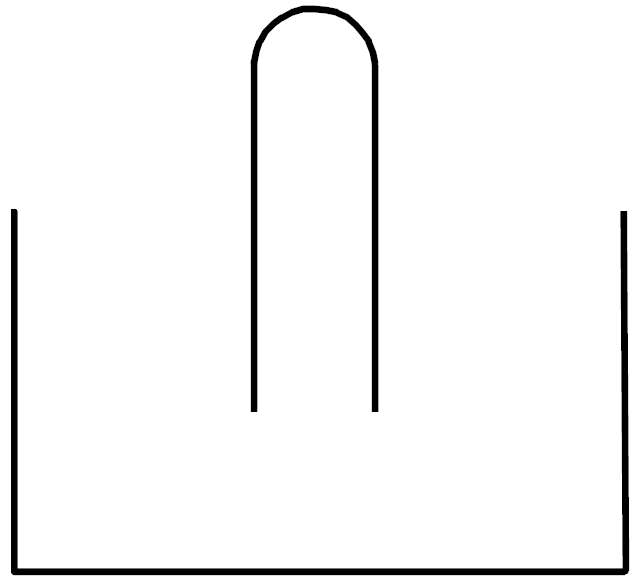
$50cc$ of oxygen is collected in an inverted gas jar over water. The atmospheric pressure is $99.4kPa$ and the room temperature is $27°C$. The water level in the jar is same as the level outside. The saturation vapour pressure at $27°C$ is $3.4kPa$. Calculate the number of moles of oxygen collected in the jar.
Answer


Pressure inside the tube = Atmospheric Pressure = 99.4KPa
Pressure exerted by $O_2$ vapour = Atmospheric pressure - V.P.
$= 99.4KPa - 3.4KPa = 96KPa$
No of moles of $O_2 = n$
$96\times10^3\times50\times10^{-6}=\text{n}\times8.3\times300$
$\Rightarrow\text{n}=\frac{96\times50\times10^{-3}}{8.3\times300}=1.9277\times10^{-3}\approx1.93\times10^{-3}$

Need a full question paper?

Generate a complete, print-ready paper with questions like this in minutes — across 16+ boards, with answer keys.

Start Generating Free

Similar questions

A narrow pencil of parallel light is incident normally on a solid transparent sphere of radius r. What should be the refractive index if the pencil is to he focused.
  1. At the surface of the sphere.
  2. At the centre of the sphere.
Read the passage given below and answer the following questions from (i) to (v). Relative Velocity Every motion is relative as it has to be observed with respect to an observer. Relative velocity is a measurement of velocity of an object with respect to other observer. It is defined as the time rate of change of relative position of one object with respect to another. For example, if rain is falling vertically with a velocity v, and a man is moving horizontally with $v_m$, the man can protect himself from the rain if he holds his umbrella in the direction of relative velocity of rain w.r.t. man.
  1. Two bodies are held separated by 9.8m vertically one above the other. They are released simultaneously to fall freely under gravity. After 2s, the relative distance between them is:
  1. 4.9m
  2. 19.6m
  3. 9.8m
  4. 39.2m
  1. If two objects P andQ move along parallel straight lines in opposite direction with velocities $v_P$ and $v_Q$ respectively, then relative velocity of P w.r.t.Q,
  1. $v_{PQ} = v_P = v_0$
  2. $v_P - v_0$
  3. $v_P + v_0$
  4. $v_0 - v_p$
  1. A train is moving towards East and a car is along North, both with same speed. The observed direction of car to the passenger in the train is:
  1. East - North direction
  2. West - North direction
  3. South - East direction
  4. None of the above
  1. Buses A and B are moving in the same direction with velocities $20\hat{\text{i}}\text{ms}^{-1}$ and $15\hat{\text{i}}\text{ms}^{-1},$ respectively. Then, relative velocity of A w.r.t. B is:
  1. $35\hat{\text{i}}\text{ms}^{-1}$
  2. $5\hat{\text{i}}\text{ms}^{-1}$
  3. $5\hat{\text{j}}\text{ms}^{-1}$
  4. $35\hat{\text{j}}\text{ms}^{-1}$
  1. A girl riding a bicycle with a speed of $5\ ms\ -1$ towards east direction sees raindrops falling vertically downwards. On increasing the speed to $15ms^{-1},$ rain appears to fall making an angle of $45^\circ$ of the vertical. Find the magnitude of velocity of rain.
  1. $5\text{ms}^{-1}$
  2. $5\sqrt5\text{ms}^{-1}$
  3. $25\text{ms}^{-1}$
  4. $10\text{ms}^{-1}$
The needle of a dip circle shows an apparent dip of 45° in a particular position and 53° when the circle is rotated through 90°. Find the true dip.
Read the passage given below and answer the following questions from (i) to (v).
A motion that repeats itself at regular intervals of time is called periodic motion. Very often, the body undergoing periodic motion has an equilibrium position somewhere inside its path. When the body is at this position no net external force acts on it. Therefore, if it is left there at rest, it remains there forever. If the body is given a small displacement from the position, a force comes into play which tries to bring the body back to the equilibrium point, giving rise to oscillations or vibrations. Every oscillatory motion is periodic, but every periodic motion need not be oscillatory. Circular motion is a periodic motion, but it is not oscillatory. The smallest interval of time after which the motion is repeated is called its period. Let us denote the period by the symbol T. Its SI unit is second. The reciprocal of T gives the number of repetitions that occur per unit time. This quantity is called the frequency of the periodic motion. It is represented by the symbol n. The relation between n and T is $\text{n}=\frac{1}{\text{T}}$. The unit of n is thus $s^{-1}$​​​​​​​. After the discoverer of radio waves, Heinrich Rudolph Hertz (1857–1894), a special name has been given to the unit of frequency. It is called hertz (abbreviated as Hz). Answer the following.
  1. Every oscillatory motion is periodic motion true or false?
  1. True
  2. False
  1. Circular motion is
  1. Oscillatory motion
  2. Periodic motion
  3. Rotational motion
  4. None of these
  1. Define period. Give its SI unit and dimensions
  2. Define frequency of periodic motion. How it is related to time period
  3. What is oscillatory motion
A kid of mass M stands at the edge of a platform of radius R which can be freely rotated about its axis. The moment of inertia of the platform is I. The system is at rest when a friend throws a ball of mass m and the kid catches it. If the velocity of the ball is v horizontally along the tangent to the edge of the platform when it was caught by the kid, find the angular speed of the platform after the event.
Two blocks of unequal masses are tied by a spring. The blocks are pulled stretching the spring slightly and the system is released on a frictionless horizontal platform. Are the forces due to the spring on the two blocks equal and opposite? If yes, is it an example of Newton's third law?
Read the passage given below and answer the following questions from $(i)$ to $(v)$. All engineering phenomena deal with definite and measured quantities and so depend on the making of the measurement. We must be
clear and precise in making these measurements. To make a measurement, magnitude of the physical quantity (unknown) is compared.
The record of a measurement consists of three parts, i.e. the dimension of the quantity, the unit which represents a standard quantity and a number which is the ratio of the measured quantity to the standard quantity.
  1. A device which is used for measurement of length to an accuracy of about $10^{-5}m$, is:
  1. Screw gauge
  2. Spherometer
  3. Vernier callipers
  4. Either $(a)$ or $(b)$
  1. Which of the technique is not used for measuring time intervals?
  1. Electrical oscillator
  2. Atomic clock
  3. Spring oscillator
  4. Decay of elementary particles
  1. The mean length of an object is 5cm. Which of the following measurements is most accurate?
  1. $4.9\ cm$
  2. $4.805\ cm$
  3. $5.25\ cm$
  4. $5.4\ cm$
  1. If the length of rectangle $l = 10.5\ cm,$ breadth $b = 2.1\ cm$ and minimum possible measurement by scale$ = 0.1\ cm,$ then the area is:
  1. $22.0\ cm^2$
  2. $21.0\ cm^2$
  3. $22.5\ cm^2$
  4. $21.5\ cm^2$
  1. Age of the universe is about $10^{10}$ yr, whereas the mankind has existed for $10^6$ yr. For how many seconds would the man have existed, if age of universe were $1$ day?
  1. $9.2\ s$
  2. $10.2\ s$
  3. $8.6\ s$
  4. $10.5\ s$
Read the passage given below and answer the following questions from 1 to 5. The property of a body, by virtue of which it tends to regain its original size and shape when the applied force is removed, is known as elasticity and the deformation caused is known as elastic deformation. However, if you apply force to a lump of putty or mud, they have no gross tendency to regain their previous shape, and they get permanently deformed. Such substances are called plastic and this property is called plasticity. Putty and mud are close to ideal plastics. We know that in a solid, each atom or molecule is surrounded by neighboring atoms or molecules. These are bonded together by interatomic or intermolecular forces and stay in a stable equilibrium position. When a solid is deformed, the atoms or molecules are displaced from their equilibrium positions causing a change in the interatomic (or intermolecular) distances. When the deforming force is removed, the interatomic forces tend to drive them back to their original positions. Thus the body regains its original shape and size. Answer the following
  1. Putty and mud are example of:
  1. Ideal plastic
  2. Ideal elastic
  3. Pseudo plastic
  4. None of these
  1. The property of a body, by virtue of which it tends to regain its original size and shape when the applied force is removed, is known as:
  1. Elasticity
  2. Plasticity
  3. Both
  4. None of these
  1. Define elasticity.
  1. Define plasticity.
  1. Explain elastic behavior of solid.
A closed bottle contains some liquid. The bottle is shaken vigorously for 5 minutes. It is found that the temperature of the liquid is increased. Is heat transferred to the liquid? Is work done on the liquid? Neglect expansion on heating.
A sample contains a mixture of $^{108}Ag$ and $^{110}Ag$ isotopes each having an activity of $8.0 \times 10^8$ disintegration per second. $^{110}Ag$ is known to have larger half-life than $^{108}Ag$. The activity A is measured as a function of time and the following data are obtained.
Time (s) Activity (A) ($10^8$ disinte- grations $s^{-1}$) Time (s) Activity (A) ($10^8$ disinte-grations $s^{-1}$)
20 11.799 200 3.0828
40 9.1680 300 1.8899
60 7.4492 400 1.1671
80 6.2684 500 0.7212
100 5.4115    
  1. Plot ln $\Big(\frac{\text{A}}{\text{A}_0}\Big)$ versus time.
  2. See that for large values of time, the plot is nearly linear. Deduce the half-life of $^{110}Ag$ from this portion of the plot.
  3. Use the half-life of $^{110}Ag$ to calculate the activity corresponding to $^{108}Ag$ in the first $50s$.
  4. Plot In $\Big(\frac{\text{A}}{\text{A}_0}\Big)$ versus time for $^{108}Ag$ for the first $50s$.
  5. Find the half-life of $^{108}Ag$.