Question
Read the passage given below and answer the following questions from $(i)$ to $(v)$. All engineering phenomena deal with definite and measured quantities and so depend on the making of the measurement. We must be
clear and precise in making these measurements. To make a measurement, magnitude of the physical quantity (unknown) is compared.
The record of a measurement consists of three parts, i.e. the dimension of the quantity, the unit which represents a standard quantity and a number which is the ratio of the measured quantity to the standard quantity.
  1. A device which is used for measurement of length to an accuracy of about $10^{-5}m$, is:
  1. Screw gauge
  2. Spherometer
  3. Vernier callipers
  4. Either $(a)$ or $(b)$
  1. Which of the technique is not used for measuring time intervals?
  1. Electrical oscillator
  2. Atomic clock
  3. Spring oscillator
  4. Decay of elementary particles
  1. The mean length of an object is 5cm. Which of the following measurements is most accurate?
  1. $4.9\ cm$
  2. $4.805\ cm$
  3. $5.25\ cm$
  4. $5.4\ cm$
  1. If the length of rectangle $l = 10.5\ cm,$ breadth $b = 2.1\ cm$ and minimum possible measurement by scale$ = 0.1\ cm,$ then the area is:
  1. $22.0\ cm^2$
  2. $21.0\ cm^2$
  3. $22.5\ cm^2$
  4. $21.5\ cm^2$
  1. Age of the universe is about $10^{10}$ yr, whereas the mankind has existed for $10^6$ yr. For how many seconds would the man have existed, if age of universe were $1$ day?
  1. $9.2\ s$
  2. $10.2\ s$
  3. $8.6\ s$
  4. $10.5\ s$

Answer

  1. (d) Either $(a)$ or $(b)$
Explanation:
A screw gauge and a spherometer can be used to measure length accurately as less as $10^{-5}m$
  1. (c) Spring oscillator
Explanation:
Spring oscillator cannot be used to measure time intervals.
  1. (a) $4.9\ cm$
Explanation:
Given, length, $l = 5\ cm$
Now, checking the errors with each options one - by - one, we get
$\triangle\text{l}_1=5-4.9=0.1\text{cm}$
$\triangle\text{l}_2=5-4.805=0.195\text{cm}$
$\triangle\text{l}_3=5.25-5=0.25\text{cm}$
$\triangle\text{l}_4=5.4-5=0.4\text{cm}$
Error $\triangle\text{l}_1$ is least.
Hence, $4.9\ cm$ is most precise or accurate.
  1. (a) $22.0\ cm^2$
Explanation:
Area of rectangle, $A =$ Length \times Breadth
So, $A = lb = 10.5 \times 21 = 2205\ cm^2$
Minimum possible measurement of scale $= 0.1\ cm.$
So, area measured by scale $= 22.0\ cm^2$
  1. (c) $8.6\ s$
Explnation:
Magnification in time $=\frac{\text{Age of mankind}}{\text{Age of universe}}$
$=\frac{10^6}{10^{10}}=10^{-4}$
Apparent age of mankind $= 10^{-4} \times 1$ day
$= 10^{-4} \times 86400\ s$
$= 8.64s = 8.6\ s$

Need a full question paper?

Generate a complete, print-ready paper with questions like this in minutes — across 16+ boards, with answer keys.

Start Generating Free

Similar questions

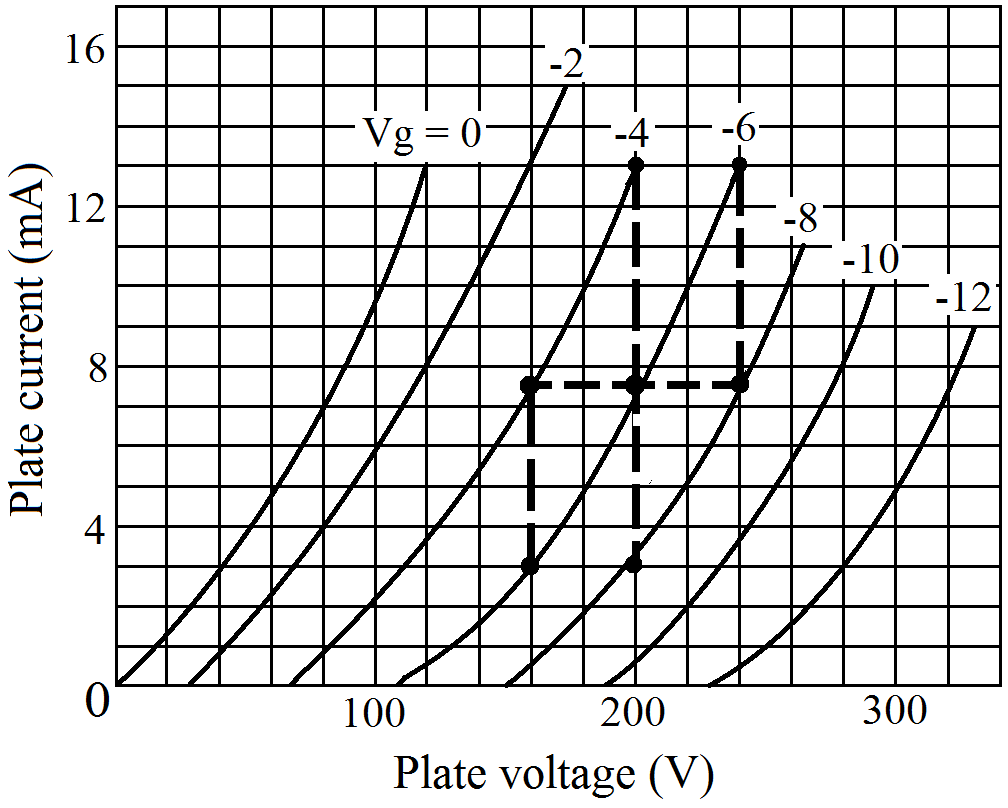
Find the values of $\text{r}_\text{p},\ \mu$ and $\text{g}_\text{m}$ of a triode operating at plate voltage 200V and grid voltage -6. The plate characteristics are shown in the figure.
Read the passage given below and answer the following questions from 1 to 5. The proportional region within the elastic limit of the stress-strain curve is of great importance for structural and manufacturing engineering designs. The ratio of stress and strain, called modulus of elasticity, is found to be a characteristic of the material. Experimental observation show that for a given material, the magnitude of the strain produced is same whether the stress is tensile or compressive. The ratio of tensile (or compressive) stress $(\sigma)$ to the longitudinal strain $(\in)$ is defined as Young’s modulus and is denoted by the symbol Y. $\text{Y}=\frac{\sigma}{\in}$ Since strain is a dimensionless quantity, the unit of Young’s modulus is the same as that of stress i.e., $N-m^{-2}$ or Pascal (Pa). As steel has more modulus of elasticity than copper brass and aluminum hence steel is preferred in heavy-duty machines and in structural designs. Wood, bone, concrete and glass have rather small Young’s moduli. Answer the following.
  1. If stress strain changes then young’s modulus is:
  1. Also changes.
  2. Remains constant.
  3. Either changes or remains constant depends on amount of stress and strain.
  4. None of these.
  1. SI unit of young’s modulus is:
  1. $N-m^{-2}​​​​​​​$
  2. Pascal (Pa).
  3. $N-m^{-2}​​​​​​​$​​​​​​​ or Pascal (Pa).
  4. None of these
  1. Which of the following is more elastic
  1. Aluminum
  2. Steel
  3. Wood
  4. Glass
  1. Defines young’s modulus. Give its SI unit and dimensions.
  1. Why steel is more preferred in heavy industries than copper and brass?
Read the passage given below and answer the following questions from 1 to 5 . Radius of gyration: The radius of gyration of a body about an axis may be defined as the distance from the axis of a mass point whose mass is equal to the mass of the whole body and whose moment of inertia is equal to the moment of inertia of the body about the axis. the moment of inertia of a rigid body analogous to mass in linear motion and depends on the mass of the body, its shape and size; distribution of mass about the axis of rotation, and the position and orientation of the axis of rotation. Theorem of perpendicular axes It states that the moment of inertia of a planar body (lamina) about an axis perpendicular to its plane is equal to the sum of its moments of inertia about two perpendicular axes concurrent with perpendicular axis and lying in the plane of the body. If we consider a planar body, An axis perpendicular to the body through a point $O$ is taken as the $z$-axis. Two mutually perpendicular axes lying in the plane of the body and concurrent with $z$-axis, i.e., passing through $O$, are taken as the $x$ and $y$-axes. The theorem states that $|z=1 x+| y$. Theorem of parallel axes The moment of inertia of a body about any axis is equal to the sum of the moment of inertia of the body about a parallel axis passing through its centre of mass and the product of its mass and the square of the distance between the two parallel axes. $z$ and $z^{\prime}$ are two parallel axes, separated by a distance $a$. The zaxis passes through the centre of mass $O$ of the rigid body. Then according to the theorem of parallel axes $I _{z^{\prime}}= I _{ z }+$ $M a^2$ Where $I_z$ and $I_z^{\prime}$ are the moments of inertia of the body about the $z$ and $z C$ axes respectively, $M$ is the total mass of the body and a is the perpendicular distance between the two parallel axes.
  1. SI unit of radius of gyration:
  1. Metre (m)
  2. $M^2$
  3. $M^3​​​​​​​$​​​​​​​
  4. None of these
  1. Moment of inertia is analogous to:
  1. Mass
  2. Area
  3. Force
  4. None of these
  1. Define radius of gyration:
  1. State Theorem of perpendicular axes:
  1. State Theorem of parallel axes:
Read the passage given below and answer the following questions from (i) to (v). Maximum absolute error in the sum or difference of two quantities is equal to sum of the absolute error in the individual quantities, i.e. Z = A + B, then, $\pm\triangle\text{Z}=\pm\triangle\text{A}\pm\text{B}$ Maximum fractional error in a product or division of quantities is equal to the sum of fractional errors in the individual quantities i.e. AB or $\frac{\text{A}}{\text{B}},$ then, $\frac{\triangle\text{Z}}{\text{Z}}=\pm\frac{\triangle\text{A}}{\text{A}}+\frac{\triangle\text{B}}{\text{B}}$ Two resistors of resistances $\text{R}_1=100\pm3\Omega$ are connected (a) in series and (b) in parallel.
  1. The percentage error in the value of $R_1$ is:
  1. 3%
  2. 4%
  3. 6%
  4. 0.3%
  1. The fractional error in the value of $R_2$ is:
  1. $\frac{1}{40}$
  2. $\frac{1}{50}$
  3. $\frac{1}{100}$
  4. $\frac{1}{200}$
  1. Find the equivalent resistance of the series combination.
  1. $(250\pm7)\Omega$
  2. $(320\pm6)\Omega$
  3. $(300\pm7)\Omega$
  4. $(300\pm1)\Omega$
  1. The percentage error in equivalent resistance in series combination is:
  1. 2%
  2. 2.3%
  3. 2.5
  4. 3%
  1. Find the equivalent resistance of the parallel combination having error of $1.8\Omega.$
  1. $(66\pm1)\Omega$
  2. $(66.7\pm1.18)\Omega$
  3. $(66.3\pm2)\Omega$
  4. $(67\pm3)\Omega$
A deflection magnetometer is placed with its arms in north-south direction. How and where should a short magnet having $\frac{\text{M}}{\text{B}_\text{H}}=40\text{A-m}^2\text{T}$ be placed so that the needle can stay in any position?
A child has near point at 10cm. What is the maximum angular magnification the child can have with a convex lens of focal length 10cm?
When a glass capillary tube is dipped at one end in water, water rises in the tube. The gravitational potential energy is thus increased. Is it a violation of conservation of energy?
In one of the exercises to strengthen the wrist and fingers, a person squeezes and releases a soft rubber ball. Is the work done on the ball positive, negative or zero during compression? During expansion?
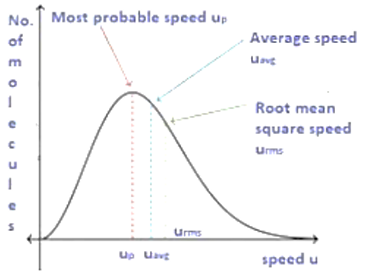
Root mean square velocity (RMS value)is the square root of the mean of squares of the velocity of individual gas molecules and the Average velocity is the arithmetic mean of the velocities of different molecules of a gas at a given temperature.
Image
1. Moon has no atmosphere because:
(a) the escape velocity of the moon’s surface is more than the r.m.s velocity of all molecules
(b) it is far away from the surface of the earth
(c) the r.m.s. velocity of all the gas molecules is more than the escape velocity of the moon’s surface
(d) its surface temperature is $10^{\circ} C$
2. For an ideal gas, $\frac{C_P}{C_V}$ is
(a) $\leq 1$    (b) none of these    (c) $>1$    (d) $<1$
3. The root means square velocity of hydrogen is $\sqrt{5}$ times that of nitrogen. If $T$ is the temperature of the gas then:
(a) $T\left(H_2\right)=T\left(N_2\right)$    (b) $T \left( H _2\right)< T \left( N _2\right)$
(c) $T \left( H _2\right) \neq T \left( N _2\right)$    (d) $T \left( H _2\right)> T \left( N _2\right)$
4. Suppose the temperature of the gas is tripled and $N _2$ molecules dissociate into an atom. Then what will be the rms speed of atom:
(a) $v_0 \sqrt{2}$    (b) $v_0 \sqrt{6}$    (c) $v_0 \sqrt{3}$    (d) $v_0$
OR
The velocities of the molecules are $v , 2 v , 3 v , 4 v \& 5 v$. The RMS speed will be:
(a) 11 v    (b) $v (12)^{11}$   (c) v    (d) $v (11)^{12}$
In a TV picture tube electrons are ejected from the cathode with negligible speed and reach a velocity of $5 \times 10^6 \mathrm{~m} / \mathrm{s}$ in travelling one centimeter. Assuming straight line motion, find the constant force exerted on the electron. The mass of the electron is $9.1 \times 10^{-31} \mathrm{~kg}$.