Question
$51$ terms of the $A.P$. whose second term is $2$ and fourth term is $8$.

Answer

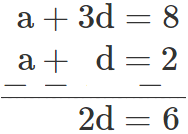
Given, $a_2 = 2$ and $a_4 = 8 a + d = 2 .....(i)$
$a + 3d = 8 .....(ii)$​​​​​​​

Put $d = 3 in .....(i)$
$\Rightarrow a + d = 2 a + 3 = 2 a = -1$
$\text{S}_{51}=\frac{51}{2}(2\times-1+(51-1)\times3)$
$\Big(\therefore\ \text{S}_\text{n}=\frac{\text{n}}{2}(2\text{a}+(\text{n}-1)\text{d})\Big)$
$=\frac{51}{2}(-2+50\times3)$
​​​​​​​ $=\frac{51}{2}\times148$
$=3774$ $\therefore\ \text{S}_{\text{n}}=3774$

Need a full question paper?

Generate a complete, print-ready paper with questions like this in minutes — across 16+ boards, with answer keys.
Start Generating Free

Similar questions

Find the $6^{th}$ term from the end of the AP 17, 14, 11, ...., (-40).
On a straight line passing through the foot of a tower, two points $C$ and $D$ are at distances of $4 m$ and $16 m$ from the foot respectively. If the angles of elevation from $C$ and $D$ of the top of the tower are complementary, then find the height of the tower.
The sum of the first n terms of an AP is given by $Sn = (3n^2 - n)$. Find its:
  1. $n^{th}$ term
  2. First term
  3. Common difference.
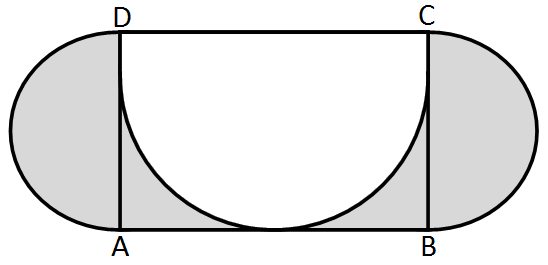
In the following figure, ABCD is a rectangle with AB = 14cm and BC = 7cm. Taking DC, BC and AD as diameters, three semi-circles are drawn as shown in the figure. Find the area of the shaded region.
The sum of the $5^{\text {th }}$ and the $7^{\text {th }}$ terms of an $A P$ is 52 and the $10^{\text {th }}$ term is 46 . Find the AP.
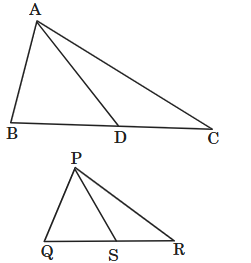
In the given figure $\triangle A B D \sim \triangle P Q S$ when $A D$ and $P S$ are medians. Prove that $\triangle A B C \sim \triangle P Q R$.
Image
A tree breaks due to storm and the broken part bends so that the top of the tree touches the ground making an angle $30^o$​​​​​​​ with it. The distance between the foot of the tree to the point where the top touches the ground is $8 \ m$. Find the height of the tree.
Verify that each of the following is an AP, and then write its next three terms: $0,\frac{1}{4},\frac{1}{2},\frac{3}{4},.....$
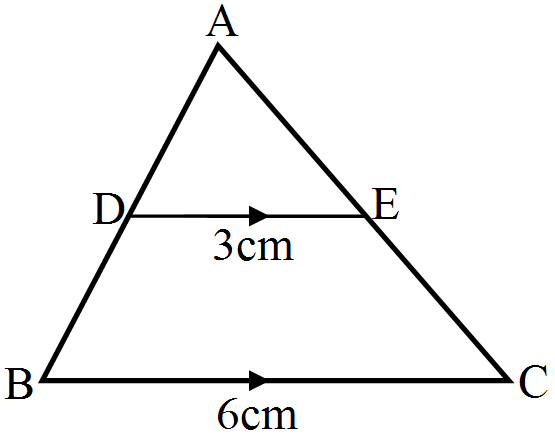
In the given figure, DE || BC. If DE = 3cm, BC = 6cm and $\text{ar}(\triangle\text{ADE})=15\text{cm}^2,$ find the area of $\triangle\text{ABC}.$
If the roots of the equation $(c^2 - ab)x^2 - 2(a^2 - bc)x + (b^2 - ac) = 0$ are real and equal, show that either a = 0 or $(a^3 + b^3 + c^3) = 3abc.$