MCQ
$6$ moles of an ideal gas expand isothermally and reversibly from a volume of $1$ litre to a volume of $10$ litres at $27\,^oC$. What is the maximum work done
  • A
    $47$ $kJ$
  • B
    $100$ $kJ$
  • C
    $0$ $kJ$
  • $34.465$ $kJ$

Answer

Correct option: D.
$34.465$ $kJ$
d
Workdone in isothermal reversible expansion $\mathrm{W}=\mathrm{P} \Delta \mathrm{V}$

$\mathrm{W}=-2.303 \,\mathrm{nRT} \log \frac{\mathrm{V}_{2}}{\mathrm{V}_{1}}$

$=-2.303 \times 6 \times 8.314 \times 300 \log \frac{10}{1}$

$=34464.8$ $Joule$ $=34.465\, \mathrm{kJ}$

Need a full question paper?

Generate a complete, print-ready paper with questions like this in minutes — across 16+ boards, with answer keys.

Start Generating Free

Similar questions

Non-oxide ceramics can be
A precipitate of $CaF_2$ $(K_{SP} = 1.7 \times 10^{-10})$ will be obtained when equal volume of the following are mixed
In Bohr series of lines of hydrogen spectrum, the third line from the red end corresponds to which one of the following inter-orbit in an atom of hydrogen
Incorrect stability order comparison for resonating structures are
$N_2H_4 + IO_3^-+ 2H^+ + Cl^-\to  ICl + N_2 + 3H_2O$ What is the equivalent weight of reductant in the above reaction
The equilibrium constant of the reaction ${H_2}_{(g)} + {I_2}_{(g)}$ $\rightleftharpoons$ $2HI_{(g)}$ is $64$. If the volume of the container is reduced to one fourth of its original volume, the value of the equilibrium constant will be
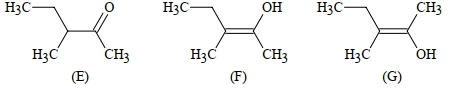
The correct statement $(s)$ concerning the structures $E, F$ and $G$ is (are) $Image$

$(A)$ $E, F$ and $\mathrm{G}$ are resonance structures

$(B)$ $E, F$ and $E, G$ are tautomers

$(C)$ $\mathrm{F}$ and $\mathrm{G}$ are geometrical isomers

$(D)$ $\mathrm{F}$ and $\mathrm{G}$ are diasteromers
In the reaction between copper nitrate solution and zinc, copper ions are reduced by gaining electrons from :
Assertion : Carbanions like ammonia have pyramidal shape.

Reason : The carbon atom carrying negative charge has an octet of electrons.

Equilibrium constant $(K_c)$ of $2HI_{(g)}  \rightleftharpoons  H_{2(g)} + I_{2(g)}$ is $5\times10^3$. What is the equilibrium concentration of $HI$, if equilibrium concentrations of $H_{2(g)}$ and $I_{2(g)}$ respectively are $2.2\times10^{-2}\, M$ and $2.2\times10^{-4}\, M$ ?