Question
Image

Answer


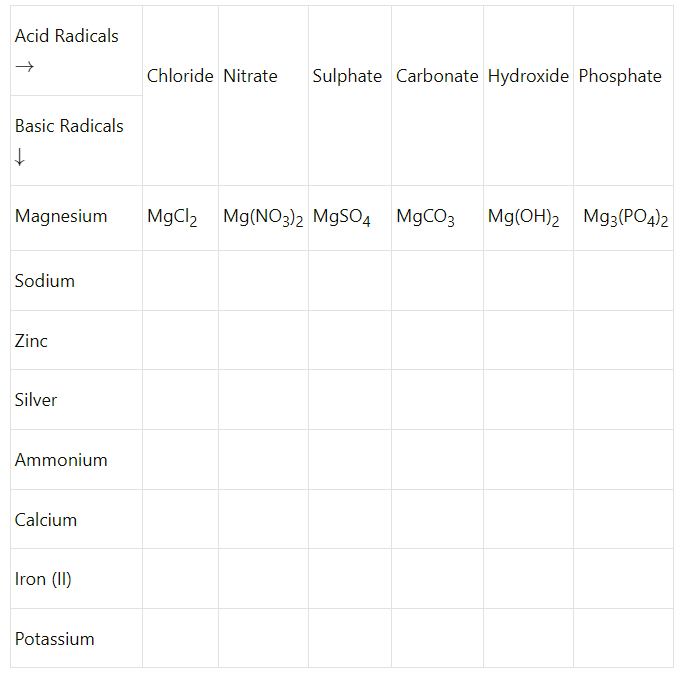
Acid Radicals `→`


Chloride


Nitrate


Sulphate


Carbonate


Hydroxide


Phosphate

Basic Radicals `↓`

Sodium

$NaCl$

$NaNO_3$

$Na_2SO_4$

$Na_2CO_3$

$NaOH$

$Na_3PO_4$

Zinc

$ZnCl_2$

$Zn(NO_3)_2$

$Zn(SO_4)$

$ZnCO_3$

$Zn(OH)_2$

$Zn_3(PO_4)_2$

Silver

$AgCl

$AgNO_3$

$Ag_2SO_4$

$Ag_2CO_3$

$AgOH$

$Ag_3PO_4$

Ammonium

$NH_4Cl$

$NH_4NO_3$

$(NH_4)_2SO_4$

$(NH_4)_2CO_3$

$NH_4OH$

$(NH)_3PO_4$

Calcium

$CaCl_2$

$Ca(NO_3)_2$

$CaSO_4$

$CaCO_3$

$Ca(OH)_2$

$Ca_3(PO_4)_2$

Iron (II)

$FeCl_2$

$Fe(NO_3)_2$
$FeSO_4$ $FeCO_3$
$Fe(OH)_2$

$Fe_3(PO_4)_2$

Potassium

$KCl$

$KNO_3$

$K_2SO_4$

$K_2CO_3$

$KOH$

$K_3PO_4$

Need a full question paper?

Generate a complete, print-ready paper with questions like this in minutes — across 16+ boards, with answer keys.

Start Generating Free

Similar questions

Match column A with column B.

Column A

Column B

(a) Element short by 1 electron in octet

(i) Transition elements

(b) Highly reactive metals

(ii) Noble gases

(c) Non-reactive elements

(iii) Alkali metals

(d) Elements of groups 3 to 12

(iv) Alkaline earth metals

(e) Radioactive elements

(v) Halogens

(f) Elements with 2 electrons in the outermost orbit

(vi)Actinides

Give the composition, causes, and effects of acid rain.
Two elements $P$ and $Q$ belong to the same period of the modern periodic table and are in group $1$ and group $2$, respectively. Compare the following characteristics in the tabular form.
  1. Number of electrons in their atoms
  2. Their tendency to lose electrons
  3. Their metallic characters
  4. Formation of their oxides
  5. Formulae of their chlorides
How do the oxides of nitrogen enter the atmosphere?
A given amount of gas A is confined in a chamber of constant volume. When the chamber is immersed in a bath of melting ice, the pressure of the gas is 100cmHg.
  1. What is the temperature when the pressure is 10cmHg?
  2. What will be the pressure when the chamber is brought to 100°C
Match the atomic numbers 4, 14, 8, 15 and 19 with each of the following:
  1. A solid non-metal of valency 3.
  2. A gas of valency 2.
  3. A metal of valency 1.
  4. A non-metal of valency 4.
A gas at 240 K is heated to 127°C. Find the percentage change in the volume of the gas (pressure remaining constant).
When hydrogen is passed over a black solid compound A, the products are a 'colorless liquid' and a 'reddish-brown metal B'.
Substance B is divided into two parts each placed in separate test tubes.
Dilute HCl is added to one part of substance B and dilute $HNO_3$ to the other.
  1. Name the substances A and B.
  2. Give two tests for the colourless liquid formed in the experiment.
  3. What happens to substance A when it reacts with hydrogen? Give reasons for your answer.
  4. Write an equation for the reaction between hydrogen and substance A.
  5. Is there any reaction between substance B and dilute hydrochloric acid? Give reasons for your answer.
What are green house gases? How are they responsible for global warming?
Describe the major air pollutants. How does carbon monoxide pollute our environment?