A $0.1 \mathrm{~kg}$ mass is suspended from a wire of negligible mass. The length of the wire is $1 \mathrm{~m}$ and its crosssectional area is $4.9 \times 10^{-7} \mathrm{~m}^2$. If the mass is pulled a little in the vertically downward direction and released, it performs simple harmonic motion of angular frequency $140 \ \mathrm{rad} \mathrm{s}^{-1}$. If the Young's modulus of the material of the wire is $\mathrm{n} \times 10^9 \mathrm{Nm}^{-2}$, the value of $\mathrm{n}$ is
IIT 2010, Advanced


Download our appand get started for free
Experience the future of education. Simply download our apps or reach out to us for more information. Let's shape the future of learning together!No signup needed.*
Similar Questions
- 1The area of cross section of a steel wire $(Y = 2.0 \times {10^{11}}N/{m^2})$ is $0.1\;c{m^2}$. The force required to double its length will beView Solution
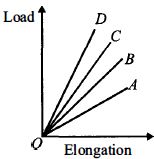
- 2View SolutionThe load versus elongation graphs for four wires of same length and made of the same material are shown in the figure. The thinnest wire is represented by the line
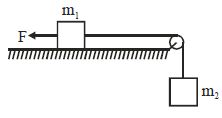
- 3Consider the situation shown in figure. The force $F$ is equal to the $m_2g/2.$ If the area of cross-section of the string is $A$ and its Young's modulus $Y$, find the strain developed in it. The string is light and there is no friction anywhereView Solution
- 4View SolutionThe isothermal bulk modulus of a gas at atmospheric pressure is
- 5If $x$ longitudinal strain is produced in a wire of Young's modulus $y,$ then energy stored in the material of the wire per unit volume isView Solution
- 6View SolutionMinimum and maximum values of Poisson’s ratio for a metal lies between
- 7View SolutionWhen strain is produced in a body within elastic limit, its internal energy
- 8A stress of $1.5\,kg.wt/mm^2$ is applied to a wire of Young's modulus $5 \times 10^{11}\,N/m^2$ . The percentage increase in its length isView Solution
- 9Consider a thin square plate floating on a viscous liquid in a large tank. The height $h$ of the liquid in the tank is much less than the width of the tank. The floating plate is pulled horizontally with a constant velocity $u_0$. Which of the following statements is (are) true?View Solution
$(A)$ The resistive force of liquid on the plate is inversely proportional to $h$
$(B)$ The resistive force of liquid on the plate is independent of the area of the plate
$(C)$ The tangential (shear) stress on the floor of the tank increases with $u _0$
$(D)$ The tangential (shear) stress on the plate varies linearly with the viscosity $\eta$ of the liquid
- 10A wire can be broken by applying a load of $200\, N$. The force required to break another wire of the same length and same material, but double in diameter, is .......... $N$View Solution