Minimum and maximum values of Poisson’s ratio for a metal lies between
Easy


Download our appand get started for free
Experience the future of education. Simply download our apps or reach out to us for more information. Let's shape the future of learning together!No signup needed.*
Similar Questions
- 1The proportional limit of steel is $8 \times 10^8 \,N / m ^2$ and its Young's modulus is $2 \times 10^{11} \,N / m ^2$. The maximum elongation, a one metre long steel wire can be given without exceeding the elastic limit is $......mm$View Solution
- 2View SolutionTwo identical wires of rubber and iron are stretched by the same weight, then the number of atoms in the iron wire will be
- 3The area of a cross-section of steel wire is $0.1\,\,cm^2$ and Young's modulus of steel is $2\,\times \,10^{11}\,\,N\,\,m^{-2}.$ The force required to stretch by $0.1\%$ of its length is ......... $N$.View Solution
- 4As shown in the figure, forces of $10^5\,N$ each are applied in opposite directions, on the upper and lower faces of a cube of side $10\,cm$, shifting the upper face parallel to itself by $0.5\,cm$ . If the side of another cube of the same material is, $20\,cm$ then under similar conditions as above, the displacement will be......... $cm$View Solution
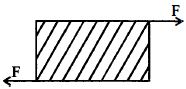
- 5The ratio of lengths of two rods $A$ and $B$ of same material is $1 : 2$ and the ratio of their radii is $2 : 1$, then the ratio of modulus of rigidity of $A$ and $B$ will beView Solution
- 6If $\rho $ is the density of the material of a wire and $\sigma $ is breaking stress, the greatest length of the wire that can hang freely without breaking isView Solution
- 7A uniform metallic wire is elongated by $0.04\, m$ when subjected to a linear force $F$. The elongation, if its length and diameter is doubled and subjected to the same force will be ..... $cm .$View Solution
- 8View SolutionThe following four wires are made of same material. Which one will have the largest elongation when subjected to the same tension ?
- 9View SolutionLiquids have no Poisson's ratio, because
- 10If the potential energy of a spring is $V$ on stretching it by $2\, cm$, then its potential energy when it is stretched by $10 \,cm$ will beView Solution