MCQ
A $0.1\,N $ solution of an acid at room temperature has a degree of ionisation $ 0.1$ . The concentration of $O{H^ - }$ would be
  • ${10^{ - 12}}\,M$
  • B
    ${10^{ - 11}}\,M$
  • C
    ${10^{ - 9}}\,M$
  • D
    ${10^{ - 2}}\,M$

Answer

Correct option: A.
${10^{ - 12}}\,M$
(a) $[{H^ + }] = C \times \alpha = 0.1 \times 0.1 = {10^{ - 2}}\,M$

$pH = 2; pOH = 12 $ ; $[O{H^ - }] = {10^{ - 12}}\,M$.

Need a full question paper?

Generate a complete, print-ready paper with questions like this in minutes — across 16+ boards, with answer keys.

Start Generating Free

Similar questions

Keto-enol tautomerism is found in
An electron is moving in Bohr's fourth orbit. Its de $-$ Broglie wavelength is $2$. Calculate the circumference of the fourth orbit.
Carbon tetrachloride has no net dipole moment because of
For the following reactions the major products are shown 

${H_2}C = CH - CH = C{H_2}\xrightarrow[{0{\,^o}C}]{{HBr}}$ $\begin{array}{*{20}{c}}
  {{H_2}C = CH - CH - C{H_3}} \\ 
  {\,\,\,\,\,\,\,\,\,\,\,|} \\ 
  {\,\,\,\,\,\,\,\,\,\,\,\,\,\,\,\,\,\,\,Br\,\,\,\,\,\,} 
\end{array}\xrightarrow{{ + 25{\,^o}C}}$ $\begin{array}{*{20}{c}}
  {C{H_2}CH = CHC{H_3}} \\ 
  {|\,\,\,\,\,\,\,\,\,\,\,\,\,\,\,\,\,\,\,\,\,\,\,\,\,\,\,\,\,\,\,\,\,\,\,\,\,\,\,} \\ 
  {Br\,\,\,\,\,\,\,\,\,\,\,\,\,\,\,\,\,\,\,\,\,\,\,\,\,\,\,\,\,\,\,\,\,\,\,\,} 
\end{array}$

These provide an example of  $......1......$ control at low temperature and $......2......$  control at higher temperature
The number of unpaired electrons in carbon atom in excited state is
How many molecules of $H _2 O$ are present in one litre water?
$IUPAC$ name of the given compound is ?
$(CH_3)_3CCH=CHC_6H_4Br-p$
Which compound is $2, 2, 3-$ trimethylhexane
The value of $'h\ ' = 6.63 \times 10^{-34}$ Js. The speed of light is $3 \times 10^{17}nm/ s^{-1}$. Which value is closer to the wavelength in nanometer of a quantum of light with frequency $6 \times 10^{15} s^{-1}$.
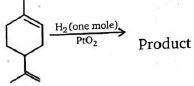
In polyenes that contain differently substituted $(C=C)$ double bonds, it is  possible to hydrogenate chemeselectively one $(C=C)$ double bond. Product is