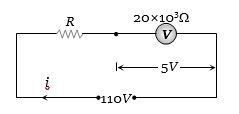
A $100\, V$ voltmeter of internal resistance $20\,k\Omega $ in series with a high resistance $R$ is connected to a $110\, V$ line. The voltmeter reads $5\, V$, the value of $R$ is ................ $k \Omega $
Medium


Download our appand get started for free
Experience the future of education. Simply download our apps or reach out to us for more information. Let's shape the future of learning together!No signup needed.*
Similar Questions
- 1A flow of $10^{7}$ electrons per second in a conducting wire constitutes a current ofView Solution
- 2A potentiometer wire has length $10\, m$ and resistance $20\,\Omega $. A $2. 5\, V$ battery of negligible internal resistance is connected across the wire with an $80\,\Omega $ series resistance. The potential gradient on the wire will beView Solution
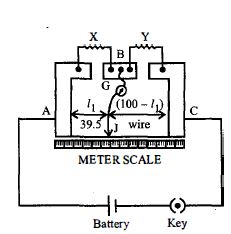
- 3In a meter bridge, as shown in the figure, it is given that resistance $Y=12.5\, \Omega $ and that the balance is obtained at a distance $39.5\, cm$ from end $A$ (by jockey $J$) . After interchanging the resistances $X$ and $Y$, a new balance point is found at a distance $l_2$ from end $A$. What are the values of $X$and $l_2$ ?View Solution
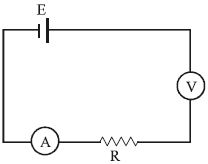
- 4Assertion : All electric devices shown in the circuit are ideal. The reading of each of ammeter $(a)$ and voltmeter $(V)$ is zero.View Solution
Reason : An ideal voltmeter draws almost no current due to very large resistance, and hence $(V)$ and $(a)$ will read zero.
- 5$STATEMENT-1$ In a Meter Bridge experiment, null point for an unknown resistance is measured. Now, the unknown resistance is put inside an enclosure maintained at a higher temperature. The null point can be obtained at the same point as before by decreasing the value of the standard resistance. andView Solution
$STATEMENT-2$ Resistance of a metal increases with increase in temperature.
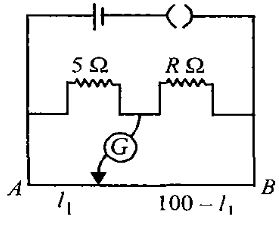
- 6The resistances in the two arms of the meter bridge are $5 \,\Omega$ and $R \,\Omega$ respectively. When the resistance $R$ is shunted with an equal resistance, the new balance point is at $1.6\,l_1$. The resistance $R$ is .................. $\Omega$View Solution
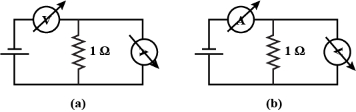
- 7A student uses the resistance of a known resistor $(1 \,\Omega)$ to calibrate a voltmeter and an ammeter using the circuits shown below. The student measures the ratio of the voltage to current to be $1 \times 10^3 \,\Omega$ in circuit $(a)$ and $0.999 \,\Omega$ in circuit $(b)$. From these measurements, the resistance (in $\Omega$ ) of the voltmeter and ammeter are found to be close toView Solution
- 8Eight copper wire of length $l$ and diameter $d$ are joined in parallel to form a single composite conductor of resistance $R$. If a single copper wire of length $2\,l$ have the same resistance $(R)$ then its diameter will be $.....d$.View Solution
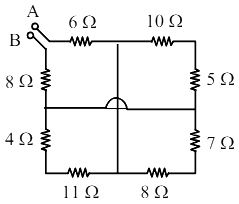
- 9The equivalent resistance between $A$ and $B$ is:View Solution
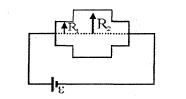
- 10A cylindrical resistance is connected across battery $\varepsilon $ . Cylinder has uniform free electron density, mid part of cylinder has larger radius as shown in figure. Then $V_d$ (drift velocity) $V/S$ (distance across the length of the resistance)View Solution