A $100\, watt$ bulb working on $200 \,volt$ and a $200\, watt$ bulb working on $100\, volt$ have
Medium
Download our app for free and get started
(b) $R = \frac{{{V^2}}}{P}$ $ \Rightarrow $ ${R_1} = \frac{{200 \times 200}}{{100}} = 400\,\Omega $ and
${R_2} = \frac{{100 \times 100}}{{200}} = 50\,\Omega .$ Maximum current rating $i = \frac{P}{V}$
So ${i_1} = \frac{{100}}{{200}}$ and ${i_2} = \frac{{200}}{{100}}$$ \Rightarrow $ $\frac{{{i_1}}}{{{i_2}}} = \frac{1}{4}$.
${R_2} = \frac{{100 \times 100}}{{200}} = 50\,\Omega .$ Maximum current rating $i = \frac{P}{V}$
So ${i_1} = \frac{{100}}{{200}}$ and ${i_2} = \frac{{200}}{{100}}$$ \Rightarrow $ $\frac{{{i_1}}}{{{i_2}}} = \frac{1}{4}$.

Download our appand get started for free
Experience the future of education. Simply download our apps or reach out to us for more information. Let's shape the future of learning together!No signup needed.*
Similar Questions
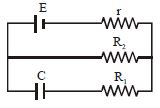
- 1In the given figure each plate of capacitance $C$ has partial value of chargeView Solution
- 2Two uniform wires $A$ and $B$ are of the same metal and have equal masses. The radius of wire $A$ is twice that of wire $B$. The total resistance of A and $B$ when connected in parallel isView Solution
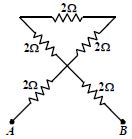
- 3For the circuit shown in the figure , the equivalent resistance between $A$ and $B$ is ............. $\Omega$View Solution
- 4A null point is found at $200\,cm$ in potentiometer when cell in secondary circuit is shunted by $5\,\Omega$. When a resistance of $15\,\Omega$ is used for shunting null point moves to $300\,cm$. The internal resistance of the cell is $..............\,\Omega$.View Solution
- 5A cylindrical conductor has uniform cross-section. Resistivity of its material increase linearly from left end to right end. If a constant current is flowing through it and at a section distance $x$ from left end, magnitude of electric field intensity is $E$, which of the following graphs is correctView Solution
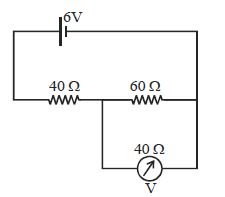
- 6The reading of voltmeter in the circuit shown is ............. $V$View Solution
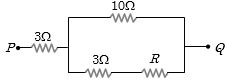
- 7In the circuit shown here, what is the value of the unknown resistor $R$ so that the total resistance of the circuit between points $P$ and $Q$ is also equal to $R$View Solution
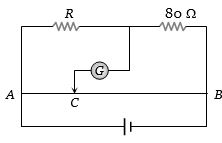
- 8$AB$ is a wire of uniform resistance. The galvanometer $G$ shows no current when the length $AC = 20\,cm$ and $CB = 80\, cm$. The resistance $R$ is equal to .............. $\Omega $View Solution
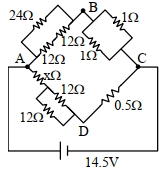
- 9The value of unknown resistance $(x)$ for which the potential difference between $B$ and $D$ will be zero in the arrangement shown, is:View Solution
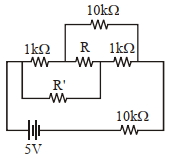
- 10When the resistance $R$ (indicated in the figure below) is changed from $1 \,k \Omega$. to $10 \,k \Omega$, the current flowing through the resistance $R'$ does not change. What is the value of the resistor $R'?$View Solution