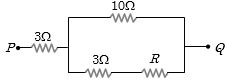
In the circuit shown here, what is the value of the unknown resistor $R$ so that the total resistance of the circuit between points $P$ and $Q$ is also equal to $R$
Medium
Download our app for free and get started
The given circuit can be simplified as follows
$R = 3 + \frac{{10 \times (3 + R)}}{{10 + 3 + R}}$ $ = 3 + \frac{{30 + 10R}}{{13 + R}}$
$R = \frac{{39 + 3R + 30 + 10R}}{{13 + R}} = \frac{{69 + 13R}}{{13 + R}}$
$13R + {R^2} = 69 + 13R$ $ \Rightarrow $ $R = \sqrt {69}\, \Omega $.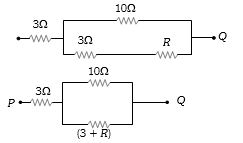

Download our appand get started for free
Experience the future of education. Simply download our apps or reach out to us for more information. Let's shape the future of learning together!No signup needed.*
Similar Questions
- 1View SolutionThe internal resistance of a cell depends on
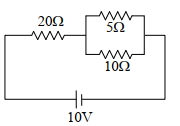
- 2The ratio of heat dissipated per second through the resistance $5 \Omega$ and $10 \Omega$ in the circuit given below is: :View Solution
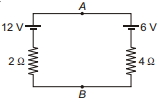
- 3Potential difference across $A B$ i.e., $V_A-V_B$ is ......... $V$View Solution
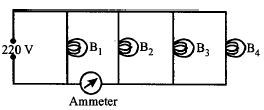
- 4Four bulbs $B_1 , B_2, B_3$ and $B_4$ of $100\, W$ each are connected to $220\, V$ main as shown in the figure. The reading in an ideal ammeter will be ............... $A$View Solution
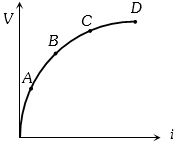
- 5Variation of current passing through a conductor as the voltage applied across its ends as varied is shown in the adjoining diagram. If the resistance $(R)$ is determined at the points $A$, $B$, $C$ and $D$, we will find thatView Solution
- 6An electron (charge $= 1.6 × 10^{-19}$ coulomb) is moving in a circle of radius $5.1 × 10^{-11}\,m$ at a frequency of $6.8 × 10^{15} $ revolutions/sec. The equivalent current is approximatelyView Solution
- 7A potentiometer wire has length $10\, m$ and resistance $20\,\Omega $. A $2. 5\, V$ battery of negligible internal resistance is connected across the wire with an $80\,\Omega $ series resistance. The potential gradient on the wire will beView Solution
- 8Two resistors of resistance, $100\,\Omega$ and $200\,\Omega$ are connected in parallel in an electrical circuit. The ratio of the thermal energy developed in $100\,\Omega$ to that in $200\,\Omega$ in a given time is:View Solution
- 9View SolutionIn meter bridge or Wheatstone bridge for measurement of resistance, the known and the unknown resistances are interchanged. The error so removed is
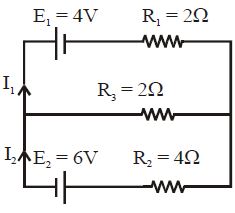
- 10In the circuit shown : $E_1 = 4.0\ V, R_1 = 2 \ \Omega,$$ E_2 = 6.0\ V, R_2 = 4\ \Omega$ and $R_3 = 2\ \Omega.$ The current $I_1$ is : ................ $A$View Solution