A $10\,\mu F$ capacitor is charged to a potential difference of $50\;V$ and is connected to another uncharged capacitor in parallel. Now the common potential difference becomes $20\;volt$. The capacitance of second capacitor is....$\mu F$
Medium
Download our app for free and get started
(d) $V = \frac{{{C_1}{V_1} + {C_2}{V_2}}}{{{C_1} + {C_2}}}$ $==>$ $20 = \frac{{10 \times 50 + {C_2} \times 0}}{{10 + {C_2}}}$
$==>$ $200 + 20{C_2} = 500$ $==>$ ${C_2} = 15\,\mu F$
$==>$ $200 + 20{C_2} = 500$ $==>$ ${C_2} = 15\,\mu F$

Download our appand get started for free
Experience the future of education. Simply download our apps or reach out to us for more information. Let's shape the future of learning together!No signup needed.*
Similar Questions
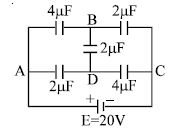
- 1The figure shows a diagonal symmetric arrangement of capacitors and a battery. If the potential of $C$ is zero, thenView Solution
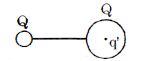
- 2Two conducting hollow sphere of radius $R$ and $3R$ are found to have $Q$ charge on outer surface when both are connected with a long wire and $q'$ charge is kept at the centre of bigger sphere. Then which one is trueView Solution
- 3View SolutionThe energy of a charged capacitor resides in
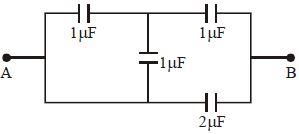
- 4The equivalent capacitance between points $A$ and $B$ of the circuit shown will beView Solution
- 5There is a uniform spherically symmetric surface charge density at a distance $R_0$ from the origin. The charge distribution is initially at rest and starts expanding because of mutual repulsion. The figure that represents best the speed $V(R(t))$ of the distribution as a function of its instantaneous radius $R(t)$ isView Solution
- 6A parallel plate capacitor of capacitance $90\ pF$ is connected to a battery of $emf$ $20\ V$. If a dielectric material of dielectric constant $K = \frac{5}{3}$ is inserted between the plates, the magnitude of the induced charge will be.......$n $ $C$View Solution
- 7View SolutionThe potential gradient is a
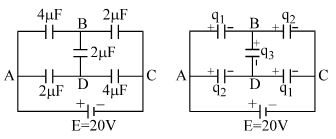
- 8The value of charge $q_1, q_2$ and $q_3$ as shown in the figure areView Solution
- 9View SolutionA parallel plate capacitor is charged to a certain potential and the charging battery is then disconnected. Now, if the plates of the capacitor are moved apart then:
- 10A molecule of a substance has permanent dipole moment $p$. A mole of this substance is polarised by applying a strong electrostatic field $E$. The direction of the field is suddenly changed by an angle of $60^{\circ} .$ If $N$ is the Avogadro's number the amount of work done by the field isView Solution