A parallel plate capacitor is charged to a certain potential and the charging battery is then disconnected. Now, if the plates of the capacitor are moved apart then:
Medium
Download our app for free and get started
When a capacitor is charged and then disconnect battery, first the capacitance will remain constant and then slowly discharge according to time constant.
The potential between the plates is $V=\frac{q d}{A \epsilon_{0}},$ so when increasing the between plate, the voltage will increase.
The energy stored in capacitor is $W=\frac{1}{2} C V^{2} .$ Thus, the electrostatic energy stored in the
capacitor also increases.

Download our appand get started for free
Experience the future of education. Simply download our apps or reach out to us for more information. Let's shape the future of learning together!No signup needed.*
Similar Questions
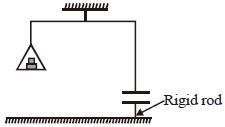
- 1The lower plate of a parallel plate capacitor is supported on a rigid rod. The upper plate is suspended from one end of a balance. The two plates are joined together by a thin wire and subsequently disconnected. The balance is then counterpoised. Now a voltage $V = 5000\, volt$ is applied between the plates. The distance between the plates is $d =5\, mm$ and the area of each plate is $A = 100 cm^2.$ Then find out the additional mass placed to maintain balance.......$g$ [All the elements other than plates are massless and nonconducting] :-View Solution
- 2$N$ identical spherical drops charged to the same potential $V$ are combined to form a big drop. The potential of the new drop will beView Solution
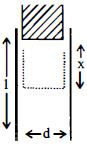
- 3A parallel plate capacitor is made of two plates of length $l$, width $w$ and separated by distance $d$. A dielectric slab ( dielectric constant $K$) that fits exactly between the plates is held near the edge of the plates. It is pulled into the capacitor by a force $F = -\frac{{\partial U}}{{\partial x}}$ where $U$ is the energy of the capacitor when dielectric is inside the capacitor up to distance $x$ (See figure). If the charge on the capacitor is $Q$ then the force on the dielectric when it is near the edge isView Solution
- 4Two charged particles of masses $m$ and $2m$ have charges $+2q$ and $+q$ respectively. They are kept in uniform electric field and allowed to move for some time. The ratio of their kinetic energies will beView Solution
- 5The capacity of a parallel plate condenser is $10\,\mu \,F$, when the distance between its plates is $8 \,cm$. If the distance between the plates is reduced to $4\, cm$, then the capacity of this parallel plate condenser will be.........$\mu \,F$View Solution
- 6Capacitance of an isolated conducting sphere of radius $R_{1}$ becomes $n$ times when it is enclosed by a concentric conducting sphere of radius $R_{2}$ connected to earth. The ratio of their radii $\left(\frac{ R _{2}}{ R _{1}}\right)$ is:View Solution
- 7The potentials of the two plates of capacitor are $+10\,V$ and $-10\, V$. The charge on one of the plates is $40 \,C$. The capacitance of the capacitor is........$F$View Solution
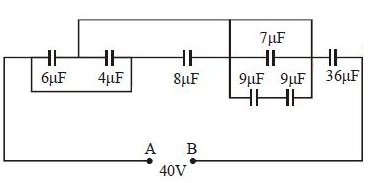
- 8In the following diagram, the charge and potential difference across $8\, \mu F$ capacitance will be nearlyView Solution
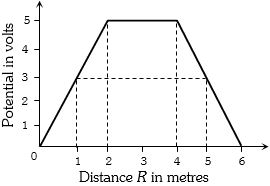
- 9The variation of potential with distance $R$ from a fixed point is as shown below. The electric field at $R = 5\,m$ is......$volt/m$View Solution
- 10A force $F$ acts between sodium and chlorine ions of salt (sodium chloride) when put $1\,cm$ apart in air. The permittivity of air and dielectric constant of water are ${\varepsilon _0}$ and $K$ respectively. When a piece of salt is put in water electrical force acting between sodium and chlorine ions $1\,cm$ apart isView Solution