MCQ
A $12 \,m$ long vibrating string has the speed of wave $48 \,m / s$. To what frequency it will resonate ........... $cps$
  • A
    $2$
  • B
    $4$
  • C
    $6$
  • All of these

Answer

Correct option: D.
All of these
d
(d)

$v=48 \,m / s , l=12 \,m , f=\frac{n v}{2 l}$

$f=2 n$ (where $n=1,2,3 \ldots$. )

Hence answer is $(d)$.

Need a full question paper?

Generate a complete, print-ready paper with questions like this in minutes — across 16+ boards, with answer keys.

Start Generating Free

Similar questions

A body, acted upon by a force of $50 \,N$ is displaced through a distance $10$ meter in a direction making an angle of $60^°$ with the force. The work done by the force be ..........$J$
A boy standing at the top of a tower of $20\, m$ height drops a stone . Assuming $g = 10 \,ms^{-2,}$ the velocity with which it hits the ground is.........$ms^{-1}$
The unit of $L/R$ is (where $L$ = inductance and $R$ = resistance)
The mass and volume of a body are $4.237g$ and $2.5 \mathrm{~cm}^3$, respectively. The density of the material of the body in correct significant figures is:
A carnot engine with its cold body at $17\,^oC$ has $50\%$ effficiency. If the temperature of its hot body is now increased by $145\,^oC$, the efficiency becomes...... $\%$
A particle moves along an arc of a circle of radius $R$ . Its velocity depends on the distance covered as $v = a\sqrt s$ , where $a$ is a constant then the angle $\alpha $ between the vector of the total acceleration and the vector of velocity as a function of $s$ will be
A particle is moving with uniform speed along the circumference of a circle of radius $R$ under the action of a central fictitious force $F$ which is inversely proportional to $R ^{3}$. Its time period of revolution will be given by
In an isothermal process on an ideal gas, the pressure increases by 0.5%. The volume decreases by about
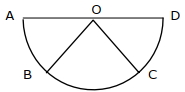
Assertion $A$ : If $A, B, C, D$ are four points on a semi-circular arc with centre at $'O'$ such that $|\overrightarrow{{AB}}|=|\overrightarrow{{BC}}|=|\overrightarrow{{CD}}|$, then $\overrightarrow{{AB}}+\overrightarrow{{AC}}+\overrightarrow{{AD}}=4 \overrightarrow{{AO}}+\overrightarrow{{OB}}+\overrightarrow{{OC}}$

Reason $R$ : Polygon law of vector addition yields $\overrightarrow{A B}+\overrightarrow{B C}+\overrightarrow{C D}+\overrightarrow{A D}=2 \overrightarrow{A O}$

In the light of the above statements, choose the most appropriate answer from the options given below
One projectile moving with velocity $v$ in space, gets burst into $2$ parts of masses in the ratio $1 : 3$ . The smaller part becomes stationary. What is the velocity of the other part ?