MCQ
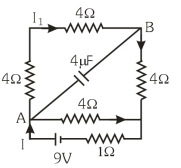
A $16\  \Omega$ wire is bend to form a square loop. A $9 \mathrm{~V}$ battery with internal resistance $1\  \Omega$ is connected across one of its sides. If a $4\  \mu \mathrm{F}$ capacitor is connected across one of its diagonals, the energy stored by the capacitor will be $\frac{x}{2} \ \mu \mathrm{J}$. where $x=$________.
  • A
    $52$
  • B
    $42$
  • $81$
  • D
    $12$

Answer

Correct option: C.
$81$
c
$ I=\frac{V}{R_{e q}} I=\frac{V}{R_{e q}}=\frac{9}{1+\frac{12 \times 4}{12+4}}=\frac{9}{4} $

$ I_1=\frac{9}{4} \times \frac{4}{16}=\frac{9}{16} $

$ V_A-V_B=I_1 \times 8=\frac{9}{16} \times 8=\frac{9}{2} V $

$ \therefore U=\frac{1}{2} \times 4 \times \frac{81}{4} \mu \mathrm{J} $

$ \therefore U=\frac{81}{2} \mu \mathrm{J} $

$ \therefore \mathrm{X}=81$

Need a full question paper?

Generate a complete, print-ready paper with questions like this in minutes — across 16+ boards, with answer keys.

Start Generating Free

Similar questions

A hall has the dimensions $10\,m \times 12\,m \times 14\,m.$A fly starting at one corner ends up at a diametrically opposite corner. What is the magnitude of its displacement...........$m$
If a body moving in circular path maintains constant speed of $10\ ms^{-1},$ then which of the following correctly describes relation between acceleration and radius ?
$A$ lateral object of height $0.5\, cm$ is placed on the optical axis of bi-convex lens of focal length $80\,cm$, at an object distance $= 60\, cm$.The image formed is :
The pressure and volume of an ideal gas are related as $\mathrm{PV}^{3 / 2}=\mathrm{K}$ (Constant). The work done when the gas is taken from state $A\left(P_1, V_1, T_1\right)$ to state $\mathrm{B}\left(\mathrm{P}_2, \mathrm{~V}_2, \mathrm{~T}_2\right)$ is :
Two men, of masses $60\, kg$ and $80\, kg$ are sitting at the ends of $a$ boat of mass $60\, kg$ and length $4\, m$. The boat is stationary. If the men now exchange their positions, then
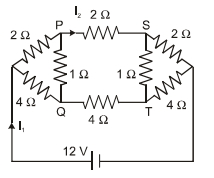
For the resistance network shown in the figure, choose the correct option$(s)$. $Image$

$(A)$ The current through $P Q$ is zero.

$(B)$ $I_1=3 A$.

$(C)$ The potential at $S$ is less than that at $Q$.

$(D)$ $I _2=2 A$.

A letter $A$ is constructed of a uniform wire with resistance $1.0\,\Omega \,per\,cm$. The sides of the letter are $20\, cm$ and the cross piece in the middle is $10\, cm$ long. The apex angle is $60^o$. The resistance between the ends is .............. $\Omega$
A silver sphere of radius $1\ cm$ and work function $4.7 \ eV$ is suspended from an insulating thread in free-space. It is under continuous illumination of $200 \ nm$ wavelength light. As photoelectrons are emitted, the sphere gets charged and acquires a potential. The maximum number of photoelectrons emitted from the sphere is $A \times 10^2$ (where $1 < A < 10$ ). The value of  $'Z '$ is
Four lenses of focal length $\pm 15\; cm$ and $\pm 150 \;cm$ are available for making a telescope. To produce the largest magnification, the focal length(in $cm$) of the eyepiece should be 
A charge $ + q$ is fixed at each of the points $x = {x_0},\,x = 3{x_0},\,x = 5{x_0}$..... $\infty$, on the $x - $axis and a charge $ - q$ is fixed at each of the points $x = 2{x_0},\,x = 4{x_0},x = 6{x_0}$,..... $\infty$. Here ${x_0}$ is a positive constant. Take the electric potential at a point due to a charge $Q$ at a distance $r$ from it to be $Q/(4\pi {\varepsilon _0}r)$. Then, the potential at the origin due to the above system of charges is