Question
A $16cm^3$ volume of water flows per second through a capillary tube of radius r сm and of length 1cm when connected to a pressure head of h cm of water. If a tube of the same length and radius $\frac{\text{r}}{2}$ is connected to the same pressure head, find the mass of water flowing per minute through the tube.
Answer

Here, $V_1 = 16cm^3/ \sec$;$\text{P}_1=\text{h}\rho\text{g};\text{r}_1=\text{r};\text{l}_1=\text{l} $
$\text{V}_2=?;\text{l}_2=\text{l};\text{r}_2=\frac{\text{r}}{2};\text{P}_2=\text{h}\rho\text{g};$
So, $\text{P}_1=\text{P}_2$ Now, $\text{V}_1=\frac{\pi\text{P}_1\text{r}^4_1}{8\eta\text{l}_1}$ and $\text{V}_2=\frac{\pi\text{P}_2\text{r}^4_2}{8\eta\text{l}_2}$$\therefore\frac{\text{V}_2}{\text{V}_1}=\frac{\text{P}_2}{\text{P}_2}\times\frac{\text{r}^4_2}{\text{r}^4_1}\times\frac{\text{l}_1}{\text{l}_2}$
$=\Big(\frac12\Big)=\frac{1}{16}$
$\text{V}_2=\frac{16}{16}=1\text{cm}^3/\text{s}$
Volume of water flowing per minute,$=1\times60$
$=60\text{cm}^3/\text{min}$
$\therefore$ Mass of water flowing per minute,
= 60gm

Need a full question paper?

Generate a complete, print-ready paper with questions like this in minutes — across 16+ boards, with answer keys.

Start Generating Free

Similar questions

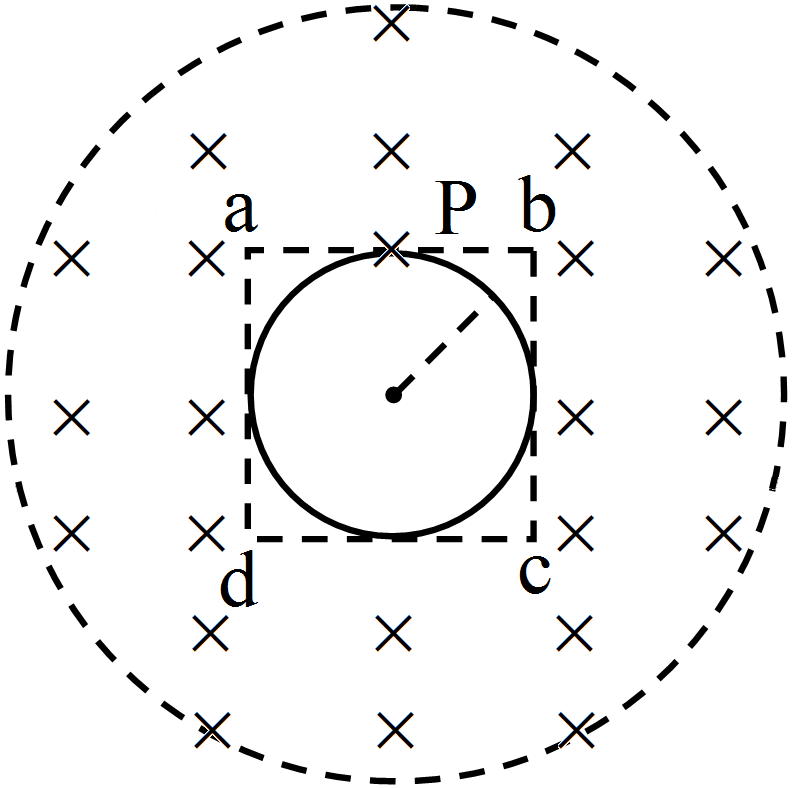
A uniform magnetic field B exists in a cylindrical region, shown dotted in figure. The magnetic field increases at a constant rate $\frac{\text{dB}}{\text{dt}}.$ Consider a circle of radius r coaxial with the cylindrical region.
  1. Find the magnitude of the electric field E at a point on the circumference of the circle.
  2. Consider a point P on the side of the square circumscribing the circle. Show that the component of the induced electric field at P along ba is the same as the magnitude found in part (a).

A particle having mass 10g oscillates according to the equation $\text{x}=(2.0\text{cm})\sin\big[(100\text{s}^{-1})\text{t}+\frac{\pi}{6}\big].$ Find (a) the amplitude, the time period and the spring constant (b) the position, the velocity and the acceleration at t = 0.
It is required to find the volume of a rectangular block. A Vernier Caliper is used to measure the length, width and height of the block. The measured values are found to be 1.37cm, 4.11cm and 2.56cm respectively.
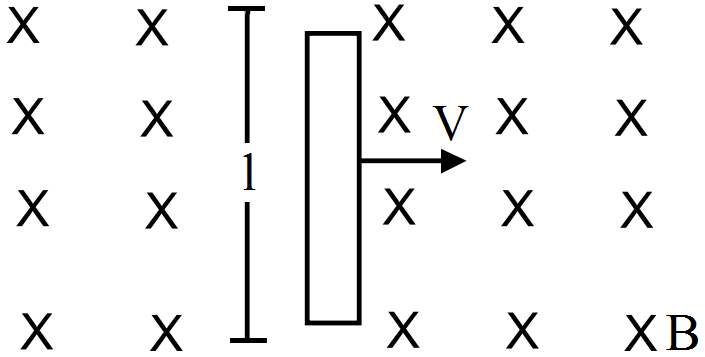
A conducting wire of length l, lying normal to a magnetic field B, moves with a velocity v, as shown in the figure.
  1. Find the average magnetic force on a free electron of the wire.
  2. Due to this magnetic force, electrons concentrate at one end, resulting in an electric field inside the wire. The redistribution stops when the electric force on the free electrons balances the magnetic force. Find the electric field developed inside the wire when the redistribution stops.
  3. What potential difference is developed between the ends of the wire?
Consider the situation of the previous problem. Suppose the block of mass $m_1$ is pulled by a constant force $F_1$ and the other block is pulled by a constant force $F_2$. Find the maximum elongation that the spring will suffer.
Obtain a relation between the distance travelled by a body in time t, if its initial velocity be u and acceleration:
A sound source, fixed at the origin, is continuously emitting sound at a frequency of 660Hz. The sound travels in air at a speed of 330m/s. A listener is moving along the line x = 336m at a constant speed of 26m/s. Find the frequency of the sound as observed by the listener when he is:
  1. At y = - 140m.
  2. At y = 0.
  3. At y = 140m.
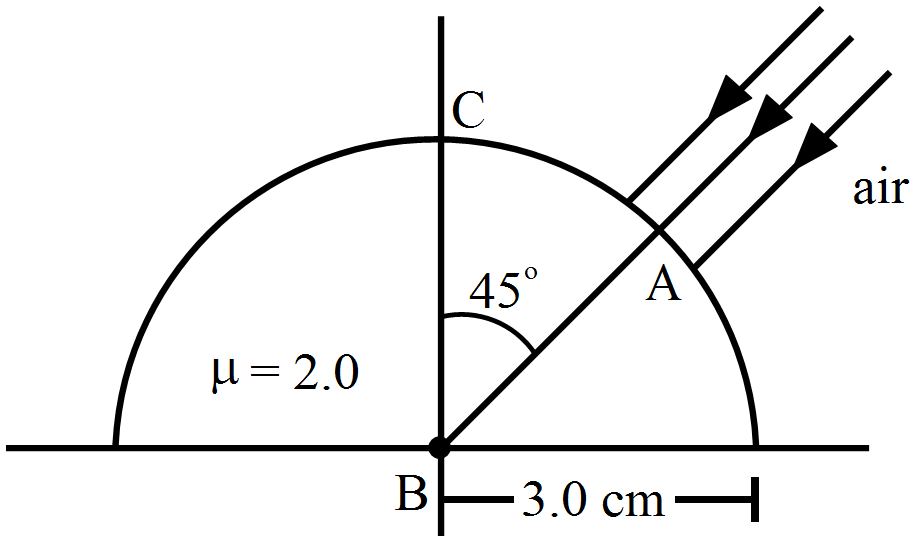
Figure shows a transparent hemisphere of radius 3.0cm made of a material of refractive index 2.0.
  1. A narrow beam of parallel rays is incident on the hemisphere as shown in the figure. Are the rays totally reflected at the plane surface?
  2. Find the image formed by the refraction at the first surface.
  3. Find the image formed by the reflection or by the refraction at the plane surface.
  4. Trace qualitatively the final rays as they come out of the hemisphere.
In a Young's double slit experiment using monochromatic light, the fringe pattern shifts by a certain distance on the screen when a mica sheet of refractive index $1.6$ and thickness $1.964$ micron ($1\ micron = 10^{-6}m$) is introduced in the path of one of the interfering waves. The mica sheet is then removed and the distance between the screen and the slits is doubled. It is found that the distance between the successive maxima now is the same as the observed fringe-shift upon the introduction of the mica sheet. Calculate the wavelength of the monochromatic light used in the experiment.
A pendulum bob of mass $50g$ is suspended from the ceiling of an elevator. Find the tension in the string if the elevator:
  1. Goes up with acceleration $1.2m/s^2$.
  2. Goes up with deceleration $1.2m/s^2$.
  3. Goes up with uniform velocity.
  4. Goes down with acceleration $1.2m/s^2$.
  5. Goes down with deceleration $1.2m/s^2$.
  6. Goes down with uniform velocity.