Question
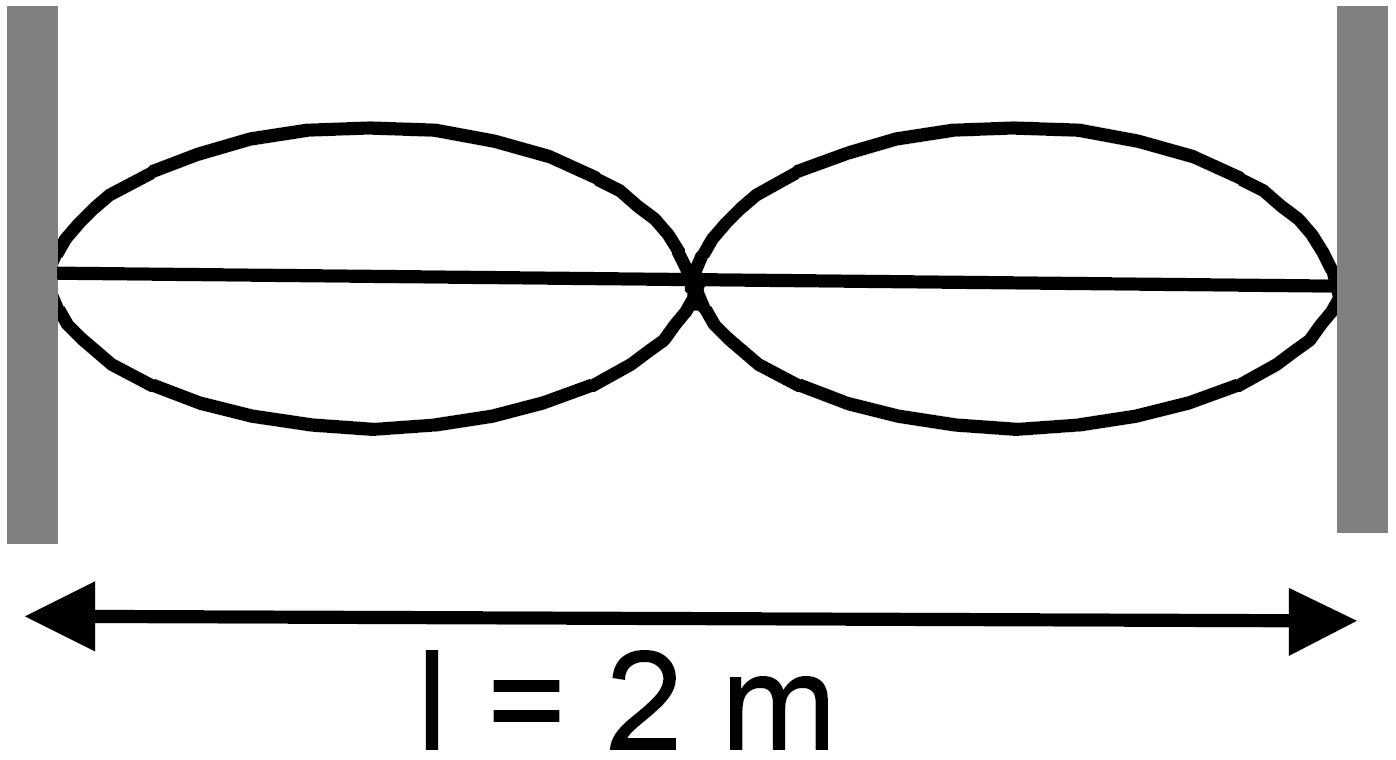
A 2 in long string fixed at both ends is set into vibrations in its first overtone. The wave speed on the string is 200m/s and thee amplitude is 0.5cm.
  1. Find the wavelength and the frequency.
  2. Write the equation giving the displacement of different points as a function of time. Choose the X-axis along the string with the origin at one end and t = 0 at the instant when the point x = 50cm has reached its maximum displacement.
Answer


$\text{V}=200\text{m/s},\ 2\text{A}=0.5\text{m}$

  1. The string is vibrating in its 1st overtone

$\Rightarrow\lambda=1=2\text{m}$

$\Rightarrow\text{f}=\frac{\text{v}}{\lambda}=100\text{Hz}$

  1. The stationary wave equation is given by

$\text{y}=2\text{A}\cos\frac{2\pi\text{x}}{\lambda}\sin\frac{2\pi\text{Vt}}{\lambda}$

$=(0.5\text{cm})\cos\big[(\pi\text{m}^{-1})\text{x}\big]\sin\big[(200\pi\text{s}^{-1})\text{t}\big]$

Need a full question paper?

Generate a complete, print-ready paper with questions like this in minutes — across 16+ boards, with answer keys.

Start Generating Free

Similar questions

A particle moves in a circle of radius 1.0cm at a speed given by v = 2.0t where v is in cm/s and t in seconds.
  1. Find the radial acceleration of the particle at t = 1s.
  2. Find the tangential acceleration at t = 1s.
  3. Find the magnitude of the acceleration at t = 1s.
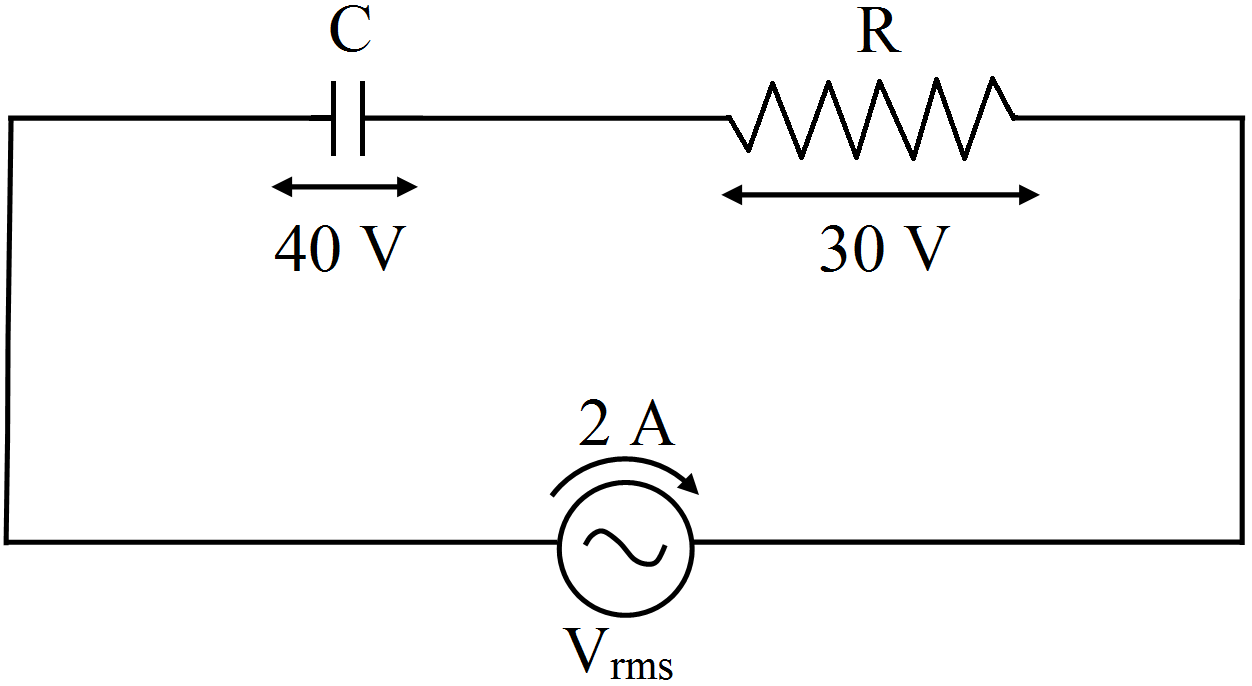
Calculate the following:

  1. Impedance of the given ac circuit.
  2. Wattless current of the given ac circuit.
What is the force between two small charged spheres having charges of 2 × 10⁻⁷C and 3 × 10⁻⁷C placed 30cm apart in air?
Carbon (Z = 6) with mass number 11 decays to boron (Z = 5).
  1. Is it a $\beta^+-\text{decay}$ or a $\beta^--\text{decay}?$
  2. The half-life of the decay scheme is 20.3 minutes. How much time will elapse before a mixture of 90% carbon-11 and 10% boron-11 (by the number of atoms) converts itself into a mixture of 10% carbon-11 and 90% boron-11?
The current generator Ig shown in figure, sends a constant current i through the circuit. The wire cd is fixed and ab is made to slide on the smooth, thick rails with a constant velocity v towards right. Each of these wires has resistance r. Find the current through the wire cd.

Find the range of frequency of light that is visible to an average human being $(400\text{nm}<\lambda<700\text{nm}).$
In a children's park a heavy rod is pivoted at the centre and is made to rotate about the pivot so that the rod always remains horizontal. Two kids hold the rod near the ends and thus rotate with the rod (fig). Let the mass of each kid be 15 kg, the distance between the points of the rod where the two kids hold it be 3.0 m and suppose that the rod rotates at the rate of 20 revolutions per minute. Find the force of friction exerted by the rod on one of the kids.

  1. Show, with the help of a diagram, how unpolarised sunlight gets polarised due to scattering.
  2. Two polaroids P1 and P2 are placed with their pass axes perpendicular to each other. Unpolarised light of intensity Io is incident on P1. A third polaroid P3 is kept in between Pand P2 such that its pass axis makes an angle of $45^{\circ}$ with that of P1. Determine the intensity of light transmitted through P1, P2 and P3.
What is Wheatstone bridge? Explain its principle.
Suppose white light falls on a double slit but one slit is covered by a violet filter (allowing $\lambda=400\text{nm}$). Describe the nature of the fringe pattern observed.