Question
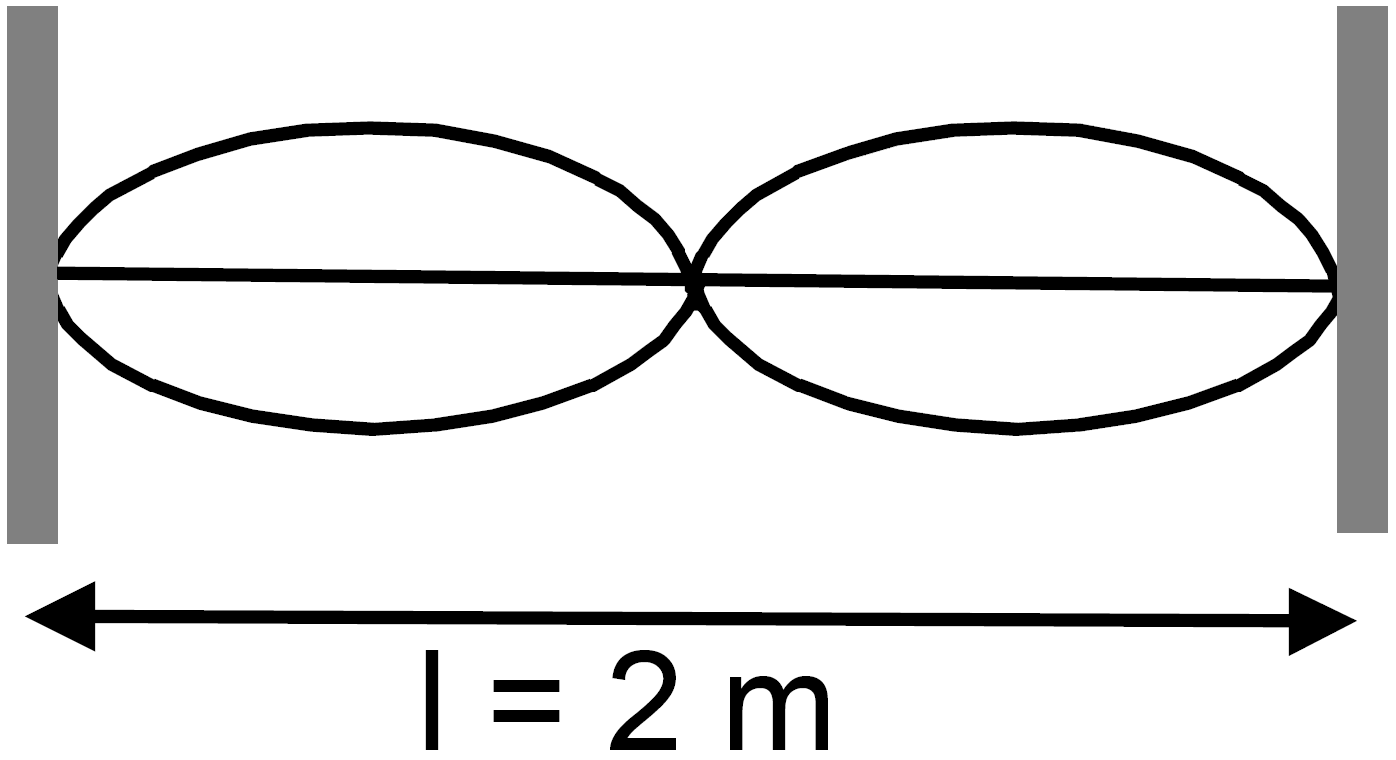
A $2$ in long string fixed at both ends is set into vibrations in its first overtone. The wave speed on the string is $200m/s$ and thee amplitude is $0.5\ cm.$
  1. Find the wavelength and the frequency.
  2. Write the equation giving the displacement of different points as a function of time. Choose the $X-$axis along the string with the origin at one end and $t = 0$ at the instant when the point $x = 50\ cm$ has reached its maximum displacement.
Answer


$\text{V}=200\text{m/s},\ 2\text{A}=0.5\text{m}$
  1. The string is vibrating in its $1^{st}$ overtone
$\Rightarrow\lambda=1=2\text{m}$
$\Rightarrow\text{f}=\frac{\text{v}}{\lambda}=100\text{Hz}$
  1. The stationary wave equation is given by
$\text{y}=2\text{A}\cos\frac{2\pi\text{x}}{\lambda}\sin\frac{2\pi\text{Vt}}{\lambda}$
$=(0.5\text{cm})\cos\big[(\pi\text{m}^{-1})\text{x}\big]\sin\big[(200\pi\text{s}^{-1})\text{t}\big]$

Need a full question paper?

Generate a complete, print-ready paper with questions like this in minutes — across 16+ boards, with answer keys.

Start Generating Free

Similar questions

A rough inclined plane is placed on a cart moving with a constant velocity u on horizontal ground. A block of mass M rests on the incline. Is any work done by force of friction between the block and incline? Is there then a dissipation of energy?
Two identical point masses, each of mass $M$ are connected to one another by a massless string of length $L$. $A$ constant force $F$ is applied at the mid-point of the string. If l be the instantaneous distance between the two masses, what will be the acceleration of each mass?
A man can swim with a speed of $4.0km/h$ in still water. How long does he take to cross a river $1.0km$ wide if the river flows steadily at $3.0km/h$ and he makes his strokes normal to the river current? How far down the river does he go when he reaches the other bank?
An ice box is built of wood $1.75cm$ thick, lined inside with cork $2cm$ thick. If the temperature of the inner surface of the cork is $0°C$ and that of the outer surface of the wood is $12°C$, what is the temperature of the interface? The thermal conductivity of wood is $0.0006$ and that of cork is $0.00012$ CGS units.
A particle starts from the origin, goes along the $X-$axis to the point $(20m, 0)$ and then returns along the same line to the point $(-20m, 0)$. Find the distance and displacement of the particle during the trip.
Two identical steel wires are under tension and are in unison. When the tension in one of the wires is increased by $1$ percent, $4$ beats per second is heard. Find the original frequency of the wires.
In one-dimensional elastic collision of equal masses, the velocities are interchanged. Can velocities in a onedimensional collision be interchanged if the masses are not equal?
Explain why: An optical pyrometer (for measuring high temperatures) calibrated for an ideal black body radiation gives too low a value for the temperature of a red hot iron piece in the open, but gives a correct value for the temperature when the same piece is in the furnace.
The normal body-temperature of a person is 97°F. Calculate the rate at which heat is flowing out of his body through the clothes assuming the following values. Room temperature = 47°F, surface of the body under clothes= $1.6m^2$, conductivity of the cloth $= 0.04\text{Js}^{-1}\text{m}^{-1}{^{\circ}}\text{C}^{-1},$ thickness of the cloth = 0.5cm.
A particle starts S.H.M. from the mean position. Its amplitude is A and its time period is T. At one time its speed is half that of the maximum speed. What is this displacement?