MCQ
A $20 \mathrm{~cm}$ long string, having a mass of $1.0 \mathrm{~g}$, is fixed at both the ends. The tension in the string is $0.5 \mathrm{~N}$. The string is set into vibrations using an external vibrator of frequency $100 \mathrm{~Hz}$. Find the separation (in $cm$) between the successive nodes on the string.
  • $5$
  • B
    $6$
  • C
    $7$
  • D
    $8$

Answer

Correct option: A.
$5$
a
Velocity of wave in a string is $V =\sqrt{ } \frac{\overline{ T }}{\mu}$ where $T =$ tension in the string and $\mu=$ mass per unit length of the string. here, $T =0.5 N$ and $\mu=\frac{1 \times 10^{-3}}{20 \times 10^{-2}}=0.5 \times 10^{-2} \ kg / m$ thus, $v =\sqrt{\frac{0.5}{0.5 \times 10^{-2}}}=10 \ m / s$ Wavelength, $\lambda=\frac{ v }{ f }=\frac{10}{100}=0.1 \ m =10 \ cm$

$\therefore$ The separation between successive nodes $=\frac{\lambda}{2}=\frac{10}{2}=5\ cm$

Need a full question paper?

Generate a complete, print-ready paper with questions like this in minutes — across 16+ boards, with answer keys.

Start Generating Free

Similar questions

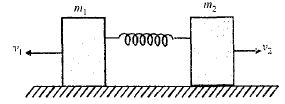
A spring is compressed between two blocks of masses $m_1$ and $m_2$  placed on a horizontal frictionless surface as shown in the figure. When the blocks arc released, they have initial velocity of $v_1$ and $v_2$ as shown. The blocks travel distances $x_1$ and $x_2$ respectively before coming to rest. The ratio $\left( {\frac{{{x_1}}}{{{x_2}}}} \right)$ is
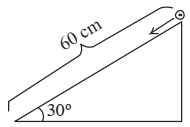
A solid cylinder is released from rest from the top of an inclined plane of inclination $30^{\circ}$ and length $60\,cm$. If the cylinder rolls without slipping, its speed upon reaching the bottom of the inclined plane is $...........ms ^{-1}$. (Given $g =10\,ms ^{-2}$)
$\int\frac{\text{dx}}{\sqrt{2\text{ax}-\text{x}^2}}=\text{a}^{\text{n}}\sin^{-1}\Big[\frac{\text{x}}{\text{a}}-1\Big].$ The value of $n$ is:
Two particles $A$ and $B$ are moving in $XY$ plane. Particle $A$ moves along a line with equation $y = x$ while $B$ moves along $X$ axis such that their $X$ coordinates are always equal. If $B$ moves with a uniform speed $3\ m/s$ , the speed of $A$ is 
Consider two thermometers $T_1$ and $T_2$ of equal length, which can be used to measure temperature over the range $\theta_1$ to $\theta_2$. $T_1$ contains mercury as the thermometric liquid, while $T_2$ contains bromine. The volumes of the two liquids are the same at the temperature $\theta_1$. The volumetric coefficients of expansion of mercury and bromine are $18 \times 10^{-5} \,K ^{-1}$ and $108 \times 10^{-5} \,K ^{-1}$, respectively. The increase in length of each liquid is the same for the same increase in temperature. If the diameters of the capillary tubes of the two thermometers are $d_1$ and $d_2$, respectively. Then, the ratio of $d_1: d_2$ would be closest to
Which of the following is a unit that of force?
A spring with spring constant $k $  is extended from $x = 0$to$x = {x_1}$. The work done will be
Young’s modulus of steel is $1.9 \times 10^{11} \ce{N/m^2}$. When expressed in $\ce{CGS}$ units of $\ce{dynes/cm^2}$, it will be equal to $\ce{(1N = 10^5 dyne, 1m^2 = 10^4cm^2)}$.
If the value of force is $100N$ and value of acceleration is $0.001\ ms^{-2}$, what is the value of mass in this system of units?
A car travels from $A$ to $ B $ at a speed of $20\,\,km/hr$ and returns at a speed of $30\,\,km/hr$. The average speed of the car for the whole journey is............$km/hr$