MCQ
A spring with spring constant $k $  is extended from $x = 0$to$x = {x_1}$. The work done will be
  • A
    $kx_1^2$
  • $\frac{1}{2}kx_1^2$
  • C
    $2kx_1^2$
  • D
    $2k{x_1}$

Answer

Correct option: B.
$\frac{1}{2}kx_1^2$
b
(b) $F=-k x$

$d w=F \cdot d x$

$\int d x=\int_{0}^{x_1}-k x d x$

$w=-k \int_{0}^{x_1}xdx$

$=-k\left[\frac{x^{2}}{2}\right]_{0}^{x_{1}}$

$=-K\left[\frac{x_{1}^{2}}{2}\right]$

$w=-\frac{-k x_{1}^{2}}{2}$

$w=\frac{-1}{2} k x_{1}^{2}$

work  done $=-(w)$

$=-\left[\frac{-1}{2} k x_{1}^{2}\right]$

$=\frac{1}{2} k x_{1}^{2}$

Need a full question paper?

Generate a complete, print-ready paper with questions like this in minutes — across 16+ boards, with answer keys.

Start Generating Free

Similar questions

Given below are two statements :

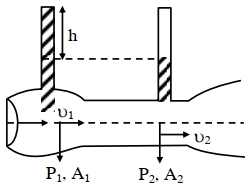
Statement $I$ : When speed of liquid is zero everywhere, pressure difference at any two points depends on equation $\mathrm{P}_1-\mathrm{P}_2=\rho \mathrm{g}\left(\mathrm{h}_2-\mathrm{h}_1\right)$

Statement $II$ : In ventury tube shown $2 \mathrm{gh}=v_1^2-v_2^2$

In the light of the above statements, choose the most appropriate answer from the options given below.
A car starts from rest and has an acceleration $a = 1\ m/ s^2.$ A truck is moving with a uniform velocity of $6\ m/ s.$ At what distance will the car overtake the truck? direction $($at $t = 0$ both start their motion in the same direction from the same position$)$
The conversion of $1 \;MW$ power in a new system having basic unit of mass, length and time as $10 \;kg , 1 \;dm$ and $1 \;minute$ respectively is:
If mass of earth is $M$, radius is $R$ and gravitational constant is $G$, then work done to take $1\, kg$ mass from earth surface to infinity will be
The phenomenon of beats can take place:
​​​​​​
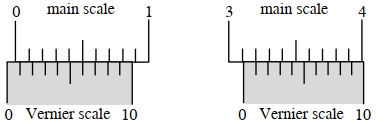
The smallest division on the main scale of a Vernier calipers is $0.1 cm$. Ten divisions of the Vernier scale correspond to nine divisions of the main scale. The figure below on the left shows the reading of this calipers with no gap between its two jaws. The figure on the right shows the reading with a solid sphere held between the jaws. The correct diameter of the sphere is
A projectile has the same range $R$ for two angles of projection. If $T_1$ and $T_2$ be the times of flight in the two cases, then $R$ is
A particle of mass $10\ kg$ is moving in a straight line. If its displacement, $x$ with time $t$ is given by $x = (t^3 - 2t - 10)m,$ then the force acting on it at the end of $4$ seconds is:
A ball of mass $m$ is attached to a string whose other end is fixed. The system is free to rotate in vertical plane. When the ball swings, no work is done on the ball by the tension in the string. Which of the following statements is the correct explanation?
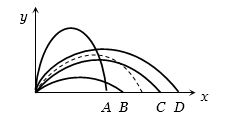
The path of a projectile in the absence of air drag is shown in the figure by dotted line. If the air resistance is not ignored then which one of the path shown in the figure is appropriate for the projectile