MCQ
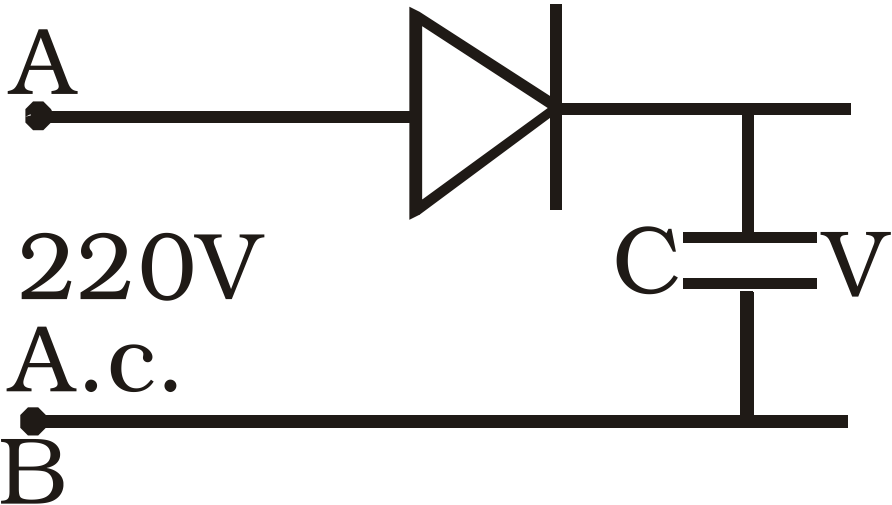
A 220 V A.C. supply is connected between points A and B (Fig.). What will be the potential difference V across the capacitor?
- A220V.
- B110V.
- C0V.
- D$220\sqrt{2}\text{V}.$
Solution:
Key concept: Half wave rectifier: When the P-N junction diode rectifies half of the ac wave, it is called half wave rectifier.
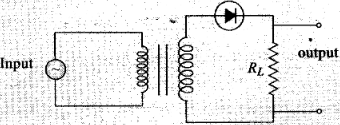
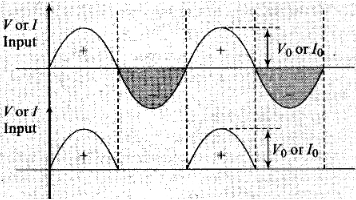
Diode → Forward biased
Output signal → obtained
Diode → reverse biased
Output signal → not obtained
$\text{I}_\text{dc}=\frac{\text{I}_0}{\pi}\text{ and }\text{V}_\text{dc}=\frac{\text{V}_0}{\pi};\text{I}_0=\frac{\text{V}_0}{\text{r}_\text{f}+\text{R}_\text{I}}$
(rf = forward biased resistance)
As p-n junction diode will consuct during positive half cycle only, during negative half cycle diode is reverse biased. During this diode will not give any output. So, potential difference across capacitor C = peak voltage of the given AC voltage
$=\text{V}_0=\text{V}_\text{rms}\sqrt{2}=220\sqrt{2}\text{V}$
Generate a complete, print-ready paper with questions like this in minutes — across 16+ boards, with answer keys.
The resistance of a galvanometer is 25 ohm and it requires 50μA for full deflection. The value of the shunt resistance required to convert it into an ammeter of 5 amp is
|
(a) 2.5 |
(b) 1.25 |
(c) 0.05 ohm |
(d) 2.5 ohm |
Avalanche breakdown is due to
|
(a) Collision of minority charge carrier |
(b) Increase in depletion layer thickness |
|
(c) Decrease in depletion layer thickness |
(d) None of these |
A 10 V storage battery of negligible internal resistance is connected across a 50 Ω resistor. How much heat energy is produced in the resistor in 1 hour
|
(a) 7200 J |
(b) 6200 J |
(c) 5200 J |
(d) 4200 J |
The minimum charge on an object is
|
(a) 1 coulomb |
(b) 1 stat coulomb |
|
(c) |
(d) |
A man can see the object between 15 cm and 30 cm. He uses the lens to see the far objects. Then due to the lens used, the near point will be at
|
(a) |
(b) 30 cm |
(c) 15 cm |
(d) |