Questions · Page 1 of 5

M.C.Q [1M]

🎯

Test yourself on this topic

50 questions · timed · auto-graded

MCQ 21 Mark
For germanium diode, the junction voltage is about _____.
  • A
    0.7V
  • B
    0.3
  • C
    0.6V
  • D
    3V
Answer
  1. 0.3

Explanation:

The junction voltage Vo​ for a germanium diode is 0.3 V at room temperature. This potential opposes the diffusion of electrons from n-side and holes from p-side. It is 0.7 eV for Si at room temperature.

View full question & answer
MCQ 31 Mark
In n-type of semiconductor, majority carries are:
  • A
    Positron
  • B
    Electron
  • C
    Holes
  • D
    Impure particles
Answer
  1. Electron

Explanation:

In n-type semiconductor, large number of free electrons is present. Hence, free electrons are the majority charge carriers in the n-type semiconductor. The free electrons (majority charge carriers) carry most of the electric charge or electric current in the n-type semiconductor.

View full question & answer
MCQ 41 Mark
The energy gap between the valence band and the condition band for a material is 6eV. The material is?
  • A
    An insulator
  • B
    A metal
  • C
    An intrinsic semiconductor
  • D
    A superconductor
Answer
  1. An insulator

Explanation:

Insulators have large energy gap between valence and conduction band (about 6eV), while semiconductors have a smaller one and conductors, the smallest energy gap.

View full question & answer
MCQ 61 Mark
Hole in semiconductor is:
  • A
    An anti – particle of electron.
  • B
    A vacancy created when an electron leaves a covalent bond.
  • C
    Absence of free electrons.
  • D
    An artificially created particle.
Answer
  1. An artificially created particle.
View full question & answer
MCQ 71 Mark
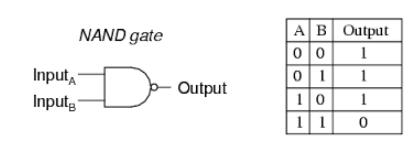
The gate for which output is high, if at least one input is low is:
  • A
    NAND
  • B
    NOR
  • C
    AND
  • D
    OR
Answer
  1. NAND

Explanation:

The truth table of NAND gate is shown as above, which implies that if at least one of the input is low then the output is high.
View full question & answer
MCQ 81 Mark
In a semiconductor, the forbidden energy gap between the valence band and the conduction band is of the order is:
  • A
    1MeV.
  • B
    0.1Mev.
  • C
    1eV.
  • D
    5eV.
Answer
  1. 1eV.
View full question & answer
MCQ 91 Mark
The impurity atoms with which pure silicon may be doped to make it a p-type semiconductor are those of:
  • A
    Phosphorus.
  • B
    Boron.
  • C
    Antimony.
  • D
    Nitrogen.
Answer
  1. Boron.
View full question & answer
MCQ 101 Mark
The load voltage is approximately constant when a zener diode is:
  • A
    Forward-biased
  • B
    Reverse-biased
  • C
    Operating in the breakdown region
  • D
    Unbiased
Answer
  1. Operating in the breakdown region

Explanation:

The zener voltage will be a constant only when it is operating in the breakdown region.

View full question & answer
MCQ 111 Mark
In a p-n junction with open ends:
  • A
    There is no systematic motion of charge carriers.
  • B
    Holes and conduction electrons systematically go from the p-side to the n-side and from the n side to the p-side respectively.
  • C
    There is no net charge transfer between the two sides.
  • D
    There is a constant electric field near the junction.
Answer
  1. Holes and conduction electrons systematically go from the p-side to the n-side and from the n side to the p-side respectively.
  2. There is no net charge transfer between the two sides.
  3. There is a constant electric field near the junction.

Explanation:

Because of the difference in the concentration of charge carriers in the p−n junction, holes from the p side move to the n side and electrons from the n side move to the p side. This motion of charge carriers gives rise to diffusion current.

Because of this, a negative space charge region is formed in the p region and a positive space region is formed in the n region. This sets up an electric field across the junction. Thus, there is a constant electric field near the junction.

This electric field further opposes the diffusion of majority charge carriers across the junction. As a result, an electron from the p region starts moving to the n region and a hole from the n region starts moving to the p region. This sets up drift current. Thus, there is a systematic flow of charge carriers across the junction. Also, there is no net charge transfer between the two sides.

View full question & answer
MCQ 121 Mark
Zener-diode is used in:
  • A
    Amplification
  • B
    Rectification
  • C
    Oscillator in producing oscillations
  • D
    Volatge regulation
Answer
  1. Volatge regulation

Explanation:

 A voltage regulator circuit can be designed using a zener diode to maintain a constant DC output voltage across the load in spite of variations in the input voltage or changes in the load current.

View full question & answer
MCQ 131 Mark
The drift current in a p-n junction is from the:
  • A
    N-side to the p-side.
  • B
    P-side to the n-side.
  • C
    N-side to the p-side if the junction is forward-biased and in the opposite direction if it is reverse biased.
  • D
    P-side to the n-side if the junction is forward-biased and in the opposite direction if it is reverse-biased.
Answer
  1. N-side to the p-side.
View full question & answer
MCQ 141 Mark
Which of the following is not the function of a NOT gate?
  • A
    Stop a signal.
  • B
    Invert an input signal.
  • C
    Complement a signal.
  • D
    Change the logic in a digital circuit.
Answer
  1. Stop a signal.

Explanation:

A NOT gate inverts the input signal which is the same as complementing a signal or changing the logic in a digital circuit. This means that when the input to the NOT gate is logic '0', the output is logic '1'. However, it does not stop a signal.
View full question & answer
MCQ 151 Mark
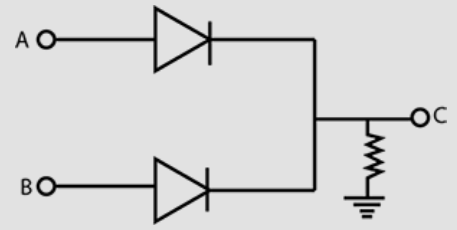
In the given circuit, if A and B represent two inputs and C represents the output, the circuit represents:

  • A
    NOR gate
  • B
    AND gate
  • C
    Gate
  • D
    OR gate
Answer
  1. OR gate

Explanation:

The image given shows a diode OR circuit. R is connected from the output to ground to provide bias current for the diodes. Any positive voltage will represent a logic 1 state and the summing of currents through multiple diodes does not change the logic level.
View full question & answer
MCQ 161 Mark
In an insulator, the forbidden energy gap between the valence band and conduction band is of the order of:
  • A
    1MeV. 
  • B
    0.1MeV.
  • C
    1eV.
  • D
    5eV.
Answer
  1. 5eV.
View full question & answer
MCQ 171 Mark
In a p-type semiconductor, the acceptor valence band is:
  • A
    Close to the valence band of the host crystal.
  • B
    Close to conduction band of the host crystal.
  • C
    Below the conduction band of the host crystal.
  • D
    Above the conduction band of the host crystal.
Answer
  1. Close to the valence band of the host crystal.
View full question & answer
MCQ 181 Mark
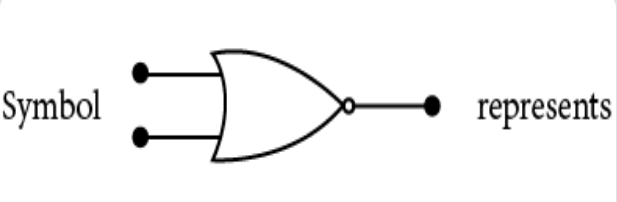
Identify the logic gate in figure.

  • A
    NAND
  • B
    NOR
  • C
    NOT
  • D
    AND
Answer
  1. NOR

Explanation:

The symbol of circle shown in figure with OR gate indicates the NOT gate hence, given gate is NOR gate.

View full question & answer
MCQ 191 Mark
In an n-type semiconductor, donor valence band is:
  • A
    Above the conduction band of the host crystal.
  • B
    Close to the valence band of the host crystal.
  • C
    Close to the conduction band of the host crystal.
  • D
    Below the valence band of the host crystal.
Answer
  1. Close to the conduction band of the host crystal.
View full question & answer
MCQ 201 Mark
If the two ends of a p-n junction are joined by a wire:
  • A
    There will not be a steady current in the circuit.
  • B
    There will be a steady current from the n-side to the pside.
  • C
    There will be a steady current from the p-side to the nside.
  • D
    There may or may not be a current depending upon the resistance of the connecting wire.
Answer
  1. There will not be a steady current in the circuit.
View full question & answer
MCQ 211 Mark
In an intrinsic semiconductor, the number of electrons in the conduction band is ________ the number of holes in the valence band.
  • A
    Equal to
  • B
    Less than
  • C
    Greater than
  • D
    None of these
Answer
  1. Equal to

Explanation:

In an intrinsic semiconductor, the number density of electrons is equal to the number density of holes i.e ne = nh.

Since there is no doping, no extra hole or electron is produced.

View full question & answer
MCQ 221 Mark
To use a transistor as an amplifier, emitter-base junction is kept in ...X... and base-collector junction is kept in ...Y... Here, X and Y refer to:
  • A
    Forward bias, forward bias.
  • B
    Reverse bias, reverse bias.
  • C
    Reverse bias, forward bias.
  • D
    Forward bias, reverse bias.
Answer
  1. Forward bias, reverse bias.
View full question & answer
MCQ 231 Mark
If the two ends of a p-n junction are joined by a wire:
  • A
    There will not be a steady current in the circuit.
  • B
    There will be a steady current from the n-side to the p-side.
  • C
    There 'will a steady current from the p-side. to the n-side.
  • D
    There may or may not be a current depending upon the resistance of the connecting wire.
Answer
  1. There will not be a steady current in the circuit.

Explanation:

In a p‒n junction, current flows only if it is connected to the battery. If two ends of a p‒n junction are joined by a wire, then there will be diffusion and drift currents in the circuit and they will cancel each other. Hence, no current will flow in the circuit.

View full question & answer
MCQ 241 Mark
In which of the following statements, the obtained impure semiconductor is of p-type?
  • A
    Germanium is doped with bismuth.
  • B
    Silicon is doped with antimony.
  • C
    Germanium is doped with gallium.
  • D
    Silicon is doped with phosphorus.
Answer
  1. Germanium is doped with gallium.

Explanation:

A p-type semiconductor is produced by doping a 14 group element with a 13 group element as 14 group element has 4 valence electron whereas that of group 13 has 3 valence electron. We know that Germanium is a 14 group element and gallium is a 13 group element, thus doping germanium with gallium forms a p-type semiconductor.

View full question & answer
MCQ 251 Mark
The energy band gap is maximum in:
  • A
    Metals
  • B
    Super conductors
  • C
    Insulators
  • D
    Semiconductors
Answer
  1. Insulators

Explanation:

In insulators, the electrons are tightly bound with the nucleus hence, at room temperature thermal energy is not enough to push the electrons into conduction band and hence, no electrons are available for conduction.

The energy required for electron to escape out from orbit and to over come the energy gap is thus of the order of 6 eV, while for semiconductors and conductors it is (of the order of) 1 eV and 0 respectively.

View full question & answer
MCQ 261 Mark
For a common base amplifier, the values of resistance gain and voltage gain are 3000 and 2800 respectively. The current gain will be:
  • A
    1.1
  • B
    0.98
  • C
    0.93
  • D
    0.83
Answer
  1. 0.93
View full question & answer
MCQ 271 Mark
Optoelectronic devices work on:
  • A
    Light
  • B
    Electrical current
  • C
    Both A and B
  • D
    None of the above
Answer
  1. Both A and B

Explanation:

Optoelectronic devices and components are those electronic devices that operate on both light and electrical currents. This can include electrically driven light sources such as laser diodes and light-emitting diodes, components for converting light to an electrical current such as solar and photovoltaic cells and devices that can electronically control the propagation of light.

View full question & answer
MCQ 281 Mark
If a small amount of antimony is added to germanium crystal:
  • A
    It becomes a p–type semiconductor.
  • B
    The antimony becomes an acceptor atom.
  • C
    There will be more free electrons than holes in the semiconductor.
  • D
    Its resistance is increased.
Answer
  1. There will be more free electrons than holes in the semiconductor.
View full question & answer
MCQ 291 Mark
A strip of copper and another of germanium are cooled from room temperature to 80K. The resistance of:
  • A
    Each of these decreases.
  • B
    Copper strip increases and that of germanium decreases.
  • C
    Copper strip decreases and that of germanium increases.
  • D
    Each of these increases.
Answer
  1. Copper strip decreases and that of germanium increases.
View full question & answer
MCQ 301 Mark
NOR gate is the series combination of:
  • A
    NOT gate followed by OR gate.
  • B
    OR gate followed by NOT gate.
  • C
    AND gate followed by OR gate.
  • D
    OR gate followed by AND gate.
Answer
  1. OR gate followed by NOT gate.

Explanation:

Truth table of NOR is complement of OR. That's why NOR is combination of OR gate followed by NOT gate.
View full question & answer
MCQ 311 Mark
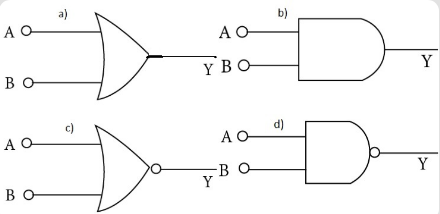
Given above are four logic gate symbols. Those for OR, NOR and NAND are respectively:

  • A
    a, d, c
  • B
    d, a, b
  • C
    a, c, d
  • D
    d, b, a
Answer
  1. a, c, d

Explanation:

a- represent OR gate 

b- represent the AND gate 

c- represent, the combination of OR and NOT gate, NOR gate.

d- represent, the combination of AND and NOT gate, NAND gate.

View full question & answer
MCQ 321 Mark
The process by which ac is converted into dc is known as:
  • A
    Purification
  • B
    Amplification
  • C
    Rectification
  • D
    Current Amplification
Answer
  1. Rectification

Explanation:

The process by which ac is converted into dc is known as "Rectification".

View full question & answer
MCQ 331 Mark
Statement-1: NOT gate is also called invertor circuit.

Statement-2: NOT gate inverts the input order.

  • A
    Statement -1 is false, statement -2 is true.
  • B
    Statement 1-is true, statement -2 is true and statement -2 is correct explanation of statement-1.
  • C
    Statement 1-is true, statement -2 is true but statement -2 is not correct explanation of statement-1.
  • D
    Statement 1-is true, statement -2 is false.
Answer
  1. Statement 1-is true, statement -2 is true and statement -2 is correct explanation of statement-1.

Explanation:

NOT gate is also called invertor circuit since NOT gate inverts the input order. Hence, statement 1-is true statement-2 is true statement-2 is correct explanation of statement-1.

View full question & answer
MCQ 341 Mark
There is a sudden increase in current in zener diode is:
  • A
    Due to rupture of bonds
  • B
    Resistance of deplection layer becomes less
  • C
    Due to high doping
  • D
    Due to less doping
Answer
  1. Due to rupture of bonds

Explanation:

When Zener diode is connected in reverse bias, as applied voltage reaches at Zener breakdown voltage, due to rupture of bonds there is a sudden increase in current in Zener diode.

View full question & answer
MCQ 351 Mark
The value indicated by Fermi energy level in an intrinsic semiconductor is:
  • A
    The average energy of electrons and holes.
  • B
    The energy of electrons in conduction band.
  • C
    The energy of holes in valence band.
  • D
    The energy of forbidden region.
Answer
  1. The average energy of electrons and holes.

Explanation:

In an intrinsic semiconductor, n=p, where, n is number of electrons and p is number of holes in intrinsic semiconductor.

This implies that there is an equal chance of finding an electron at the conduction band edge as there is of finding a hole at the valence band edge. Thus, the average energy level of electrons and holes is half of the energy band gap in intrinsic semiconductors.

Also the Fermi energy level lie exactly in the middle of energy band gap in intrinsic semiconductors. Thus, the value indicated by Fermi energy level in an intrinsic semiconductor is the average energy of electrons and holes.

View full question & answer
MCQ 361 Mark
If ‘p’ region of a semi conductor is connected to negative and ‘n’ region to positive pole, it is said to be:
  • A
    Directed biased
  • B
    Unbiased
  • C
    Forward biased
  • D
    Reverse biased
Answer
  1. Reverse biased

Explanation:

In reverse bias, 'p' region of a semi conductor is connected to negative pole and 'n' region to positive pole.

View full question & answer
MCQ 371 Mark
Among the following one can act as the building blocks for the other gates is:
  • A
    NAND and NOR
  • B
    NAND and AND
  • C
    XOR and OR
  • D
    NOT and OR
Answer
  1. NAND and NOR

Explanation:

NAND and NOR gates are known as universal gates. Any one of these gates can be used to implement any kind of logic gate. This kind of feasibility is does not exist with other gates i.e. any other gate cannot solely implement all logic gates. For example, AND gate cannot be implemented using an OR gate and vice-versa. The implementation of NAND and NOR gates to generate other logic gates is shown above.
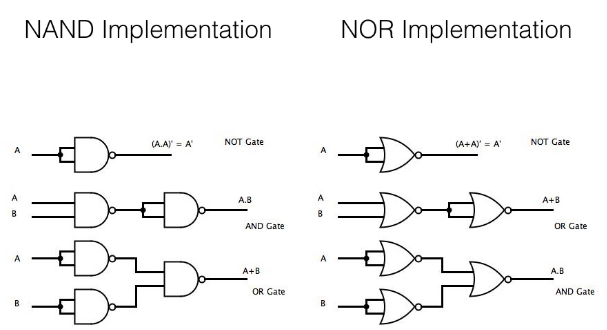
View full question & answer
MCQ 381 Mark
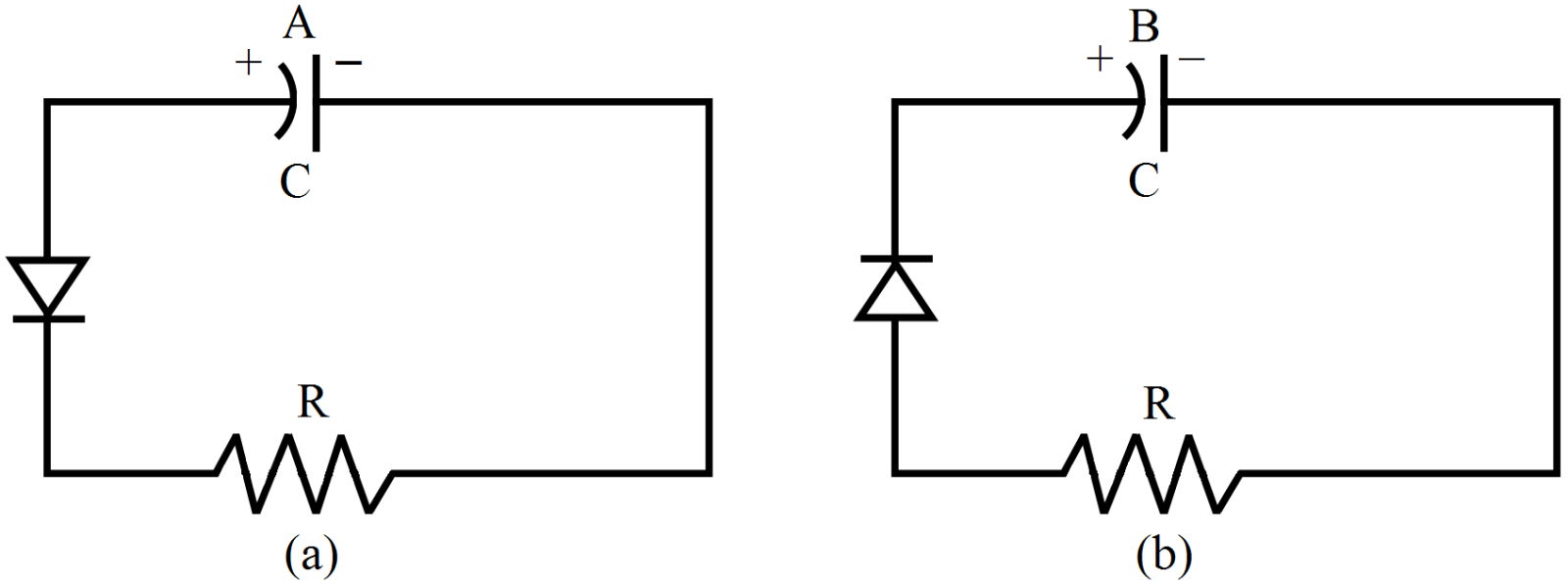
Two identical capacitors A and B are charged to the same potential V and are connected in two circuits at t = 0 as shown in figure. The charges on the capahltors at a time t = CR are, respectively:

  • A
    $\text{VC}, \text{VC}$
  • B
    $\frac{\text{VC}}{\text{e}}, \text{VC}$
  • C
    $\text{VC}, \frac{\text{VC}}{\text{e}}$
  • D
    $\frac{\text{VC}}{\text{e}}, \frac{\text{VC}}{\text{e}}$
Answer
  1. $\frac{\text{VC}}{\text{e}}, \text{VC}$

Explanation:

In circuit (a), the diode is forward biassed. So, it offers negligible resistance to the flow of current and can thus be replaced by a short circuit. Now, the capacitor charge will leak through the resistance and decay exponentially with time.

Capacitor charge $=\frac{\text{VC}}{\text{e}}$

In circuit (b), the diode is reverse biassed. So, it offers infinite resistance to the current flow and can thus be replaced by an open circuit. As the circuit is open now, no current can flow across the resistance. So, the charge in the capacitor cannot leak through the resistor.

Capacitor charge = VC

View full question & answer
MCQ 391 Mark
The diffusion current in a p-n junction is:
  • A
    From the n-side to the p-side.
  • B
    From the p-side to the n-side.
  • C
    From the n-side to the p-side if the junction is forward-biased and in the opposite direction if it is reverse-biased.
  • D
    From the p-side to the n-side if the junction is forward-biased and in the opposite direction if it is reverse-biased.
Answer
  1. From the p-side to the n-side.

Explanation:

When a p‒n junction is formed then because of the difference in the concentration of charge carriers in the two regions, electrons from the n region move to the p region and holes from the p region move to the n region. Since the direction of the current is always opposite to the motion of electron, the direction of the current is from the p side to the n side.

Similarly, when the junction is forward biassed, the positive terminal of the battery is connected to the pside of the p‒n junction and the negative terminal of the battery is connected to the n side of the p‒njunction. As a result, electrons in the n side of the p‒n junction are repelled by the negative terminal of the battery and they move to the p side, where the positive terminal of the battery attracts them. Similarly, holes from the p side of the p‒n junction are repelled by the positive terminal of the battery and they move to the n side, where the negative terminal of the battery attracts them. Thus, they give diffusion current from the p side to the n side across the p‒n junction.

In reverse biassing, there is no flow of majority carriers across the junction; hence, there is not diffusion current. Here, the flow of majority carriers is opposed by the applied voltage.

View full question & answer
MCQ 401 Mark
Materials which allow only larger currents to flow through them are:
  • A
    Insulators
  • B
    Semi-conductors
  • C
    Conductors
  • D
    Alloys
Answer
  1. Semi-conductors

Explanation:

Semiconductors in their natural state are poor conductors because a current requires the flow of electrons, and semiconductors have their valence band filled, preventing the entry flow of new electrons.

Thus semi-conductors allows a large current to pass through them.

View full question & answer
MCQ 411 Mark
A p-type semiconductor is:
  • A
    Positively charged.
  • B
    Negatively charged.
  • C
    Uncharged.
  • D
    Uncharged at 0K but charged at higher ternperatures.
Answer
  1. Uncharged.

Explanation:

A p-type semiconductor is formed by doping a pure semiconductor with a p-type material. As impurity atoms take the position of the germanium atom in a germanium crystal, three electrons of a p-type material form covalent bonds by sharing electrons with three neighbouring germanium atoms. However, the fourth covalent bond is left incomplete, with a want of one electron. This creates a hole. As the atom as a whole is neutral, the p-type material is also neutral.

View full question & answer
MCQ 421 Mark
The electrical conductivity of pure germanium can be increased by:
  • A
    Increasing the temperature.
  • B
    Doping acceptor impurities.
  • C
    Doping donor impurities.
  • D
    Irradiating ultraviolet light on it.
Answer
  1. Increasing the temperature.
  2. Doping acceptor impurities.
  3. Doping donor impurities.
  4. Irradiating ultraviolet light on it.

Explanation:

We know that the conductivity of any semiconductor can be increased by increasing the number of charge carriers. All the given methods are effective in increasing the number of free charge carriers. Hence, all options are correct.

View full question & answer
MCQ 431 Mark
A hole diffuses from the p-side to the n-side in a p-n junction. This means that.
  • A
    A bond ia broken on the n-side and the electron freed from the bond jumps to the conduction band.
  • B
    A conduction electron on the p-side jumps to a broken bond to complete it.
  • C
    A bond is broken on the n-side and the electron freed from the bond jumps to a broken bond on the p-side to complete it.
  • D
    A bond is broken on the p-side and the electron freed from the bond jumps to a broken bond on the n-side to complete it.
Answer
  1. A bond is broken on the n-side and the electron freed from the bond jumps to a broken bond on the p-side to complete it.

Explanation:

A hole diffuses from the p side to the n side in a p−n junction; that is, an electron moves from the n side to the p side. This implies that a bond is broken on the n side. As the electron travels towards the p side, which is rich in holes, it combines with a hole. A hole is created because of the deficiency of one electron. So, when an electron combines with a hole, it completes that bond.

View full question & answer
MCQ 441 Mark
Two identical p-ri junctions may be connected in series with a battery in three ways (figure). The potential difference across the two p-n. junctions are equal in:
  • A
    Circuit 1 and circuit 2.
  • B
    Circuit 2 and circuit 3.
  • C
    Circuit 3 and circuit 1.
  • D
    Circuit 1 only.
Answer
  1. Circuit 2 and circuit 3.

Explanation:

In circuit 1, one diode is forward biassed and the other diode is reverse biassed. The forward-biassed diode offers zero resistance (ideally) to the current flow, so it can be replaced by a short circuit. The voltage drop across the first diode will be zero. The second diode is reverse biassed, so it can be replaced by an open circuit; hence, the voltage drop across this diode will be maximum.

In circuit 2, both the diodes are forward biassed, so they can be replaced by short circuits; hence, the voltage drop across both of them will be minimum and equal.

In circuit 3, both the diodes are reverse biassed, so both can be replaced by open circuits; hence, the voltage drop across both of them will be maximum and equal.

View full question & answer
MCQ 451 Mark
In a semiconductor:
  • A
    There are no free electrons at 0K.
  • B
    There are no free electrons at any temperature.
  • C
    The number of free electrons increases with temperature.
  • D
    The number of free electrons is less than that in a conductor.
Answer
  1. There are no free electrons at 0K.

  1. The number of free electrons increases with temperature.

  2. The number of free electrons is less than that in a conductor.

Explanation:

In semiconductors, the valence band is full at 0K, but the conduction band is empty. So, no free electron is available for conduction at 0K.

As the temperature increases, covalent bonds that provide free charge carriers for conduction in a semiconductor break.

As the conduction band in metals is already partially filled at 0K, many free electrons below the Fermi level acquire energy from an external source or temperature, jump to the conduction band and start behaving like free electrons. Hence, metals contain more free electrons than semiconductors.

View full question & answer
MCQ 461 Mark
The drift current in a p-ri junction is:
  • A
    From the n-side to the p-side.
  • B
    From the p-side to the n-side.
  • C
    From the n-side to the p-side if the junction is forward-biased and in the opposite direction if it is reverse-biased.
  • D
    From the p-side to the n-side if the junction is forward-biased and in the opposite direction if it is reverse-biased.
Answer
  1. From the n-side to the p-side.

Explanation:

After the diffusion of majority charge carriers across a p‒n junction, an electric field is set up because of the accumulation of immobile ions at the junction. These further oppose the motion of majority charge carriers across the junction. As a result, electrons from the p region start moving to the n region and holes from the n region start moving to the p region. This constitutes the drift current. As the direction of the current is opposite to the direction of the motion of the electrons, the direction of the drift current is from the n side to the p side.

In forward biasing, there is no movement of electrons from the p region to the n region and of holes from the n region to the p region. Hence, there is not drift current.

View full question & answer
MCQ 471 Mark
Diffusion current in a p-n junction is greater than the drift current in magnitude:
  • A
    If the junction is forward-biased.
  • B
    If the junction is reverse-biased.
  • C
    If the junction is unbiased.
  • D
    In no case.
Answer
  1. If the junction is forward-biased.

Explanation:

In the forward biassing of a p−n junction, the positive terminal of the battery is connected to the p side of the p−n junction and the negative terminal of the battery is connected to the n side of the p−n junction. As a result, electrons in the n side of the p−n junction are repelled by the negative terminal of the battery and move to the p side, where the positive terminal of the battery attracts the electrons. Similarly, holes from the p side of the p−n junction are repelled by the positive terminal of the battery and move to the nside, where the negative terminal of the battery attracts the holes. Thus, they give diffusion current across the p−n junction.

In case of reverse biassing, no conduction takes place across the junction because of the diffusion of majority carriers. Hence, there is no diffusion current.

If the junction is unbiased, then diffusion current is initially maximum. But at equilibrium, diffusion current becomes equal to drift current.

View full question & answer
MCQ 481 Mark
In a p-n junction:
  • A
    New holes and conduction electrons are produced continuously throughout the material.
  • B
    New holes and conduction electrons are produced continuously throughout the material except in the depletion region.
  • C
    Holes and conduction electrons recombine continuously throughout the material.
  • D
    Holes and conduction electrons recombine continuously throughout the material except in the depletion region.
Answer
  1. New holes and conduction electrons are produced continuously throughout the material.
  1. Holes and conduction electrons recombine continuously throughout the material except in the depletion region.

Explanation:

In a p‒n junction diode, diffusion current flows because of the diffusion of holes from the p side to the n side and of electrons from the n side to the p side. The current flowing in the diode due to the diffusion of charge carriers across the junction is called the diffusion current. The current flowing in the diode due to the movement of minority carriers across the junction due to their thermal energy is called the drift current. In an unbiased diode, the net current flowing across the junction is zero due to the cancellation of the drift current by the diffusion current. For the flow of diffusion and drift currents, holes and electrons are produced continuously throughout the material. When a hole crosses the junction, it combines with an electron on the n side. As the depletion region is devoid of free charge carriers, this recombination never takes place inside the depletion region.

View full question & answer
MCQ 491 Mark
Let np and ne be the number of holes and conduction electrons in an intrinsic semiconductor.
  • A
    $\text{n}_\text{p} > \text{n}_\text{e}$
  • B
    $\text{n}_\text{p} = \text{n}_\text{e}$
  • C
    $\text{n}_\text{p} < \text{n}_\text{e}$
  • D
    $\text{n}_\text{p}\neq\text{n}_\text{e}$
Answer
  1. $\text{n}_\text{p} = \text{n}_\text{e}$

Explanation:

As the intrinsic semiconductor is free from all impurities, the number of electrons is equal to the number of holes.

View full question & answer
MCQ 501 Mark
A semiconducting device is connected in a series circuit with a battery and a resistance. A current is found to pass through the circuit. If the polarity of the battery is reversed, the current drops to almost zero. the device may be:
  • A
    An intrinsic semiconductor.
  • B
    A p-type semiconductor.
  • C
    An n-type semiconductor.
  • D
    A p-n junction.
Answer
  1. A p-n junction.

Explanation:

As a p−n junction allows the flow of current in forward bias and stops the current in reverse bias (almost negligible reverse leakage current flows in the reverse-biassed p−njunction), the device should be a p−n junction. Other options are examples of semiconductors that allow moderate current to flow and that do not have any effect of changing the polarity of the battery.

View full question & answer
M.C.Q [1M] - Physics STD 12 Science Questions - Vidyadip