A $25\, W$, $ 220\, V$ bulb and a $100\, W$, $220\, V$ bulb are connected in parallel across a $440\, V$ line
Easy


Download our appand get started for free
Experience the future of education. Simply download our apps or reach out to us for more information. Let's shape the future of learning together!No signup needed.*
Similar Questions
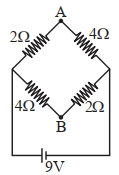
- 1A network of four resistances is connected to $9\,V$ battery, as shown in figure. The magnitude of voltage difference between the points $A$ and $B$ is .......... $V.$View Solution
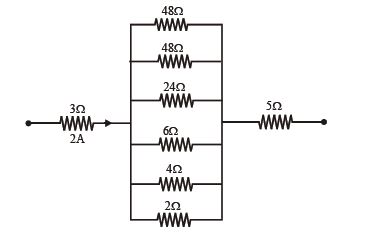
- 2Find potential difference across $24\,\Omega $ ............. $\mathrm{volt}$View Solution
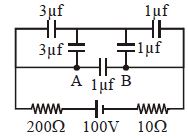
- 3Find potential difference between $A$ and $B$ in given circuit in steady state ............... $\mathrm{V}$View Solution
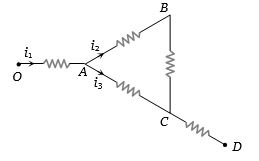
- 4The current in the arm $CD$ of the circuit will beView Solution
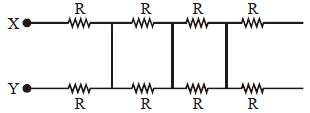
- 5Net resistance between $X$ and $Y$ isView Solution
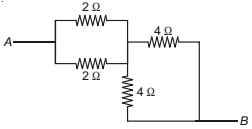
- 6Effective resistance across $A B$ in the network shown in .......... $\Omega$View Solution
- 7A current source drives a current in a coil of resistance $R_1$ for a time $t$. The same source drives current in another coil of resistance $R_2$ for same time. If heat generated is same, find internal resistance of source.View Solution
- 8A battery has $e.m.f.$ $4\, V$ and internal resistance $r$. When this battery is connected to an external resistance of $2\, ohms$, a current of $1\, amp$. flows in the circuit. How much current will flow if the terminals of the battery are connected directly .......... $amp$View Solution
- 9Two wires $A$ and $B$ made of same material and having their lengths in the ratio $6 : 1$ are connected in series. The potential difference across the wires are $3\,V$ and $2\,V$ respectively. If $r_A$ and $r_B$ are the radii of $A$ and $B$ respectively, then $\frac{{{r_B}}}{{{r_A}}}$ isView Solution
- 10$10$ wires (same length, same area, same material) are connected in parallel and each has $1$ $\Omega$ resistance, then the equivalent resistance will be .............. $\Omega$View Solution