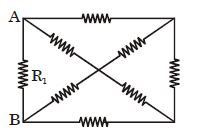
A current source drives a current in a coil of resistance $R_1$ for a time $t$. The same source drives current in another coil of resistance $R_2$ for same time. If heat generated is same, find internal resistance of source.
Diffcult
Download our app for free and get started
Let internal resistance of source $=\mathrm{R}$
Current in coil of resistance
$\mathrm{R}_{1}=\mathrm{I}_{1}=\frac{\mathrm{V}}{\mathrm{R}+\mathrm{R}_{1}}$
Current in coil of resistance
$\mathrm{R}_{2}=\mathrm{I}_{2}=\frac{\mathrm{V}}{\mathrm{R}+\mathrm{R}_{2}}$
Further, as heat generated is same, so
$\mathrm{I}_{1}^{2} \mathrm{R}_{1} \mathrm{t}=\mathrm{I}_{2}^{2} \mathrm{R}_{2} \mathrm{t}$
or $\quad\left(\frac{\mathrm{V}}{\mathrm{R}+\mathrm{R}_{1}}\right)^{2} \mathrm{R}_{1}=\left(\frac{\mathrm{V}}{\mathrm{R}+\mathrm{R}_{2}}\right)^{2} \mathrm{R}_{2}$
$\Rightarrow \quad \mathrm{R}_{1}\left(\mathrm{R}+\mathrm{R}_{2}\right)^{2}=\mathrm{R}_{2}\left(\mathrm{R}+\mathrm{R}_{1}\right)^{2}$
$\Rightarrow \mathrm{R}^{2} \mathrm{R}_{1}+\mathrm{R}_{1} \mathrm{R}_{2}^{2}+2 \mathrm{RR}_{1} \mathrm{R}_{2}$
$\Rightarrow \quad \mathrm{R}^{2} \mathrm{R}_{2}+\mathrm{R}_{1}^{2} \mathrm{R}_{2}+2 \mathrm{RR}_{1} \mathrm{R}_{2} ?$
$\Rightarrow \quad \mathrm{R}^{2}\left(\mathrm{R}_{1}-\mathrm{R}_{2}\right)=\mathrm{R}_{1} \mathrm{R}_{2}\left(\mathrm{R}_{1}-\mathrm{R}_{2}\right)$
$\Rightarrow \quad \mathrm{R}=\sqrt{\mathrm{R}_{1} \mathrm{R}_{2}}$

Download our appand get started for free
Experience the future of education. Simply download our apps or reach out to us for more information. Let's shape the future of learning together!No signup needed.*
Similar Questions
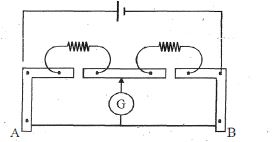
- 1A meter bridge set up as shown to determine end correction at $A$ and $B$ . When a resistance of $15\,\Omega $ is used in left gap and of $20\,\Omega $ in right gap, then null point comes at a distance $42\ cm$ from $A$ . When these resistances are interchanged null point comes at a distance $57\ cm$ from $A$ . Values of end corrections areView Solution
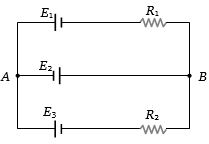
- 2In the circuit shown here, $E_1 = E_2 = E_3 = 2 V$ and $R_1 = R_2 = 4\,ohms$. The current flowing between points $A$ and $B$ through battery $E_2$ isView Solution
- 3If a $2\, kW$ boiler is used everyday for $1$ hour, then electrical energy consumed by boiler in thirty days is .......... $uint$View Solution
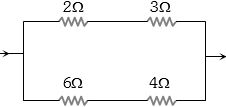
- 4In the circuit as shown in the figure, the heat produced by $6\, ohm$ resistance due to current flowing in it is $60$ calorie per second. The heat generated across $3\, ohm$ resistance per second will be ................. $calorie$View Solution
- 5The drift velocity of electrons for a conductor connected in an electrical circuit is $V _{ d }$. The conductor in now replaced by another conductor with same material and same length but double the area of cross section. The applied voltage remains same. The new drift velocity of electrons will beView Solution
- 6For what value of the resistor $X$ will the equivalent resistance of the two circuits shown be the same?View Solution
- 7The total current supplied to the circuit by the battery is ............. $A$View Solution
- 8The variation of applied potential and current flowing through a given wire is shown in figure. The length of wire is $31.4 \,cm$. The diameter of wire is measured as $2.4 \,cm$. The resistivity of the given wire is measured as $x \times 10^{-3} \,\Omega cm$. The value of $x$ is_______ [Take $\pi=3.14]$View Solution
- 9A battery of internal resistance one ohm and $emf$ $3\,volt$ sends a current through $1\,metre$ of uniform wire of resistance $5\,\Omega $. The pole of the cell of $emf$ $1.4\,volt$ are connected to two points on the wire so that no current passes through this cell. Then, the potential gradient of the wire isView Solution
- 10As shown, the circuit is made of $8$ different resistors. It is found that when $R_1 = 4\,\,\Omega,$ the resistance between $A$ and $B$ is $2\,\,\Omega.$ Now replace $R_1$ by a $6\,\,\Omega$ resistor, what is the resistance between $A$ and $B$?View Solution