A $25\, watt$, $220\, volt$ bulb and a $100\, watt$, $220\, volt$ bulb are connected in parallel across a $220\, volt$ line. Which bulb will glow more brightly
Easy


Download our appand get started for free
Experience the future of education. Simply download our apps or reach out to us for more information. Let's shape the future of learning together!No signup needed.*
Similar Questions
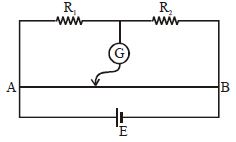
- 1In the fig. shown for given values of $R_1$ and $R_2$ the balance point for jockey is at $40\, cm$ from $A$. When $R_2$ is shunted by a resistance of $10\,\Omega $, balance shifts to $50\, cm. R_1$ and $R_2$ are $(AB = 1\,m)$View Solution
- 2Assertion : A larger dry cell has higher $emf$View Solution
Reason : The $emf$ of a dry cell is proportional to its size
- 3Resistance $n$, each of $r\; ohm$, when connected in parallel give an equivalentresistance of $R\; ohm$. If these resistances were connected in series, the combination would have a resistance in $ohms$, equal toView Solution
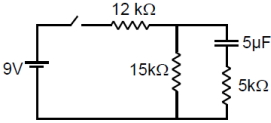
- 4Find charge on the capacitor after $1$ sec of opening the switch at $t=\infty ?$View Solution
- 5A potential difference of $5 \,V$ is applied across a conductor of length $10 \,cm$. If drift velocity of electrons is $2.5 \times 10^{-4} \,m / s$, then electron mobility will be ............ $m ^2 V ^{-1} s ^{-1}$View Solution
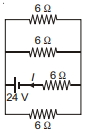
- 6Current $I$ in the network shown in figure is .......... $A$View Solution
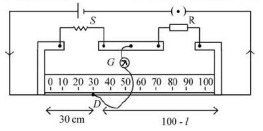
- 7In meter bridge experiment for measuring unknown resistance ' $S$ ', the null point is obtained at a distance $30 cm$ from the left side as shown at point $D$. If $R$ is $5.6 k \Omega$, then the value of unknown resistance ' $S$ ' will be $\Omega .$View Solution
- 8In the circuit shown $E, F, G$ and $H$ are cells of $\mathrm{e.m.f.}$ $2\,V, 1\,V, 3\,V$ and $1\,V$ respectively and their internal resistances are $2\,\Omega , 1\,\Omega , 3\,\Omega$ and $1\,\Omega$ respectively.View Solution
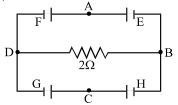
- 9For the circuits shown in figures $I$ and $II$, the voltmeter reading would beView Solution
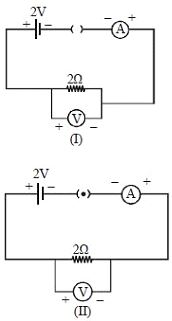
- 10In a metre-bridge when a resistance in the left gap is $2\ \Omega$ and unknown resistance in the right gap, the balance length is found to be $40\ \mathrm{~cm}$. On shunting the unknown resistance with $2\ \Omega$, the balance length changes by :View Solution